Showing posts with label voice. Show all posts

Monday, September 24, 2018

Guest Post from Descript

How to Overcome Writer’s Block with Automatic Transcription

a guest post from Descript

If you’re a writer — of books, essays, scripts, blog posts, whatever — you’re familiar with the phenomenon: the blank screen, a looming deadline, and a sinking feeling in your gut that pairs poorly with the jug of coffee you drank earlier.
If you know that rumble all too well: this post is for you. Maybe it’ll help you get out of a rut; at the very least, it’s good for a few minutes of procrastination.
Here’s the core idea: thinking out loud is often less arduous than writing. And it’s now easier than ever to combine the two, thanks to recent advances in speech recognition technology.
Of course, dictation is nothing new — and plenty of writers have taken advantage of it. Carl Sagan’s voluminous output was facilitated by his process of speaking into an audio recorder, to be transcribed later by an assistant (you can listen to some of his dictations in the Library of Congress!) And software like Dragon’s Naturally Speaking has offered automated transcription for people with the patience and budget to pursue it.
But it’s only in the last couple of years that automated transcription has reached a sweet spot — of convenience, affordability and accuracy—that makes it practical to use it more casually. And I’ve found it increasingly useful for generating a sort of proto-first draft: an alternative approach to the painful process of converting the nebulous wisps inside your head into something you can actually work with.
I call this process idea extraction (though these ideas may be more accurately dubbed brain droppings).
Part I: Extraction
Here’s how my process works. Borrow what works for you and forget the rest — and let me know how it goes!

  • Pick a voice recorder. Start talking. Try it with a topic you’ve been chewing on for weeks — or when an idea flits your head. Don’t overthink it. Just start blabbing.
  • The goal is to tug on as many threads as you come across, and to follow them as far as they go. These threads may lead to meandering tangents— and you may discover new ideas along the way.
  • A lot of those new ideas will probably be embarrassingly bad. That’s fine. You’re already talking about the next thing! And unlike with text, your bad ideas aren’t staring you in the face.
  • Consider leaving comments to yourself as you go — e.g. “Maybe that’d work for the intro”. These will come in handy later.
  • For me, these recordings run anywhere from 20–80 minutes. Sometimes they’re much shorter, in quick succession. Whatever works.
Part II: Transcription
Once I’ve finished recording, it’s time to harness ⚡️The Power of Technology⚡️
A little background: over the last couple of years there’s been an explosion of tools related to automatic speech recognition (ASR) thanks to huge steps forward in the underlying technologies.
Here’s how ASR works: you import your audio into the software, the software uses state-of-the-art machine learning to spit back a text transcript a few minutes later. That transcript won’t be perfect—the robots are currently in the ‘Write drunk’ phase of their careers. But for our purposes that’s fine: you just need it to be accurate enough that you can recognize your ideas.
Once you have your text transcript, your next step is up to you: maybe you’re exporting your transcript as a Word doc and revising from there. Maybe you’re firing up your voice recorder again to dictate a more polished take. Maybe only a few words in your audio journey are worth keeping — but that’s fine too. It probably didn’t cost you much (and good news: the price for this tech will continue to fall in the years ahead).
A few more tips:
  • Use a recorder/app that you trust. Losing a recording is painful — and the anxiety of losing another can derail your most exciting creative moments (“I hope this recorder is working. Good, it is... @#*! where was I?”)
  • Audio quality matters when it comes to automatic transcription. If your recording has a lot of background noise or you’re speaking far away from the mic, the accuracy is going to drop. Consider using earbuds (better yet: Airpods) so you can worry less about where you’re holding the recorder.
  • Find a comfortable space. Eventually you may get used to having people overhear your musings, but it’s a lot easier to let your mind “go for a walk” when you’re comfortable in your environment.
  • Speaking of walking: why not go for a stroll? The pains of writing can have just as much to do with being stationary and hunched over. Walking gets your blood flowing — and your ideas too.
  • I have a lot of ideas, good and bad, while I’m thinking out loud and playing music at the same time (in my case, guitar — but I suspect it applies more broadly). There’s something about playing the same four-chord song on auto pilot for the thousandth time that keeps my hands busy and leaves my mind free to wander.
The old ways of doing things — whether it’s with a keyboard or pen — still have their advantages. Putting words to a page can force a sort of linear thinking that is otherwise difficult to maintain. And when it comes to editing, it’s no contest: QWERTY or bust.
But for getting those first crucial paragraphs down (and maybe a few keystone ideas to build towards)? Consider talking to yourself. Even if you wind up with a transcript full of nothing but profanity — well, have you ever seen a transcript full of profanity? You could do a lot worse.

This article was originally published by Descript.

Friday, May 8, 2015

Finding Your Voice as a Writer

“Words mean more than what is set down on paper. It takes the human voice to infuse them with deeper meaning.” –Maya Angelou 


How do I find my writing voice? This is a question I hear often from writers of all ages, and especially from young writers. And it is very closely related—indeed, I would say it is interwoven—with other important questions, such as:

  • How do I get “unstuck” when I am struggling with writer’s block? 
  • Will other people think my ideas are interesting enough? 
  • What do I have to say that the world will care about? 
Developing your voice as a writer is akin to developing your voice as a human being, as a global citizen of this one world we all share. Cultivating your own unique writing voice will resonate in all aspects of your life. It requires you to reflect on what you believe and how you feel comfortable sharing those beliefs with others. What feels natural to you on the page? What captures you most fully and truthfully?

All writers begin as readers, and when we first begin writing it is natural for us to write like—for our voices to sound like—the writers we most love and admire. The first pieces I ever wrote were Dr. Seuss-like poems; years later, in college, I was still honing my writing voice, working on magical-realism short stories inspired by Aimee Bender and George Saunders. Gradually, as I have grown and learned and developed as a writer—and as a person—my own true voice has emerged more and more clearly.

Now, when I sit down to write, I don’t sound like anyone else. I simply sound like me.

The process reminds me of breaking in a pair of shoes until they fit your own individual feet perfectly. You can even use your speaking voice to develop your writing voice! How? If you feel stuck, a great strategy is to “talk through” your idea to a friend or teacher. Better yet, talk it through to yourself by recording your thoughts—you can buy an inexpensive tape recorder or digital recorder, or many smartphones have free apps you can download.

Why does this strategy work? Speaking often feels like “less pressure” than writing; the more pressure you put on yourself to write, the harder it can be. Many people feel more comfortable talking out a story or essay instead of trying to write the words down on paper. Once you’re done talking it through, play back the audio and write down, word for word, what you said. Now you have your authentic voice down on paper, and you can edit and shape it as you wish!


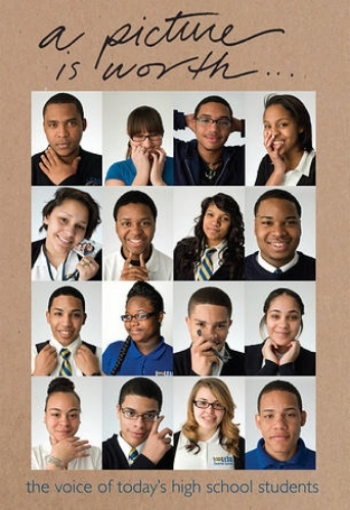
The engaging and inspiring book, a picture is worth… the voice of today’s high school students (available from Arch Street Press) used a similar strategy to help the students develop their essays for the book. The sixteen students featured in this outstanding collection write about everything from their families to their faith, from their communities to their experiences in society as a whole, from their past histories to their dreams for the future. In order to craft their essays, each student told their story to an interviewer, preserved it as a recording, listened to it and shared it, and—yes—captured it in written words. But the writing down of the story was simply one strand of a larger web of storytelling, connecting, and sharing.

In the introduction of a picture is worth…, David Castro and Alisa del Tufo write: “Particularly within the personal essay form, good writing demonstrates voice. … [B]eginning with each student’s voice, this project grounds itself in the essential strength of the spoken word as a harbinger of awareness, creativity, and human connection.” By discovering and defining your own voice as a writer, you are then able to engage with the voices of others—and that is how meaningful conversations happen and true connections are born.

Wednesday, February 15, 2012

Review of Moon Over Manifest by Clare Vanderpool

Moon Over ManifestMoon Over Manifest by Clare Vanderpool

What drew me in right away was the voice of Abilene Tucker, the book’s spunky, curious, and honest young narrator for the present line of action. In the acknowledgments at the end of the book, Vanderpool thanks her grandparents, whose voices were in her head while writing: “Their voices and their stories, which I heard as a young girl, are the heart and soul of this book” (349). It is a book that begs to be read aloud. The voice sweeps the reader into the world, and it is not long before Abilene seems like a friend we know well.

In addition, I was greatly impressed by the way Vanderpool weaves history into a highly engaging narrative. By choosing to set the “present” storyline of action in 1936, and the past in 1918, Vanderpool is able to paint a vivid portrait of two distinct periods in U.S. history. In the 1936 storyline, Abilene thinks of 1918 as being in the distant past; for today’s young readers, who likely think of both 1918 and 1936 as a blurred "looong time ago," this subtly pushes them to consider the many different periods of the past, and that their grandparents and great-grandparents were once children like Abilene (and readers themselves.) The historical framework is reinforced by Vanderpool's choice to use newspaper clippings and letters home from World War I to tell the story in addition to a more straightforward narrative.

Other books by Clare Vanderpool: "Navigating Early" is forthcoming

Themes/motifs: the importance and healing powers of storytelling; collective memory; love of family and friends; home is “not down on any map; true places never are”; history: World War I, Great Depression, Prohibition/Temperance Movement, immigration, mining community, small town life

Teaching idea: Ask students to become historians themselves by writing down an oral history narrative, much as Abilene does in the novel. They could talk to their parents, grandparents, aunts, uncles, or even visit a nursing home and talk to residents there. What was life like for them as children? What are some funny stories they remember from growing up? Ask students to write one of these stories down, as if they are Miss Sadie divining the past, or Abilene piecing together the information she hears about Jinx/Gideon.

View all my Goodreads reviews

Friday, June 3, 2011

Guest Post by Aggie Villanueva: Avoid Passive Writing!

Our friend Aggie Villanueva was kind enough to share this great video post about avoiding passive writing. Enjoy!


About Aggie: A published author at Thomas Nelson before she was 30, Aggie Villanueva published Chase the Wind, and Rightfully Mine, both Thomas Nelson 1980s, and is now a multiple fiction & nonfiction Amazon/Kindle category bestseller, also making Top Rated list in three categories for her how-to The Rewritten Word. Aggie founded Promotion รก la Carte, author promotional services July 2010 and 6 months later was voted #2 at Predators & Editors in the Promotion category. Among other sites, she teaches author promotion at BookBuzzr Blog, Book Marketing Technoligies Center Webinars, Promotion a la Carte Blog and Promotion a la Carte Radio. Villanueva is also a critically acclaimed photographic artist represented by galleries nationwide, including Xanadu Gallery in Scottsdale, AZ. Contact Villanueva at aggie@promotionalacarte.com.