Showing posts with label students. Show all posts
Wednesday, March 15, 2017
Celebrating Success
For most of the year, my job as a writing teacher is a slow, gradual process with my students… helping them write more clearly and expansively, broaden and deepen their thinking, and discover more joy and freedom in the act of writing. Like training for a marathon, it is a “slow and steady” endeavor. I see their growth, but sometimes it is harder for them to see it.
Then, every so often, there are spectacularly exciting days. Days when I receive their giddy emails and phone calls and I get to celebrate with them. Days when their hard work and hours of time are rewarded.
Just in the past few weeks, I have learned that my students were honored in the Scholastic Art & Writing Awards with a whopping 7 Gold Keys, 11 Silver Keys, and 3 Honorable Mentions; Honorable Mention in the national Princeton University High School Poetry Contest; and National Finalist honors in the American High School Poets Just Poetry Competition.
Sometimes the successes are more personal, such as my student who proudly told me that he received a perfect score on an in-class English essay “for the first time ever!!” He said, “I didn’t think I could do that.” I knew he could.
Recently, I received an email from one of my adult students -- who is finally, bravely working on a book that has been bouncing around in her mind for years -- that simply said: "Thank you for helping me break through my inertia." After years of thinking she was not good enough to try her hand at writing, she is now getting her words and ideas down on paper.
I am so grateful for my students, who remind me daily the power of persistence and who fill my life with imagination and enthusiasm. I am so proud of them. It fills my heart to see them gain pride and confidence in themselves.
Would you like to work with me?
I currently have a select number of spots available in my Guided Mentorship and Online Tutoring programs for young writers, as well as my Writing Coaching programs for adults. Contact me to learn more and book your free 20-minute consultation call with me. I'd love to help you, or your child, gain confidence in your ideas and tell the stories that matter most to you. Let's work together to reframe writing for what it truly is: a tool of connection and empowerment!
Friday, October 28, 2016
On Setting a High Bar
Whenever I read a rough draft by a young writer, or when I look over a business plan from a student asking me for feedback, or when I am pitched an idea for a collaboration or project, I think of a woman named Cynthia. I don't even know her last name, but she had a profound impact on me.
I was a sophomore in high school, attending a writing conference for the first time. It was the Santa Barbara Writers Conference and it was a wonderful, energizing smorgasbord of resources, lectures, writing workshops, speakers, and information.
However, I felt completely and utterly overwhelmed.
The youngest one in attendance by at least a decade, to say I was "out of my comfort zone" that week would be putting it mildly. Shy by nature, I was desperately homesick and felt like I did not belong. I remember those first few meals in the dining hall, looking around for somewhere to sit, feeling like the little kid asking to eat at the grown-up table.
Then I met Cynthia, in a workshop called "Writing for Children." I summoned the courage to share a story I had written with other members of the workshop, and they responded with heartfelt encouragement. Cynthia, with no-nonsense energy and a warm smile, came up to me after class ended and asked if she could read a copy of my entire story. "You're talented," she said. "I want to help you get published." Not only did I have a friend to sit with in the dining hall the rest of the week, but I also had a writing buddy -- someone who treated me like a peer and took my work seriously.
Later that summer, I received a package in the mail with my story pages, generously written all over with comments, suggestions and edits in blue pen. Out of the goodness of her heart, Cynthia took the time (a lot of time, I know now, from commenting on student manuscripts myself) to painstakingly read through the pages of my story and help me become better. She invested time in me because she believed in me. In setting a high standard -- in treating me like a fellow professional writer, even though I was still a high school student -- she inspired me to treat myself like a professional, too.
I think of Cynthia's gift to me whenever I encounter work by a young person. I make a point to never talk down to my students or brush their dreams off, for "someday later" when they are older or wiser or more experienced. I know the truth: they have all the experience they need, right in this moment, to create the best work they are able to right now. Because we are always growing and evolving and changing, all of us, no matter how old. We are always learning and becoming better. But this marvelous and important growth does not happen when we patronize our young people. So, like Cynthia did for me, I set the bar high for my students -- and then, I delight in watching them rise and surpass those high expectations.
I thought about all of this when listening to a recent Innovate Podcast interview with Liz Maw, CEO of the nonprofit organization Net Impact. At the heart of Net Impact's mission is a passion to empower a new generation to use their careers to "drive transformational change in the workplace and the world." This struck me as incredibly innovative -- and yet also, familiar. It made me think of the way Cynthia treated me. Indeed, when I listened to Net Impact's mission, I found it refreshing that they are not aiming to connect with the established "old guard" to spur change that transforms the world. Nope -- they are reaching out to a community of students and recent graduates who are just starting out in their careers. Rather than dismissing young people as too inexperienced or not influential enough, Liz Maw and Net Impact set a high bar for these students as capable of making big positive change. And what an effect they have had! Net Impact’s community now includes more than 60,000 student and professional leaders from more than 300 volunteer-led chapters around the globe, working together for a sustainable future.
How are you setting a high bar, for others and for yourself? Who has set a high bar for you in your life, and what impact has this had on where you are now?
Cynthia, if you ever read this, I want to say, THANK YOU.
I was a sophomore in high school, attending a writing conference for the first time. It was the Santa Barbara Writers Conference and it was a wonderful, energizing smorgasbord of resources, lectures, writing workshops, speakers, and information.
However, I felt completely and utterly overwhelmed.
The youngest one in attendance by at least a decade, to say I was "out of my comfort zone" that week would be putting it mildly. Shy by nature, I was desperately homesick and felt like I did not belong. I remember those first few meals in the dining hall, looking around for somewhere to sit, feeling like the little kid asking to eat at the grown-up table.
Then I met Cynthia, in a workshop called "Writing for Children." I summoned the courage to share a story I had written with other members of the workshop, and they responded with heartfelt encouragement. Cynthia, with no-nonsense energy and a warm smile, came up to me after class ended and asked if she could read a copy of my entire story. "You're talented," she said. "I want to help you get published." Not only did I have a friend to sit with in the dining hall the rest of the week, but I also had a writing buddy -- someone who treated me like a peer and took my work seriously.
Later that summer, I received a package in the mail with my story pages, generously written all over with comments, suggestions and edits in blue pen. Out of the goodness of her heart, Cynthia took the time (a lot of time, I know now, from commenting on student manuscripts myself) to painstakingly read through the pages of my story and help me become better. She invested time in me because she believed in me. In setting a high standard -- in treating me like a fellow professional writer, even though I was still a high school student -- she inspired me to treat myself like a professional, too.
I think of Cynthia's gift to me whenever I encounter work by a young person. I make a point to never talk down to my students or brush their dreams off, for "someday later" when they are older or wiser or more experienced. I know the truth: they have all the experience they need, right in this moment, to create the best work they are able to right now. Because we are always growing and evolving and changing, all of us, no matter how old. We are always learning and becoming better. But this marvelous and important growth does not happen when we patronize our young people. So, like Cynthia did for me, I set the bar high for my students -- and then, I delight in watching them rise and surpass those high expectations.
I thought about all of this when listening to a recent Innovate Podcast interview with Liz Maw, CEO of the nonprofit organization Net Impact. At the heart of Net Impact's mission is a passion to empower a new generation to use their careers to "drive transformational change in the workplace and the world." This struck me as incredibly innovative -- and yet also, familiar. It made me think of the way Cynthia treated me. Indeed, when I listened to Net Impact's mission, I found it refreshing that they are not aiming to connect with the established "old guard" to spur change that transforms the world. Nope -- they are reaching out to a community of students and recent graduates who are just starting out in their careers. Rather than dismissing young people as too inexperienced or not influential enough, Liz Maw and Net Impact set a high bar for these students as capable of making big positive change. And what an effect they have had! Net Impact’s community now includes more than 60,000 student and professional leaders from more than 300 volunteer-led chapters around the globe, working together for a sustainable future.
How are you setting a high bar, for others and for yourself? Who has set a high bar for you in your life, and what impact has this had on where you are now?
Cynthia, if you ever read this, I want to say, THANK YOU.
Friday, May 8, 2015
Finding Your Voice as a Writer
“Words mean more than what is set down on paper. It takes the human voice to infuse them with deeper meaning.” –Maya Angelou
How do I find my writing voice? This is a question I hear often from writers of all ages, and especially from young writers. And it is very closely related—indeed, I would say it is interwoven—with other important questions, such as:
All writers begin as readers, and when we first begin writing it is natural for us to write like—for our voices to sound like—the writers we most love and admire. The first pieces I ever wrote were Dr. Seuss-like poems; years later, in college, I was still honing my writing voice, working on magical-realism short stories inspired by Aimee Bender and George Saunders. Gradually, as I have grown and learned and developed as a writer—and as a person—my own true voice has emerged more and more clearly.
Now, when I sit down to write, I don’t sound like anyone else. I simply sound like me.
The process reminds me of breaking in a pair of shoes until they fit your own individual feet perfectly. You can even use your speaking voice to develop your writing voice! How? If you feel stuck, a great strategy is to “talk through” your idea to a friend or teacher. Better yet, talk it through to yourself by recording your thoughts—you can buy an inexpensive tape recorder or digital recorder, or many smartphones have free apps you can download.
Why does this strategy work? Speaking often feels like “less pressure” than writing; the more pressure you put on yourself to write, the harder it can be. Many people feel more comfortable talking out a story or essay instead of trying to write the words down on paper. Once you’re done talking it through, play back the audio and write down, word for word, what you said. Now you have your authentic voice down on paper, and you can edit and shape it as you wish!
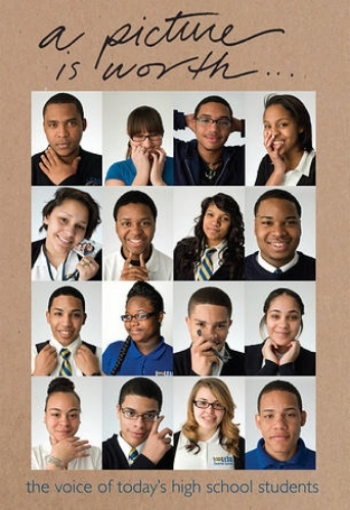
The engaging and inspiring book, a picture is worth… the voice of today’s high school students (available from Arch Street Press) used a similar strategy to help the students develop their essays for the book. The sixteen students featured in this outstanding collection write about everything from their families to their faith, from their communities to their experiences in society as a whole, from their past histories to their dreams for the future. In order to craft their essays, each student told their story to an interviewer, preserved it as a recording, listened to it and shared it, and—yes—captured it in written words. But the writing down of the story was simply one strand of a larger web of storytelling, connecting, and sharing.
In the introduction of a picture is worth…, David Castro and Alisa del Tufo write: “Particularly within the personal essay form, good writing demonstrates voice. … [B]eginning with each student’s voice, this project grounds itself in the essential strength of the spoken word as a harbinger of awareness, creativity, and human connection.” By discovering and defining your own voice as a writer, you are then able to engage with the voices of others—and that is how meaningful conversations happen and true connections are born.
How do I find my writing voice? This is a question I hear often from writers of all ages, and especially from young writers. And it is very closely related—indeed, I would say it is interwoven—with other important questions, such as:
- How do I get “unstuck” when I am struggling with writer’s block?
- Will other people think my ideas are interesting enough?
- What do I have to say that the world will care about?
All writers begin as readers, and when we first begin writing it is natural for us to write like—for our voices to sound like—the writers we most love and admire. The first pieces I ever wrote were Dr. Seuss-like poems; years later, in college, I was still honing my writing voice, working on magical-realism short stories inspired by Aimee Bender and George Saunders. Gradually, as I have grown and learned and developed as a writer—and as a person—my own true voice has emerged more and more clearly.
Now, when I sit down to write, I don’t sound like anyone else. I simply sound like me.
The process reminds me of breaking in a pair of shoes until they fit your own individual feet perfectly. You can even use your speaking voice to develop your writing voice! How? If you feel stuck, a great strategy is to “talk through” your idea to a friend or teacher. Better yet, talk it through to yourself by recording your thoughts—you can buy an inexpensive tape recorder or digital recorder, or many smartphones have free apps you can download.
Why does this strategy work? Speaking often feels like “less pressure” than writing; the more pressure you put on yourself to write, the harder it can be. Many people feel more comfortable talking out a story or essay instead of trying to write the words down on paper. Once you’re done talking it through, play back the audio and write down, word for word, what you said. Now you have your authentic voice down on paper, and you can edit and shape it as you wish!
The engaging and inspiring book, a picture is worth… the voice of today’s high school students (available from Arch Street Press) used a similar strategy to help the students develop their essays for the book. The sixteen students featured in this outstanding collection write about everything from their families to their faith, from their communities to their experiences in society as a whole, from their past histories to their dreams for the future. In order to craft their essays, each student told their story to an interviewer, preserved it as a recording, listened to it and shared it, and—yes—captured it in written words. But the writing down of the story was simply one strand of a larger web of storytelling, connecting, and sharing.
In the introduction of a picture is worth…, David Castro and Alisa del Tufo write: “Particularly within the personal essay form, good writing demonstrates voice. … [B]eginning with each student’s voice, this project grounds itself in the essential strength of the spoken word as a harbinger of awareness, creativity, and human connection.” By discovering and defining your own voice as a writer, you are then able to engage with the voices of others—and that is how meaningful conversations happen and true connections are born.
Monday, February 16, 2015
Teaching Creative Writing
One of my guided mentees recently sent me some questions about teaching writing for a class project she was working on. She asked fantastic questions, and gave me permission to share my answers with you!
Here are some of my thoughts on teaching creative writing... I hope this post might be helpful or thought-provoking for any of you who teach writing, or are working on writing projects of your own! Teaching writing has, without a doubt, made me a better writer.
Is there a specific way that people should teach the writing process, or are there different ways that can all be good to learn? If there are different ways, what are the best ways to teach it?
Great question! In my opinion, the most important part of teaching the writing process is to be aware of the individual student and what they struggle with. For example, some writers struggle with getting started; others struggle more with editing a completed first draft. So part of being a great writing teacher is helping guide the student through their individual struggles with writing.
Over-all, I think it is important to allow students to have freedom in the writing process to be creative and to make mistakes -- during first drafts, I tell my students not to “overthink” or be self-critical or worry about spelling/grammar mistakes. Those mistakes can always be corrected in the editing phase, and having your “editing” cap on when you’re trying to write a first draft can be very creatively stifling. I believe people write more and write better when they feel confident, are comfortable taking risks, and enjoy the writing process!
What tips do you give kids who are starting stories?
Don’t think too much -- just write! Tap into your subconscious. Try to start with a BANG! -- skip the “boring” stuff and start in the middle of things.
What tips do you give kids who are developing stories?
If you feel stuck, ask yourself, “What do my characters WANT?” There will likely be at least two characters whose desires are in conflict with each other… and conflict is what keeps plots moving forward.
What tips do you give ids who are trying to finish stories?
It will always be easier to start a fresh new story instead of finishing a story you’ve been working on for a while, but it is infinitely more satisfying to finish a story, so keep plugging away and don’t give up! If you’re trying to finish, don’t introduce any new problems for your characters. Rather, work on resolving the existing problems you have given your characters. Also, be aware that not every problem HAS to be resolved; not every loose end needs to be tied up. Some beautiful stories end with images, a resonant line, or a piece of dialogue that speaks to the overall theme of the story. It’s okay if your reader has some lingering questions, if not every single thing has been answered. In that way, stories are like real life -- we don’t have all the answers, do we?
What are some exercises you give students not just to help them develop a story, but to strengthen them as writers?
- Give students a simple sentence (i.e. “The cat walked across the room”) and have them add adjectives, descriptions, details to make it shine and be memorable.
- Ask students questions about their main character and have them answer the questions as if they are the character. (It is helpful for them to write their answers down rather than just saying them out loud, so they can look back at what they wrote.)
- Have them brainstorm details/descriptions using all five senses and work these details into their story. Often writers use a lot of “sight” details but forget about the other senses!
I think the main thing is to be yourself. Kids blossom for authentic, kind, enthusiastic people. The best writing teachers I have studied under weren't the best because they had all the answers -- the most important thing was that they made me feel excited about writing, like I had something worthy and unique to say.
How is a younger student's thought process or natural writing process different than an older student? (For example, a second-grader versus a sixth-grader?)
Younger kids often write simpler stories (A + B = C) and they usually can’t juggle as many factors in their minds -- character-wise, plot-wise, etc. Thematically, their stories are often more black-and-white, with “good guys” and “bad guys” and less gray area. And that’s okay. These things develop with time.
I think it is important when teaching writing at any level to let the student write the story he or she wants to write, and not try to change it into the story you want it to be. You can guide them, but it is still THEIR story, and your job as a teacher is to make it the best version of THEIR story as it can be.
Does changing your writing curriculum every so often help with a kid's creativity? If so, how often should you change it up, and how exactly does it help?
Yes, I think it helps -- especially because not every kid will blossom with every activity. Some writers are better brain-stormers, others like more-structured activities, others like less-structured activities. So if you mix it up, it forces kids to try different types of writing and use their brains in new and different ways. I like to mix it up by using a variety of word-based writing prompts, image-based writing prompts, and music-based writing prompts.
Another thing you can do is have students tell a story in a different narrative order; for example, starting at the ending and working backwards to the beginning, or starting in the middle. Or, you could have them take a popular story and write it from a different character’s point of view. (Think: Wicked versus The Wizard of Oz.)
What is the best way to help students when they are stuck?
Sometimes simply having them talk through their ideas while you listen and tell them it’s a good idea is enough to get them un-stuck. I like to jot down notes as they are talking to me, so then I can give them a piece of paper that has all the ideas they were just telling me about. Then I can say, “Look at all these amazing ideas! Now go write these down into your story!”
Another helpful thing is to set a timer for seven minutes (I’ve found seven to be a good number -- more than five, but less than ten) and tell them they have to keep writing SOMETHING for that entire period. Even if they think what they are writing is silly or stupid, they just have to keep writing. This is a trick I use when I am stuck myself; it's a way to tap into your subconscious, which often helps you get unstuck.
How do I spark inspiration in kids?
I think your energy and enthusiasm will do a lot to make kids feel inspired. You want to set a tone of freedom to be creative and express imaginative ideas. You can also do things like bring in costumes for kids to “act out” characters, or magazines for them to cut out words or pictures that inspire them, or even a “magic writing wand” that you wave over all their heads before you start a writing session. Anything to make the vibe FUN and feel exciting and out-of-the-ordinary is wonderful.
How do I create assignments that will keep them entertained while also helping them learn a wide variety of tools and skills?
I think a great template is to have them read an example of a piece of writing that shows a concept you are trying to get across (i.e. realistic dialogue or vivid sensory details), discuss as a class why this piece is so effective and what is so great about it, and then give them time and space to practice that element of writing for themselves -- making sure you are positive and encouraging, always always! And then afterwards give them time to share their work and give positive feedback to each other, and review again what everyone learned about writing through that activity.
Anything else I should know?
I think the main thing is to be yourself. Kids blossom for authentic, kind, enthusiastic people. The best writing teachers I have studied with weren’t the best because they had all the answers -- the most important thing was that they made me feel excited about writing, like I had something unique and worthy to say.
Wednesday, February 15, 2012
Review of Moon Over Manifest by Clare Vanderpool
What drew me in right away was the voice of Abilene Tucker, the book’s spunky, curious, and honest young narrator for the present line of action. In the acknowledgments at the end of the book, Vanderpool thanks her grandparents, whose voices were in her head while writing: “Their voices and their stories, which I heard as a young girl, are the heart and soul of this book” (349). It is a book that begs to be read aloud. The voice sweeps the reader into the world, and it is not long before Abilene seems like a friend we know well.
In addition, I was greatly impressed by the way Vanderpool weaves history into a highly engaging narrative. By choosing to set the “present” storyline of action in 1936, and the past in 1918, Vanderpool is able to paint a vivid portrait of two distinct periods in U.S. history. In the 1936 storyline, Abilene thinks of 1918 as being in the distant past; for today’s young readers, who likely think of both 1918 and 1936 as a blurred "looong time ago," this subtly pushes them to consider the many different periods of the past, and that their grandparents and great-grandparents were once children like Abilene (and readers themselves.) The historical framework is reinforced by Vanderpool's choice to use newspaper clippings and letters home from World War I to tell the story in addition to a more straightforward narrative.
Other books by Clare Vanderpool: "Navigating Early" is forthcoming
Themes/motifs: the importance and healing powers of storytelling; collective memory; love of family and friends; home is “not down on any map; true places never are”; history: World War I, Great Depression, Prohibition/Temperance Movement, immigration, mining community, small town life
Teaching idea: Ask students to become historians themselves by writing down an oral history narrative, much as Abilene does in the novel. They could talk to their parents, grandparents, aunts, uncles, or even visit a nursing home and talk to residents there. What was life like for them as children? What are some funny stories they remember from growing up? Ask students to write one of these stories down, as if they are Miss Sadie divining the past, or Abilene piecing together the information she hears about Jinx/Gideon.
View all my Goodreads reviews
Tuesday, August 9, 2011
Part II: Interview with Alan Sitomer, award-winning author of NERD GIRLS
Today I am delighted to continue our Write On! interview with award-winning author and California 2007 Teacher of the Year Alan Sitomer. His latest book, Nerd Girls, is available on Amazon here.
Besides being an author, you are an award-winning teacher. How does teaching influence your writing and the creation of your material?
I show all of my books to real kids first. My students, former students, fans I have gotten to know from around the country, they all get to check out my books hot off the press before anyone else gets a chance to see them. That means before my literary agent. That means before my editor. That means before anyone in the adult world who works in “the publishing industry.” Real kids are my readers and if they don’t like something – if they don’t laugh, if they don’t cry, if they don’t approve – then it doesn’t really matter what the adults think.
Kids are my best, and toughest audience. If my books flies with them, then I know I am good and I’ll go ahead and take it to the next level and begin to show it to the people in the publishing industry. But if I do not get their seal of approval, I stop, listen to their feedback and go back into the piece to go make it work. It’s probably why my fans are so loyal; they know that I respect them and I listen to them and I like them.
Kids who read my books can know that other kids have read them first and given the “Thumbs Up!” sign. I really think that is an important element to my work.
You often talk about “puttin’ the fun” in reading, writing and school. Why?
Let’s be honest: sometimes school can get SO BORING! And there’s no reason for it. But still, grumpy adults sometimes send the message to kids that life is to be serious, serious, serious and humorless, humorless, humorless.
To them I say BLAAAAHHH!
Students are at their best when they are enjoying what they are doing. Students will read more books when they like what they are reading. Students will learn more about a subject when they like what they are learning. Students will try harder to do a good job on the work they are being asked to do if they like the work that they are doing.
That’s my belief and I am sticking with it. (Besides, I was named California Teacher of the Year so ya might think I know just a wee little bit about this stuff, huh?)
Of course, there is a time to be serious. But being serious does not mean that you can’t enjoy yourself. Of course kids have to realize that there are some things in life you just have to do - and do well - even if they are not “fun.” I get that. It’s called reality and the bigger point of school is not to be entertaining. But for the most part I’ve found it’s actually quite satisfying to work really, really hard on something that challenges you deeply. Finding the joy in the challenge is what brings out the best in us.
However, sad to say, it seems as if some schools have forgotten this. Not all – and if you have a teacher that tries hard to make learning fun and meaningful and exciting and interesting – consider yourself lucky. Why? Because I’d venture to say that teachers like this eventually end up teaching you a great deal. School is not a comedy club, but it’s not a funeral home, either, and I believe that a classroom without laughter is a classroom that is not operating at its highest possible potential. Before kids are students, they are people and people need to laugh much like they need to eat and breathe and love.
Just to be clear, I believe that working hard is important. In my classroom, I have little patience for goof-offs but I have a lotta love for kids who put good ol’ fashioned positive energy into their efforts. My belief is that you are not enjoying the work, you probably aren’t going to learn as much as you would if you were enjoying the work. Plus, you are much more likely to try harder when you care about and enjoy what you are doing. Making reading enjoyable and making writing enjoyable makes better readers and writers.
Fun is my secret sauce. It works!
What else can we expect from Nerds Girls beyond this first book?
There is all kinds of crazy, fun stuff right now. I’ve built a game. I’ve created some author videos. There’s a Nerd Girls comic.
All free for anyone who wants them.
Of course, there’s already Hollywood talk of a movie and a TV show and clothes and merchandise and blah, blah, blah. (www.TheNerdGirlsWorld.com is the home base for information about all of this stuff.)
But for me, it’s all about the core material right now. Nerd Girls Book II is on its way and beyond that there are a few more surprises in the works.
All in all, I guess it’s just about making sure to have fun, work hard and continue enjoying all the great kids I get to meet who have become fans of my writing. Of course, the teachers and the librarians are great, too, but it’s all about the kids. Their approval means the most to me.
And really, how ridiculously lucky am I to have it? As I tell folks all the time, it’s quite healthy to channel your inner nerd. That’s all I am doing right now. It’s good for the soul.
If you missed Part I of my interview with Alan, check it out here.
Links:
Besides being an author, you are an award-winning teacher. How does teaching influence your writing and the creation of your material?
I show all of my books to real kids first. My students, former students, fans I have gotten to know from around the country, they all get to check out my books hot off the press before anyone else gets a chance to see them. That means before my literary agent. That means before my editor. That means before anyone in the adult world who works in “the publishing industry.” Real kids are my readers and if they don’t like something – if they don’t laugh, if they don’t cry, if they don’t approve – then it doesn’t really matter what the adults think.
Kids are my best, and toughest audience. If my books flies with them, then I know I am good and I’ll go ahead and take it to the next level and begin to show it to the people in the publishing industry. But if I do not get their seal of approval, I stop, listen to their feedback and go back into the piece to go make it work. It’s probably why my fans are so loyal; they know that I respect them and I listen to them and I like them.
Kids who read my books can know that other kids have read them first and given the “Thumbs Up!” sign. I really think that is an important element to my work.
You often talk about “puttin’ the fun” in reading, writing and school. Why?
Let’s be honest: sometimes school can get SO BORING! And there’s no reason for it. But still, grumpy adults sometimes send the message to kids that life is to be serious, serious, serious and humorless, humorless, humorless.
To them I say BLAAAAHHH!
Students are at their best when they are enjoying what they are doing. Students will read more books when they like what they are reading. Students will learn more about a subject when they like what they are learning. Students will try harder to do a good job on the work they are being asked to do if they like the work that they are doing.
That’s my belief and I am sticking with it. (Besides, I was named California Teacher of the Year so ya might think I know just a wee little bit about this stuff, huh?)
Of course, there is a time to be serious. But being serious does not mean that you can’t enjoy yourself. Of course kids have to realize that there are some things in life you just have to do - and do well - even if they are not “fun.” I get that. It’s called reality and the bigger point of school is not to be entertaining. But for the most part I’ve found it’s actually quite satisfying to work really, really hard on something that challenges you deeply. Finding the joy in the challenge is what brings out the best in us.
However, sad to say, it seems as if some schools have forgotten this. Not all – and if you have a teacher that tries hard to make learning fun and meaningful and exciting and interesting – consider yourself lucky. Why? Because I’d venture to say that teachers like this eventually end up teaching you a great deal. School is not a comedy club, but it’s not a funeral home, either, and I believe that a classroom without laughter is a classroom that is not operating at its highest possible potential. Before kids are students, they are people and people need to laugh much like they need to eat and breathe and love.
Just to be clear, I believe that working hard is important. In my classroom, I have little patience for goof-offs but I have a lotta love for kids who put good ol’ fashioned positive energy into their efforts. My belief is that you are not enjoying the work, you probably aren’t going to learn as much as you would if you were enjoying the work. Plus, you are much more likely to try harder when you care about and enjoy what you are doing. Making reading enjoyable and making writing enjoyable makes better readers and writers.
Fun is my secret sauce. It works!
What else can we expect from Nerds Girls beyond this first book?
There is all kinds of crazy, fun stuff right now. I’ve built a game. I’ve created some author videos. There’s a Nerd Girls comic.
All free for anyone who wants them.
Of course, there’s already Hollywood talk of a movie and a TV show and clothes and merchandise and blah, blah, blah. (www.TheNerdGirlsWorld.com is the home base for information about all of this stuff.)
But for me, it’s all about the core material right now. Nerd Girls Book II is on its way and beyond that there are a few more surprises in the works.
All in all, I guess it’s just about making sure to have fun, work hard and continue enjoying all the great kids I get to meet who have become fans of my writing. Of course, the teachers and the librarians are great, too, but it’s all about the kids. Their approval means the most to me.
And really, how ridiculously lucky am I to have it? As I tell folks all the time, it’s quite healthy to channel your inner nerd. That’s all I am doing right now. It’s good for the soul.
If you missed Part I of my interview with Alan, check it out here.
Links:
- Alan's official website: www.AlanSitomer.com
- Nerd Girls books: www.TheNerdGirlsWorld.com
Thursday, June 16, 2011
To the Class of 2011: Follow Your Dreams, No Matter What!
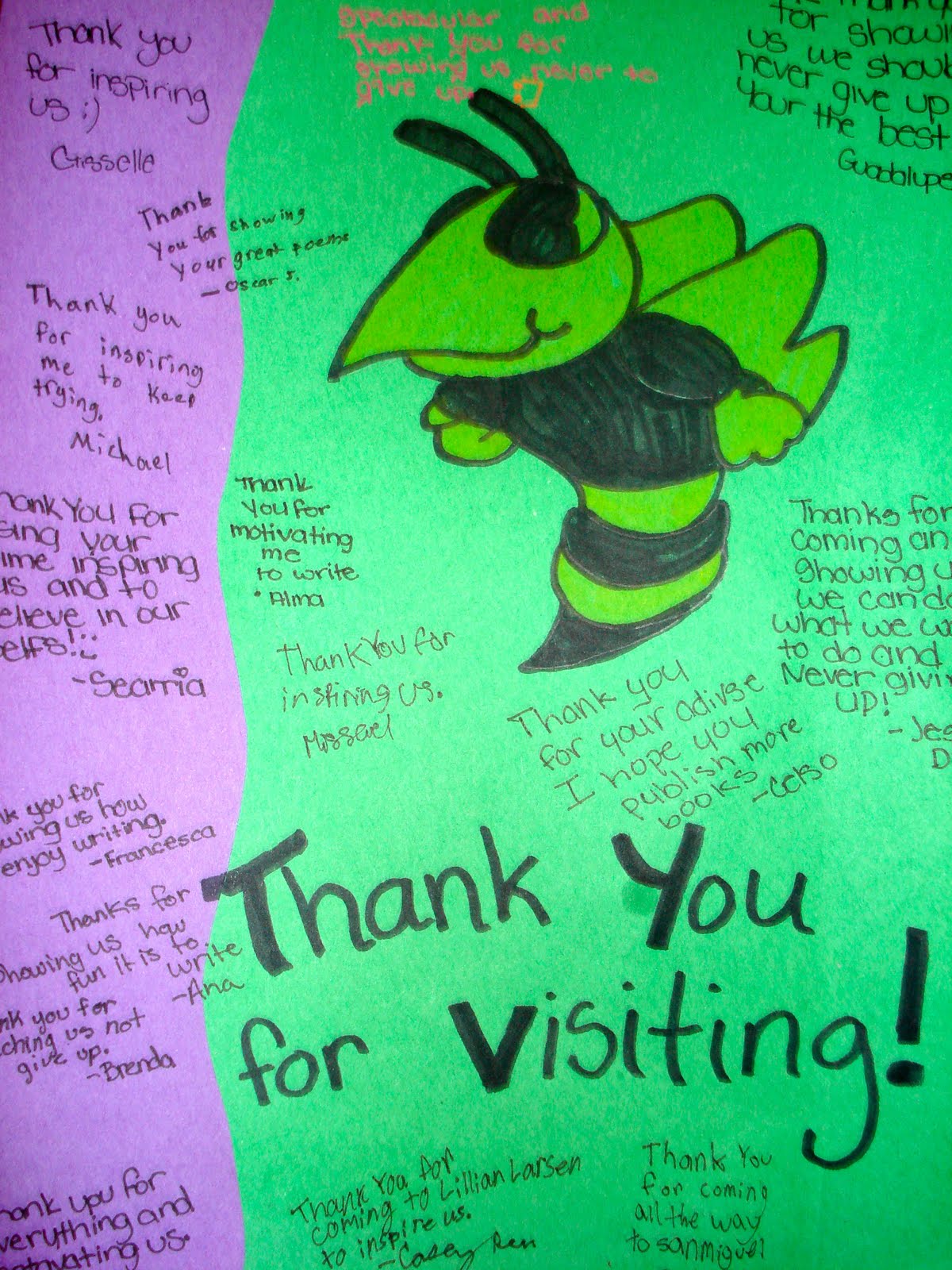
Last week I had the pleasure of speaking to students at Lillian Larsen Elementary School in San Miguel, California. My wonderful boyfriend was sweet enough to come along and pose as my "publicist" (as the students called him) and film part of my talk, which you can watch on YouTube via the link below.
Teacher Carolyn Loughridge sent me a very nice note afterwards, writing:
Thank you for taking time to share your passion with children who truly need it the most. After talking with the other teachers, the only way we can describe how our students reacted was magical. I have never seen so many students here take pride in what they have written. I sincerely hope you find time next school year to pay us a visit.
I'd love to visit your school, club or community group! Schedule a talk by emailing me at dallaswoodburn@aol.com. Read more testimonials here.
Teacher Carolyn Loughridge sent me a very nice note afterwards, writing:
Thank you for taking time to share your passion with children who truly need it the most. After talking with the other teachers, the only way we can describe how our students reacted was magical. I have never seen so many students here take pride in what they have written. I sincerely hope you find time next school year to pay us a visit.
I'd love to visit your school, club or community group! Schedule a talk by emailing me at dallaswoodburn@aol.com. Read more testimonials here.
Wednesday, June 30, 2010
Beware of Self-Publishing Scammers
This is a terrible story and a reminder of the sometimes-dangerous world of publishing. There are many reputable self-publishing companies, but there are also unfortunately some scammers. That is why it is SO important to research thoroughly before signing -- or paying -- anything.
If you are looking into self-publishing, I have been thrilled with my experience publishing with iUniverse and would highly recommend them. iUniverse treats each author as a valued individual and publishing consultants work with you to make your book the best it can be.
Finally, a reminder: if an agent *ever* charges you money to read your work, turn around and run!
Sunday, September 27, 2009
GradtoGreat.com Staff Writer
I am very excited to share that I am now a Staff Writer at GradtoGreat.com, a wonderful online resource for college students and recent college grads. My first article, about how to avoid online job board scams, is now live. You can find it on the homepage: www.gradtogreat.com. I'd love to hear your comments!
Friday, June 5, 2009
Book Talk at Cabrillo Middle School
Here's a short video clip from my recent talk to students at my alma mater, Cabrillo Middle School. I had a wonderful time! Thanks to Jon for filming!
Sunday, November 4, 2007
Talking to Students about Writing

Last week I had the pleasure of being invited to speak to the eighth grade classes at Windemere Middle School. The students were a terrific audience -- listening attentively as I read a story from my book, asking insightful and interesting questions, and volunteering when I asked them questions. They even made a banner welcoming me to their school!
Talking to students is one of my favorite things -- they never fail to inspire me with their passion, enthusiasm, and curiosity about life. I think it is an important thing for writers -- or anyone! -- to remember: what made you fall in love with your passion in the first place? Sometimes I get wrapped up in the tedium and solitude of writing and the constant struggle to revise and make my work better. But after talking to a classroom full of kids about my writing process and what I love about writing, it re-opens my own eyes to the wonder and magic of the written word.
At the beginning of my talk, I always ask the students: "How many of you like to write?" Usually, a few shy hands raise. At the end of my talk, I ask the same question, and usually a lot more hands raise -- my own hand included. Talking to kids about my writing journey reminds me how blessed I am to be doing something I truly love.
Subscribe to:
Posts (Atom)


.jpg)