Showing posts with label reading. Show all posts

Friday, June 10, 2016

Reading as a Creative Act

In the introduction to the wonderfully insightful book Genership 1.0, David Castro writes, "The journey of self-discovery involves the possibility of transcendence. The effort to see ourselves changes us. Thomas Mann reminded us that '[n]o one remains quite what he was when he recognizes himself.' We are the sculptor; we are the stone. The strangely transformational search for true human nature belongs not only to myth-makers, poets and philosophers. We experience the quest for our identity as social beings. Through families, organizations, communities and nations, humanity writ large shares the pilgrimage toward the self. Religion, philosophy, art, science and history undertake the same fundamental inquiry: Who are we?"


I love this image of all of humanity in the quest together, asking the same foundational questions, reflecting ourselves in each other. For me, this calls to mind the act of reading: a form of connection, inspiration, newness, delight. I believe that reading itself is an act of creation. The reader brings the writers' words to life uniquely and individually. No two readers experience a book in exactly the same way. Readers create the experience of the book based on their frame of reference, mood, memories, and associations. Words on a page are not static -- they are a conversation between writer and reader.

Malcolm Bradbury observed, "A conventional good read is usually a bad read, a relaxing bath in what we know already. A truly good read is surely an act of innovative creation in which we, the readers, become conspirators." I would add that a truly great read takes what might be viewed as "conventional" and makes it feel innovative. Joseph Campbell famously suggested that only seven basic story plots exist, which we retell again and again; I believe truly great authors are able to retell "what we already know" in ways that are refreshing and newly enlightening.

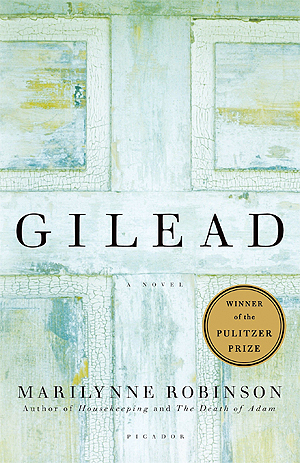
I recently reread Marilynne Robinson’s luminous novel Gilead, in which she does precisely this. Robinson takes a plot we have all read before—an aged man on his deathbed recounting the experiences of his life—and turns it into a novel that is both profound and original. Further, I was struck by the seamlessness of the narrative voice. Robinson structures the novel as a letter written by Congregationalist minister John Ames to his young son, and after only a few pages I forgot I was reading a novel and began to believe that there really existed an old minister named John Ames, whose own words I was reading. Robinson expertly weaves together memories, insights, and day-to-day observations, capturing not only how John Ames thinks and speaks, but also how he expresses himself in a letter. Ames even addresses this uniqueness of voice in the early pages of the novel: "I don't write the way I speak. … I don't write the way I do for the pulpit either, insofar as I can help it. … I do try to write the way I think. But of course that all changes as soon as I put it into words" (28-29).


Above all, what impresses me about Gilead is how effortless Robinson makes the written word seem, the same way Fred Astaire made dancing appear simple, Monet made painting seem easy, and Roger Federer turns tennis into ballet. The writing and storytelling dovetail so flawlessly into one man’s stirring and lucid recollections of his life that it is easy to forget that John Ames is not a real man, but the creation of Marilynne Robinson. Furthermore, Ames’ words flow so elegantly that it is difficult to imagine that Robinson toiled over them for years. However, upon deeper consideration, this proves Nathaniel Hawthorne’s oft-quoted words: “Easy reading is damn hard writing.”

Perhaps the book I read this past year that has most influenced me as a writer is one I reread nearly every year: The Catcher in the Rye. Each time I read this novel, it strikes me as a slightly different book. The words on the page are the same, but I have changed and grown; the conversation feels new. I first read J.D. Salinger’s classic novel my junior year in high school. Rarely has another book touched me in such a raw, visceral way. I wanted to climb into the pages of the book and into Holden Caulfield’s life. I realized that it is possible for a character to draw in the reader and carry the entire story on his back.


People hold an endless source of intrigue and inspiration to me. One of my favorite activities is people-watching. I love to imagine lives for the people who pass by, wondering where they came from and where they are going; what they are thinking and who they love; what they worry about and what their futures hold. However, as a storyteller, I used to think that in order to produce something that will stick with a reader, I had to dream up a wholly new and original idea. I fretted over coming up with a labyrinthine plot unique to anything I had ever come across. The Catcher in the Rye opened my mind to a new definition of what "great writing" can be. I came to understand that what makes an idea unique is that it is filtered through my own life experiences and perspective. Rather than building compelling stories through intricate, convoluted plotlines, as a writer I am interested in exploring the intricacies, subtleties, and contradictions of the human psyche.


E. M. Forster wrote, "I suggest that the only books that influence us are those for which we are ready, and which have gone a little further down our particular path than we have gone ourselves." I am grateful to the numerous books and authors who have influenced me, and to those who will influence me in the future, for leading me down my particular path as an ever-growing, ever-changing creative writer -- and reader.

Tuesday, September 8, 2015

International Literacy Day

I'm teaming up with my friends at Grammarly today on International Literacy Day!

Brittany Ross of Grammarly writes:

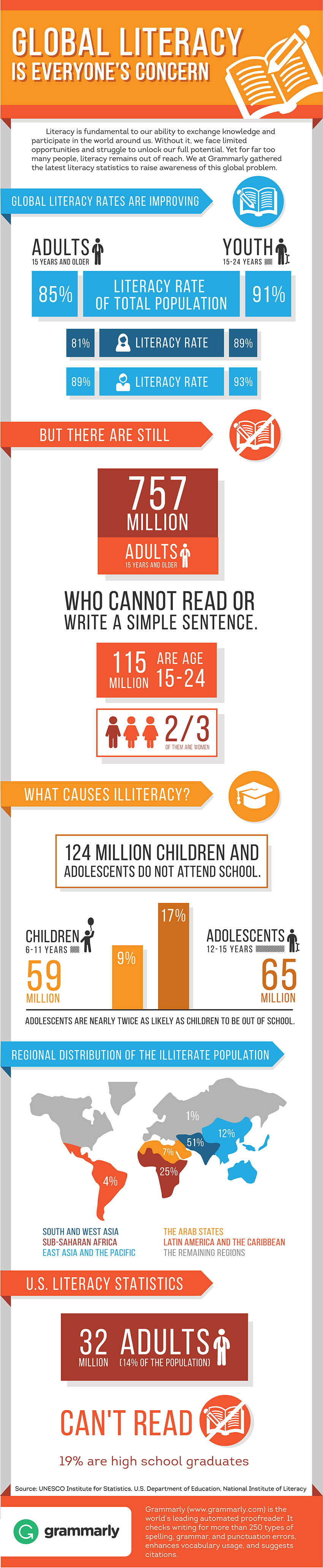
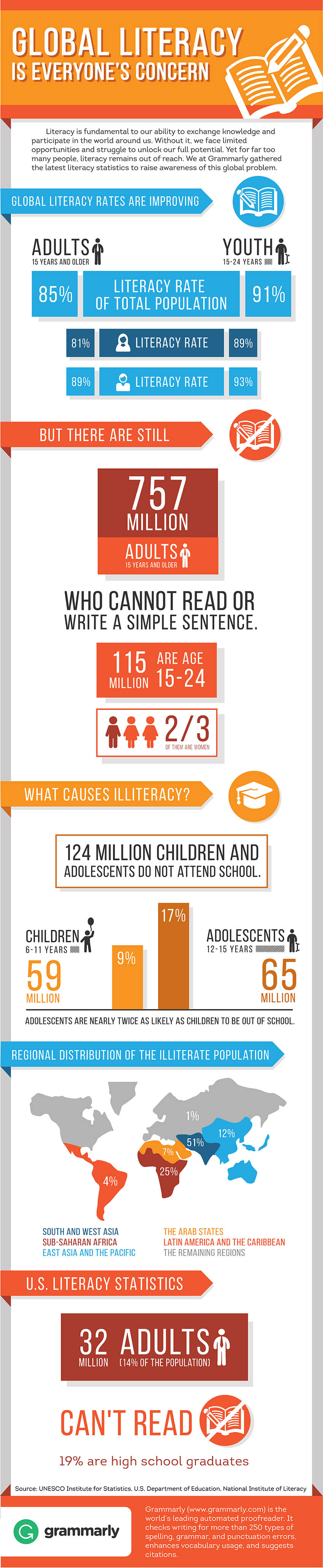
Since UNESCO celebrated the very first International Literacy Day on September 8, 1966, the plight of millions of people around the world has improved through programs dedicated to helping marginalized populations become literate. But there is still a long way to go.

Illiteracy is more than just a lack of reading skills. Around the world, it is a clear predictor of poverty, illness, and disempowerment. It’s not a problem confined to the developing world, either. Even in the United States, there are thirty-two million adults who cannot read, according to the U.S. Department of Education.

To celebrate International Literacy Day and help raise awareness about the importance of literacy, we have gathered the latest literacy statistics from around the world into an infographic.

Literacy Day


Infographic credit: https://www.grammarly.com/plagiarism-checker

Monday, May 18, 2015

Interview with Young Author and Entrepreneur Chental-Song Bembry

Chental-Song Bembry is the creator, author, and illustrator of The Honey Bunch Kids series, which she uses to promote literacy and entrepreneurship in youth. The Honey Bunch Kids is a humorous book series for boys and girls ages 7-12. The series follows the adventures of a group of middle-schoolers who learn the meaning of true friendship, respect, and getting along with others. You can purchase her books directly here.

Chental-Song was recently honored at the 2015 BET Honors as an "Early Riser" for her accomplishments as a young author and motivational speaker. Last month, she was honored as a Making a Difference Girl at the 2015 BET Black Girl's Rock awards show for her commitment to community service and education. 

Tell us about your book series THE HONEY BUNCH KIDS. What inspired you to write these books? 

I created The Honey Bunch Kids when I was 10 years old. At this age, I loved to read, write, and I loved to watch cartoons. I created three cartoon characters of my own and called them "The Honey Bunch Kids." When I turned 11, my mother sent me to a writing camp at Middlesex County College, where I wrote a story about my three characters, and I called that story The Honey Bunch Kids. In April 2010, The Honey Bunch Kids was published, and based on the overwhelmingly positive feedback I received from boys and girls, I wrote two more books: The Honey Bunch Kids: School's In Session (Book 1) and The Honey Bunch Kids: School's In Session (Book 2). Throughout each book, I highlight elements of African-American history, group dynamics, teamwork, and problem-solving skills.

In addition to being a writer, you are also a literacy advocate. Why are reading and writing so important, especially for young people? 

After publishing the first book in The Honey Bunch Kids series, I started the "Chental-Song Literacy Campaign," which allows me to travel to schools, libraries, and churches to speak to youth on the importance of literacy, goal setting, and the impact of reading on academic success. I believe that reading and writing are so important for young people because with reading comes knowledge, and with knowledge comes confidence. High confidence levels create the drive to achieve any and all goals in life. Writing allows freedom of expression and a chance to showcase creativity. It is an escape, and when people write, they discover stories inside of them that might have never gotten a chance to be exposed. The better the reader, the stronger the writer. When young people embrace literacy, they will be more inclined to tackle difficult homework assignments, and will be able to converse with others at a higher level. Literacy and education are crucial components to the success of a young person, and this is why I am so dedicated to the advancement of literacy in all children. 

You were a busy student in school when you first published THE HONEY BUNCH KIDS, and now you are a college student. What is your writing schedule? When/how do you find time to write? 

Currently, I attend Hampton University as a sophomore Broadcast Journalism major with a minor in Leadership Studies. Before sitting down to write anything, I make sure that my assignments are completed. I write (and draw) whenever I have the free time, and whenever a great idea hits me. If I cannot sit down at the computer to fully flesh out an idea, I will jot it down in my notes. I usually have more time to write and develop story ideas during Christmas, Spring, and Summer breaks. I always make sure to put energy into my craft each and every day, because energy creates movement in a positive direction.

Very true! What is your biggest advice for people (especially young people) going after their dreams and facing their own challenges in life? 

My biggest advice for young people (and all people) who are going after their dreams is to push forward, never settle, and do not give up. There will always be roadblocks and challenges along your journey to success, but you must remember that each challenge is put in your path to help you grow and develop into a stronger person. Do not fear challenges. Embrace them. Always remember that nothing of greatness comes without struggle. It is through hard work and difficulties that you become humbled and more prepared for the next chapter of your life.

Another piece of advice I have is a quote by Louis Pasteur: "Chance favors the prepared mind." You will only get your greatest opportunity in life when you are both physically and mentally prepared for it. You must always trust God and know that He has ordered your steps, and through Him, you can do all things.


Who are some of your favorite writers? 

Some of my favorite writers include Nancy Farmer, Virginia Hamilton, Zora Neale Hurston, and Maya Angelou. I grew up reading fantastic pieces by each of these authors, who influenced my passion for writing a unique story that all children can enjoy. 

What's next for Chental-Song Bembry? 

As I finish out my remaining three years at Hampton University, I am currently developing The Honey Bunch Kids book series into an animated series and a global brand, which will be featured on a major television network. From the animated series will come more books, and I will continue the literacy campaign I have started.

Is there anything else you would like to add? 

I am so grateful to God for each and every opportunity He places before me. I am looking forward to expanding The Honey Bunch Kids brand into an entertainment source that children around the world will enjoy, because I believe it is so important for all children to have positive role models within their cultures.

Here are links to connect with this amazing writer, illustrator, entrepreneur, and literacy advocate, Chental-Song Bembry:

Tuesday, August 5, 2014

Guest Post: Motivate Yourself to Write

How to motivate yourself for an academic piece of writing

a guest post by Eileen Archer

Most of us do it wrong: we sit down at our desks about a day or two beforehand thinking that we’re going to be able to write a first-class essay without having done any preparation. Especially if it’s the first time writing an important academic piece, this is a disastrous strategy. Here is a quick guide to show you the most important skills for essay writing, how to perfect them and how to get motivated.

Practice makes perfect

Keep a journal to document your life! Do it with music! Find some joy in writing! Then, when it comes to writing academically and trying to express complicated theories or discussing your opinion, it should be a lot easier for you. If you do find it difficult to write then maybe joining a writing group will help. Try also reading related papers to help you analyze the ideas and writing of others.

Organization is key

Make timetables for every complicated aspect of your life, for example: household chores, studying, writing, being productive, and hanging with friends. Attach themes or pictures to each hence turning it into something proactive, fun and interesting, not a chore! Stick them up on your walls, or give them to your parents in case you get lazy with it. Organizing your life to this extent will serve you well for any future work you have to do, both inside and outside of academia.

Reading from the same page

Surround yourself with books -- read, read and read more. There’s nothing like curling up with a good book. But, be wise about it. Reading chick lit or trashy magazines is all well and good, but if you don’t have several books on the go at once you’ll lose that writing knowledge. The ideal book selection is obviously something light-hearted that you enjoy and don’t have to think too much about, but more importantly you should be reading something that is well-written and certainly something attached to your work. So, on your night stand and desk, even before you do some academic writing, make sure there lays an academic journal or a classroom book too. And make sure you spread the time between the books evenly, rather than just staring at it dumbly from behind your top ten apps article.

Research – no pain no gain

You’re not alone, most everyone detests research. This is why you have to do it early. If you’re going to procrastinate in any part of your life or writing work, don’t do it here. Imagine a big pile of books and papers and links to references you’ve used. That’s what you’ll end up with; a big unorganized mess in front of you that will take forever to deal with. So, the key here is once you’ve used a reference, type it in a document, fully. Use the correct referencing style and make sure it’s 100% correct and all you’ll have to do at the end is click one button to arrange them alphabetically.


Bio: Eileen Archer is currently a resident blogger and a chief writer at EssayPlanet.org. After obtaining a Masters in English language she decided to dedicate her time to creative writing as well as providing assistance to students. She spends her free time reading, writing poetry and studying for a PhD in an art-related field.

Monday, July 21, 2014

Bay Area writers: call for submissions

Hi, friends! I just received this call for submissions and wanted to share ... looks like a neat opportunity if you're in the Bay Area!


Peninsula Literary Call for Submissions
We're now accepting submissions for our September reading. See details below.

Peninsula Literary will present the next reading on Friday, September 12, at 7:00 p.m. David Roderick and Alice LaPlante will be featured.

Readings will take place at Gallery House in Palo Alto. You can also visit our Facebook page at Peninsula Literary or view our websitehttp://peninsulaliterary.wordpress.com/

To round out our lineup, we're now accepting fiction, creative non-fiction and poetry submissions for 5-7 minute guest reading slots.  The deadline for submissions is Tuesday, August 12, 2014.
Submission Guidelines:

1.  Original poetry or prose – please include all submitted materials, along with your bio, in the body of your email. Submissions may additionally include pdf or Word attachments, but all pieces must appear in the main email message or they will be returned. 

2.  No more than 7 minutes total reading time (2-4 poems or 3-3.5 pages of double-spaced prose, 12 pt. text).

3.  Include your name, phone number, and preferred email.

4.  Please send all submissions via email to Carrie and Jean at peninsulaliterary@gmail.com.

Thanks for your support – we look forward to seeing you on September 12!

Carrie Hechtman & Jean Znidarsic, Peninsula Literary

Visit us on Facebook
http://www.facebook.com/#!/PeninsulaLiterary?fref=ts

Thursday, January 2, 2014

Make 2014 Your Best Writing Year Yet!


Happy New Year, everyone! I love the brand-new slate a new year brings. A chance to reflect on where we've come and where we want to go.

Here are some of my goals for 2014:

Writing Goals
1. Establish writing routine. 400 words. Every day. No excuses.
2. Revise thesis manuscript and send to agent.
3. Complete memoir manuscript.
4. Complete 200 pgs of new novel.
5. Write a new one-act play.
6. Write a full-length play.
7. Finish Verna novella & put out as an ebook.
8. Write three blog posts a week.
9. Read at least one short story a week.
10. Read at least 40 books.

Write On! For Literacy Goals
1. Send out a newsletter every other month.
2. Become an official nonprofit organization.
3. Teach a summer writing camp.
4. Teach a winter writing camp.
5. Teach a college essay/app seminar.
6. New ebook of work by young writers.
7. Compile Writing Camp ebook/program
8. Hold a Holiday Book Drive.

I'm inspired by this story shared by Glamour Editor-in-Chief Cindi Leive: "When my father-in-law was 58, he volunteered with a group that assists disabled athletes. Fit but no marathoner, he agreed to run the first half of the New York City Marathon tethered to a blind runner who'd flown all the way from Thailand for the race. At mile 13, another volunteer would take over. Except: That other volunteer never showed, and there was my father-in-law, exhausted, with 13 painful miles he'd never trained for ahead of him. 'What did I do?' he recalls now. 'I kept going!' All the way to the finish line -- inspired by the even more heroic efforts of the blind man beside him. I think of that story often, and not just while running. With the right motivation you can almost always go farther, accomplish more, reach higher than you thought."

What motivates you to go farther and reach higher than you thought possible? And how can you stretch that motivation past the sparkling new shine of 2014, into the coming weeks and months?

Here are some habits that work for me, to help keep me motivated:
  • Keep a gratitude journal to remind yourself of all the things going well in your life.
  • Keep a list of all your successes to look over whenever you feel discouraged.
  • Set goals that are based in ACTIONS rather than results. For example, instead of setting a goal to win first place in a writing contest (something you have no control over) set a goal to enter x number of writing contests. Entering contests is an action you can control; the judging process is something you have zero control over.
  • Remind yourself of the "big picture" -- what are the bigger underlying reasons you are going after your goals? For example, maybe you want to write a book this year. Who is the audience you are writing for? How might they be inspired by what you have to say? Imagining a reader picking up your book and being moved by your words can be enough to banish ever the worst case of writers block!  
I'll leave you with this quote, one of my favorites, from Sallie Krawcheck of 85 Broads: "Plant seeds, plant seeds, and don't ask for anything. The seeds will grow." 

What seeds can you plant today?

Thursday, June 6, 2013

A terrific new book available for pre-order!

945567_10101564929565435_1193568778_n

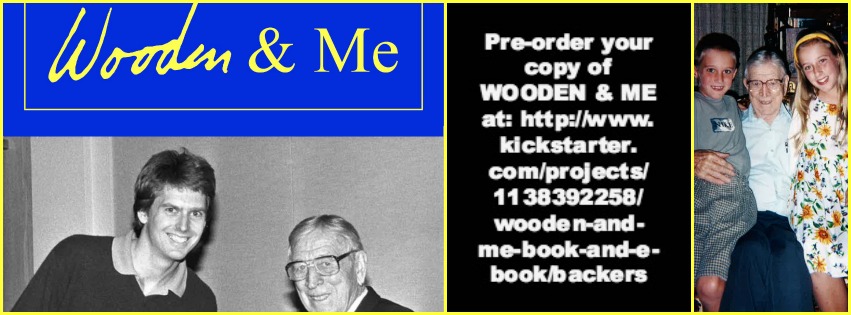
WOODEN & ME: Life Lessons from 
My Two-Decade Friendship with 
Humanitarian and Coach John Wooden to Help 
"Make Each Day Your Masterpiece"

Hi, friends! I have a special post today with some terrific news to share: my amazing dad, who also happens to be an amazing writer, has written a book about his relationship with the legendary coach and humanitarian John Wooden. The book is now available for pre-order on Kickstarter, and he needs your help to make this book's publication a reality! Do you ever feel adrift? Are you looking for more purpose, love and strength in your life? Maybe you're feeling overwhelmed by your goals or disappointed by setbacks that inevitably spring up. Or perhaps you are looking for a wise, heart-warming book to read this summer.

If you loved books like Tuesdays With Morrie, The Happiness Project, or Kitchen Table Wisdom, I know you will love WOODEN & ME! This book would also make a terrific Father's Day or graduation gift. Do you love basketball or have a basketball lover in your life? This is the book for you!

Here's how you can help:

1) Pre-order your copy at the Kickstarter campaign at: http://www.kickstarter.com/projects/1138392258/wooden-and-me-book-and-e-book

 2) Share the link with your friends and family -- and ask them to do the same. Pledged supporters will receive a signed copy of WOODEN & ME this summer upon publication.

 3) Join the Facebook event and spread the word! https://www.facebook.com/events/630992526929012/633205676707697/?notif_t=plan_mall_activity 

970833_191704637653112_1862690072_n


Now I'll leave you with some words from my dad about the genesis of this project and what your support means to him:


As a longtime newspaper sports columnist in Southern California I am often asked to speak to civic groups – and the person audiences invariably want to hear more about during the Q&A afterward is Coach John Wooden. Listeners at these talks, as well as readers of my columns, over the years have encouraged me to write a book about my experiences with Coach.

Now I have, with the memoir WOODEN & MELife Lessons from My Two-Decade Friendship with the Legendary Coach and Humanitarian to Help “Make Each Day Your Masterpiece.” It was in 1987 as a young sports writer and near-newlywed that I met Coach, who soon became a friend and mentor through the births of my two children and their growth into young adulthood; the death of my mother; career decisions; and more.

As I note in my completed manuscript: “One did not have to play for Coach Wooden in order to be one of his students, and of this I am a privileged example. I was not one of his basketball players – except for one glorious week at his youth camp in 1975 – but make no mistake, I was his pupil. No coach or teacher or professor has taught me more, or taught me more important things.”

Just as Coach Wooden was beloved and revered by people of all ages and all backgrounds, readers from teens to parents to grandparents, basketball fans and non-fans alike, will find WOODEN & ME enlightening and inspiring.

 * * *

WOODEN & ME is an inspiring combination of Tuesdays With Morrie and Chicken Soup for the Soul -- author Randy Robertson

Order your copy today! http://www.kickstarter.com/projects/1138392258/wooden-and-me-book-and-e-book

Monday, August 13, 2012

Interview with Erika Dreifus, author of Quiet Americans

I am so excited to have Erika Dreifus as a guest on my blog today! I first discovered Erika through her extremely helpful newsletter The Practicing Writer, and was blown away by her moving and beautifully nuanced collection of short stories Quiet Americans. I am delighted to have her here today to talk more about her fiction and her own writing journey.

Erika is the author of Quiet Americans: Stories (Last Light Studio), which is a 2012 ALA Sophie Brody Medal Honor Title for outstanding Jewish literature. Quiet Americans was also named a Notable Book (The Jewish Journal) and a Top Small-Press Book (Shelf Unbound). Erika is a contributing editor for The Writer magazine and Fiction Writers Review and an advisory board member for J Journal: New Writing on Justice, and she wrote the section on “Choosing a Low-Residency MFA Program in Creative Writing” for the second edition of Tom Kealey’s Creative Writing MFA Handbook (Continuum, 2008). Erika is also the editor/publisher of The Practicing Writer, a free (and popular) e-newsletter featuring advice, opportunities, and resources on the craft and business of writing for fictionists, poets, and writers of creative nonfiction.

Tell us about Quiet Americans. What was your inspiration/motivation behind this book? 

First, Dallas, thanks so much for your interest and for the opportunity to "meet" your readers. Quiet Americans is a collection of short stories. It’s a book of fiction, but most of the stories are inspired in some way by the histories and experiences of my paternal grandparents, German Jews who immigrated to the United States in the late 1930s, and by my awareness of this legacy.

How did you get started writing? 

I was a reader, first. An early and enthusiastic reader! Words, stories, and books simply grabbed me. My first bylined publications were brief poems that were published in my elementary-school newsletter. I haven’t stopped writing since then.

What is your writing process like? 

My process isn’t fixed. It can vary by genre or assignment, and it has definitely changed over the years that I’ve been writing (computers weren’t always an option!). These days, most of the writing I do these days is, in fact, on a computer. But sometimes I really enjoy returning to a notepad or notebook, especially if I’m working on a shorter piece or just beginning something new.

What are some of your favorite books? 

A few years after those poems were published in my elementary-school newsletter, I read Betty Smith’s classic A Tree Grows in Brooklyn for the first time. That novel became and remains one of my favorite books. And I’ve studied French history and literature fairly extensively, so there are several French books—like Gustave Flaubert’s Madame Bovary—that mean a great to me, too.

What is your biggest advice for young people reaching for their dreams? 

Don’t give up!

Erika has generously offered to give an ebook copy of Quiet Americans away to one lucky blog reader!! All you need to to do enter is leave a comment below. A winner will be chosen at random on Friday, August 17.

(The ebook will be through Kindle, but readers don't need to own a Kindle device to read Kindle e-books! http://www.amazon.com/gp/feature.html/ref=sv_kinh_1?ie=UTF8&docId=1000493771)

Connect with Erika:
Erika loves to share writing resources with others. For starters, check out her Practicing Writing blog and Practicing Writer newsletter. Her website also features an extensive resources section. You can follow Erika on Twitter (@erikadreifus) or via Facebook (facebook.com/erikadreifusauthor).

Thursday, March 8, 2012

Review of "Mockingbird" by Kathryn Erskine

MockingbirdMockingbird by Kathryn Erskine

My rating: 4 of 5 stars

I was impressed by how authentic the voice of the main character, Caitlin, seemed as a portrayal of a young girl with Asperger’s Syndrome. On Kathryn Erskine's website she shares a long list of books she read to research Autism and Asperger’s; it also mentions that she interviewed experts and teachers and had them read her manuscript and give her feedback. I think this level of detailed research shines through this book. I took a literature class last semester that focused on portrayals of disability in fiction, and one of the commonalities we discussed was the tendency of authors to give disability some sort of heightened symbolic meaning, or for the characters with disabilities to be defined wholly by their disabilities/differences rather than being portrayed as whole and nuanced human beings. I thought Kathryn Erskine avoided both of these tired tropes in Mockingbird. Caitlin’s voice is unique, but not in a way that impeded me from seeing her as a vivid, real character. As I read further along into the book, it was like her disability faded into the background and I knew Caitlin more for her other traits: her artistic talent, her bravery and curiosity, her quick thinking, her stubbornness, and her compassion and thoughtfulness.

This book tackles difficult subjects—grief, violence, bullying, difference—with a gentle and generous spirit. It is a great reminder to students (and teachers and parents!) that we all have our differences, but we also all have much the same about us. Mockingbird seems to argue that the only way to combat exclusion and meanness is to strive towards understanding each other and being patient with each other, and though some adult readers might find the treatment of this theme/motif a bit heavy-handed, I think it is a valuable lesson for all readers and one that is worth sharing.

Caveats: A school shooting plays a major plot point in the book, which may be upsetting for some students to read about. Teachers should be extra sensitive to this topic and perhaps use the book as a jumping-off point for discussion on school safety, violence, bullying, etc.

Teaching idea: This book would be excellent to pair with To Kill a Mockingbird (and possibly the film version of the novel as well.) Teachers might also work in creative art time by giving students an assignment to draw a mockingbird as a charcoal or pencil sketch (black and white) and then to do another version with pastels or watercolors (color). What different beauty can be found in each version? A reader-response question might be: Think of a time you had an argument or disagreement with someone. Write down your point of view of what happened. Now, turn over the piece of paper and write about the same event as if you are the other person telling the story. Get inside this person’s head/perspective, much as Caitlin tries to do in the book when she is learning to empathize with others.

Other books by Kathryn Erskine: Quaking (2007) and The Absolute Value of Mike (2011)

Themes/motifs: grief and healing, art, family, community, friendship, loss, disability and difference, black & white vs. color & nuance

View all of my Goodreads reviews

Saturday, February 25, 2012

Interview with Children's Book Author Joanne Lécuyer


I am so pleased to have Joanne Lécuyer as a guest on the blog today! She has a Bachelor of Arts in Communications and Visual Arts from the University of Ottawa and a Diploma in Public Administration from the University of Quebec. She is also a Professional and Personal Coach and Reiki Master. Joanne has worked for the Canadian federal government for over 25 years, with the last 15 years in strategic and organizational communications to help management and employees communicate better. She has published two children’s books “The Witch, the Cat and the Egg” (2010), and “Kaptain Vamp” (2011).

What would you like readers to know about you as an introduction?

I’m Canadian and was born in Timmins, Ontario. I come from a small town called North Bay, Ontario, where I lived until I was 18. I now live in a small rural community near Ottawa, Ontario with my husband Rick, our dog Kato and two cats, Black Magic and Minx (photos on the website). I love nature so I like small towns. I only starting writing children’s books 2 years ago and I love it!

Tell us about your most recent book "Kaptain Vamp." What was your inspiration behind this book?

Kaptain Vamp is my second children’s book. The story is about a young vampire named Allistaire, who is also part human, who wants to change the fact that humans are afraid and distrustful of vampires. His family has been living among humans for hundreds of years and they’ve always used their abilities for good. One day, while reading his favorite superhero comic, Allistaire decides that he’s going to do everything he can to help humans. He enlists the aid of his best friend Rich to help him become Kaptain Vamp.

Since vampires have been so popular with teens and adults, for the last few years, I thought it would be fun to write a story about them for kids. I liked the challenge of taking this theme and making it positive, so it wouldn’t give kids nightmares. Also, I thought a vampire-human superhero would make a good story. I’m getting a lot of good feedback – seems my readers agree.

What have you learned through writing this book?

It’s possible to write a positive story about vampires. Also that, although it’s a challenge, it’s gratifying to self-publish.

How did you get started writing?

I’ve been writing stories for children for about 2 years now. But, it all started about 6-7 years ago, after spending a weekend with my younger brother. He’s a graphic artist and has always been extremely creative. On my way back home on the train, I jotted a story down on some scraps of paper that I called Topsyturvia. When I got home I just put the pages away.

In 2009, I remembered the story and transcribed into my computer and just kept adding to it. I got to about 6,000 words and read it to my husband–who can sometimes be brutally honest. He told me that he thought it was a very good story. I gave a copy to a few colleagues with children and they liked it too. I worked on it some more and asked my brother to do the illustrations for the book Topsyturvia. And then more stories came. In 2010, I published my first book The Witch, the Cat and the Egg, and in 2011 I published Kaptain Vamp. Topsyturvia should be out later in 2012!

What is your writing process like? Do you write on a computer? In a spiral notebook? Do you draw illustrations?

I seem to get my story ideas early in the morning while I’m walking to catch the bus or during my commute into the city. But sometimes they come when I’m really tired, after a long day at work. I always keep a small notepad and pen with me to jot down ideas (something small enough to keep in my purse). Generally, I sit down to write when the inspiration comes which is sometimes once a day, a week or a month. In one sitting, I may write as little as a brief outline or a whole chapter. When I’m getting close to finishing a story, I’ll stay up until the wee hours of the morning to get it done. I like writing with a computer since you can move things around.

When I started writing children’s books, I decided that I wanted them to include lots of images and they had to be in color. So I was looking for the style of illustrations to match the story I was trying to create. I like working with different illustrators. I met the illustrator for Kaptain Vamp, Amy Rottinger, through LinkedIn. I’d liked what I saw on her website (www.arottinger.daportfolio.com). Amy and I chatted on the phone. She was very enthusiastic, and we just hit it off. We worked through email. I gave her an electronic version of the book, told her how many images I wanted in each chapter, and asked her to submit her ideas. She was great to work with and the results are amazing. I love the book. We are now working on a comic book. When I was younger, I thought I might be an illustrator. I realized however that I was more of a copy artist. I had trouble inventing characters or scenes. In the last two years, I found that I’m a better storyteller. For kids stories, I think pictures help create some of the story magic and I don’t want to write a book without them.

How do you get ideas for what you write?

The Witch book idea came from memories of reading Snow White and Cinderella. I just love how they could talk to the animals. So Juliane is a young witch that lives on the border of a magical forest who can talk and understand the magical creatures that live there. For Kaptain Vamp, I wanted write about good vampires and a superhero type. In Topsyturvia, it’s all about mixing different animals even the flora and fauna, and I’m using dream time as the vehicle for getting there. A lot of it is using my imagination. That’s what is fun about fantasy and fiction – anything goes. But you still have to make it somewhat believable – that’s the challenge.

What is your biggest advice for other writers and young people reaching for their dreams?

Just do it! Write down your ideas when you get them. I carry a little notepad with me and jot down all my ideas in there. When I have the time to finally sit and write, I pull it out and the notes and ideas get me going. Write the best story you can and ask friends and colleagues to be your test readers. They can help find the holes in the story and give you ideas. Don’t try to edit your own work. A good editor is your friend. As the author, I think we sometimes forget to add some of the details that we have in our head. Of course, you don’t have to take all the suggestions you get. But I do think that considering them makes for a better story in the end. I write for children, so I get kids and their parents to read the draft manuscript. Initially, I think I write the story for me. But I also want to share it, so it needs to be enjoyable for the reader–the kids, their parents or grandparents.

What are some of your favorite books?

Did I mention that I really enjoy fiction and fantasy? For children’s books, I would have to say all the Disney classics. That’s what I grew up reading. Other books that stand out are The Hobbit, Lord of the Rings, The Chrysalids, and The Stand. My husband and I are reading an oldie but goodie trilogy about Merlin by Mary Stewart (Merlin is my favourite character). I’m also reading a French series called “Les chevaliers d’Émeraude” (The Knights of Emerald) by Anne Robillard – there are 12 books and I’m only on book 3. I’ve just finished the “Twelfth Insight” by James Redfield – I loved The Celestine Prophecy.

Is there anything else you would like to add?

When I started writing stories for children, I decided that I would write the kinds of books that leave my readers feeling good and wanting more; that also leave them with a smile on their faces. The type of book that you can read to kids before they go to bed that will help them have good dreams! That’s what Topsy Books is all about. My personal motto is “Dare to imagine and believe in the magic of possibilities!” I hope that new readers will make Topsy Books part of their reading collection.

There will be a sequel to The Witch, the Cat and the Egg in 2012 and to Kaptain Vamp next year. I’m currently working on two comic books and a French version of the Witch book. My books are available on my website, Amazon.com and Barnes and Noble.com

Connect with Joanne:
Thursday, January 26, 2012

Part Two: Interview with Jeevan Sivasubramaniam


I am honored and delighted to have Jeevan Sivasubramaniam as my guest on the blog! I first "met" him on Twitter (follow him @EditorialHell) after becoming a fan of the informative and hilarious monthly newsletters he sends out for Berrett-Koehler Publishers. (Check out their website and subscribe to their newsletter here.) Berrett-Koehler is a publisher of nonfiction books and is a company dedicated to "creating a world that works for all." They are celebrating their 20th anniversary and also have a feature article in the latest issue of Publisher's Weekly: http://www.publishersweekly.com/pw/by-topic/industry-news/publisher-news/article/50199-berrett-koehler-posts-another-profitable-year.html.

Read on for an editor's insights on the writing and publishing process!

Some writers are anxious about today's publishing landscape-- the loss of many independent bookstores, the rise of ebooks. What are your thoughts about publishing today? Any advice for writers, particularly ones anxious about so much change?


The landscape is always changing in media and someone's always complaining. Back in the 1950s when there was a gradual shift to paperbacks, publishers said it was the end of the industry. I am old enough to remember when videotapes came on the market and everyone said that television was now dead because you could fast-forward through commercials so advertising would dry up. Traditional publishing is changing but I think there's a tremendous opportunity here if someone could just figure out the answer to the challenge. The challenge is this: people are reading more today than in any other time in history. They may not be reading books, but they are definitely reading -- mass quantities of it, in fact. Publishers are essentially generators of reading materials, and we are living in a time when people are reading more than ever before. Do you see how frustrating that is? Ideally, this should be our time to shine, not crash. So, writers, don't be anxious, but be innovative and don't restrict yourself to traditional mediums. Look what Amanda Hocking did by being innovative about how she created a market for her writing -- and sold over a million copies of her book (http://www.guardian.co.uk/books/2012/jan/12/amanda-hocking-self-publishing).

For you as an editor, what makes a writer great to work with?

A genuine openness to guidance. I understand why writers are hesitant about letting someone get involved with their writing. Writing is the most personal thing we can create and we're inevitably going to be very protective and guarded about it. That said, you have to trust the editor because, quite honestly, you can't trust yourself. This is why surgeons don't operate on their own family -- a level of distance and objectivity is needed to really assess and edit a project and a writer's over-protectiveness is not going to help. Just as the even the best surgeon in the world will hand the scalpel over to a trusted colleague when it comes to operating on a family member, writers need to listen to their editors. Remember that an editor's job is to make the book the strongest it can be and so make the author look the best he or she can be. Editors' names do not appear anywhere on the book (unless they are specifically thanked in the acknowledgments) and no will ever know their role in creating a book, so authors should understand that editors are not in this business for personal gain or fame. They genuinely like what they do.

Do you have some favorite books that might be helpful for writers to read?
  • Elements of Style has always been the primer for any writer, I think.
  • On Writing Well by Zinser
  • And of course the instruction manual for language, The Chicago Manual of Style (though I hate that they keep revising it annually).
  • Also, my friend and author Mark Levy's book Accidental Genius: Using Writing to Generate Your Best Ideas, Insight, and Content.
Is there anything else you would like to add?

I was thinking of something clever to say here but I think that if I really wanted to help your readers, I would be better off saving the pithy remarks and instead saying I am happy to take any questions and will do my best to answer them. Just email them to me at jsiva@bkpub.com and in the subject line, say "Question after reading Dallas' blog interview" so I'll know it's one of your folks.

Wednesday, January 25, 2012

Interview with Jeevan Sivasubramaniam, Managing Director, Editorial at Berrett-Koehler Publishers, Inc.

I am honored and delighted to have Jeevan Sivasubramaniam as my guest on the blog today! I first "met" him on Twitter (follow him @EditorialHell) after becoming a fan of the informative and hilarious monthly newsletters he sends out for Berrett-Koehler Publishers. (Check out their website and subscribe to their newsletter here.) Berrett-Koehler is a publisher of nonfiction books and is a company dedicated to "creating a world that works for all." They are celebrating their 20th anniversary and also have a feature article in the latest issue of Publisher's Weekly: http://www.publishersweekly.com/pw/by-topic/industry-news/publisher-news/article/50199-berrett-koehler-posts-another-profitable-year.html.

Read on for an editor's insights on the writing and publishing process!


What would you like readers to know about you as an introduction?

Well, I'm the Managing Director for the Editorial Department here at Berrett-Koehler Publishers. I do work on acquiring a project or two here and there but by and large I am the chief administrator for the Editorial Department and handle a lot of the inter-departmental stuff. People never think of editorial departments as having administrators, but they actually need it more than anyone else because a company lives or dies by the acquisitions and decisions the editorial department makes. I am responsible for tracking all projects, drafting contracts, administrating editorial reviews, overseeing signings by the editors (and meeting various signings goals), handling author relationships, inter-departmental communications, legal and copyright concerns, communications with various Library of Congress offices, and a few other boring things. I am also given some leeway to do the initial legwork on acquiring some promising projects and authors and I usually pull in about two or three a year. Because I don't have a quota of signings like the other editors, I can be very selective and hold out for the most promising authors -- a luxury few editors can afford.

How did you get interested in editing and publishing?

I was originally interested in intellectual property and legal documentation but slowly gained an interest in copyright and publishing legal issues during my time with a legal services company after graduation from college. In grad school I worked with a professor as a graduate research assistant and her big task for me was to find a publisher for an anthology of plays by women from around the world. I had to educate myself as I went along and it was quite exciting. It was also downright frustrating as I saw how publishers can treat authors. Almost all authors you meet have an adversarial relationship with their publisher -- as if they consider each other as necessary evils. I felt publishers could do better, and also wanted to be a part of a better publishing model.

What grabs you as a reader?

A compellingly different way of looking at things. I say "compellingly" because just seeing something in a different way is not enough. As human beings, we are programmed to see things differently whether we like it or not -- that in itself is nothing too exciting. But some people see things that almost contradict what everyone else sees. To give an example, there are so many books on how to act on the here and now -- how the past is not relevant, only the present moment and what you choose to do with it. Then I met an author who actually felt that was simplistic and wrong. He felt that the past was the most valuable tool we had to shape our futures -- that the lessons from our regrets and things we would rather not think about are most important to this exercise. I liked that he was not afraid of going up against an entire movement (you know which authors I'm talking about and you know how big they are) and challenging how they advised people to do things. A colleague once told me that I'm always looking for a good fight when it comes to the books that I like. I think his assertion was spot-on. I like books that create trouble and make people question what they thought they knew.

Check back tomorrow for PART TWO of my interview with Jeevan!

Monday, November 28, 2011

10th Annual Holiday Book Drive to benefit underprivileged children!

Last year Write On! For Literacy collected nearly 1,000 books (bringing our grand total to more than 12,000 books!) that were distributed to various schools and charities including the Boys & Girls Club, Casa Pacifica, and Project Understanding. Please do your part to help children have a better holiday season. Help beat illiteracy and give the gift that lasts forever: the gift of reading!

About Write On!

"Write On! For Literacy" is a volunteer-run organization founded by author Dallas Woodburn in 2001. The goal is to encourage kids to discover confidence, happiness, a means of self-expression, and connection to others through reading and writing. The Write On! website features writing contests, book reviews, author interviews, writing tips and ideas, and more.

Want to get involved?
  • You can mail book donations to the Write On! chapter headquarters: 400 Roosevelt Court, Ventura, CA, 93003
  • You can also mail monetary donations that will be used to purchase books to the above address. (Checks made out to Dallas Woodburn.)
  • You can start a chapter in your area! Donate books to a local charity -- Boys & Girls Clubs are usually very grateful for donations -- and then e-mail Dallas the total number of books donated which will then be added to our grand-total.

Friday, August 12, 2011

Interview with Robert-Harry Rovin, writing teacher to the homeless

A few weeks ago I was introduced to an amazing fellow writer, writing teacher, and literacy advocate named Robert-Harry Rovin. (Thanks to the wonderful Ilene Dillon, host of the Emotional Pro radio show, for making the introduction.) Robert-Harry leads a writing workshop for the homeless, coincidentally also called W R I T E O N, which proves that great minds do think alike! :) He was kind enough to visit the blog today to speak about the empowerment and hope that writing can bring into people's lives.

What would you like readers to know about you as an introduction?

I have a background of professional acting, singing and dancing in New York City and studies in Continuum with Emile Conrad, then teaching her work. I practiced Rosen Method Bodywork for twenty years and was a member of an Authentic Movement group for many years. Also for many years I’ve offered a program of the lyric poetry of nature as Green Man Alive as well as Yertl the Turtle and The Lorax for children portraying this archetypal character. Eleven years ago I enrolled as a student in Ridhwan’s Diamond Approach, a somatically based inquiry and meditation practice of self realization, which continues to be a strong foundation for my life.

Tell us about how the Write On! Workshops began.

Eight years ago I started a creative writing program for homeless people called W R I T E O N ! I had been working in a homeless shelter for years and felt that the depersonalization that results from people being enmeshed in the social service system was not being dealt with. I started offering creative writing classes to support people’s connection to their deeper selves and to nourish their well-being through self-expression. I combined the inquiry and meditation methods of the Diamond Approach with creative writing.

What have you learned through creating this program?

The creative work that has come forward also helps shift social perceptions: through the eyes of those more comfortably ensconced, the homeless can now be seen as creative individuals of worth rather than faceless abstractions; and in turn these souls without homes are supported in their ability to relate to the more affluent on a level where creativity and truth of expression are a shared experience.

I've been so moved watching people come alive as they discover and articulate their personal truth through prose and poetry. This aliveness has translated into all of us finding our deeper, more authentic voices as well as homeless people having more confidence and more success in advocating for a home, good health and work.


In your opinion, why is writing so important?

Writing provides an opportunity to give language to sensation, feeling and thought. Once articulated onto the page, this material is available for reflection and makes room for the next wave of truth telling to appear. Additionally, in W R I T E O N ! workshops the writers have the opportunity to read what they've written, then to receive only positive reflection of their writing, which further affirms the validity of their expression.

What is your writing process like?

In the workshops as well as at home or around and about, I write in a composition book with a black and white marbleized cardboard cover. Writings I wish to preserve I copy into my laptop. Occasionally I draw illustrations or elaborate doodles to accompany my poems, stories and essays.

Does teaching these workshops influence your own writing?

Extending unconditional acceptance to the writers in the workshops has had the affect of extending that affirming support to my own creative process, including writing.

What is your biggest advice for young people reaching for their dreams?

For young people, I would advise them to feel what part of their dream is most alive to them and to focus on following that aspect first; the rest will follow.

What are some of your favorite books?

Favorite books include Mary Oliver’s New and Selected Poems and Writing Alone or With Others by Pat Schneider. Right now I’m enjoying Speak Peace in a World of Conflict by Marshall B. Rosenberg, Ph.D; Wisdom Jesus by Cynthia Bourgeault; and Working in the Dark by Jimmy Santiago Boca.

Is there anything else you would like to add?

W R I T E O N ! presents public readings of creative writing and also has an internet radio program (www.blogradio.com) where people share their creative work. Type in robert-harryrovin at their web site to select an archived episode; or Google "Robert-Harry Rovin" to arrive at the W R I T E O N ! page on the same web site. Check out some of our participant’s writings on the blog at www.writeonworkshops.org

Wednesday, August 3, 2011

Interview with Lucia Chen


Today we continue our Dancing With The Pen blog tour with an interview with young writer Lucia Chen, whose story "Take My Hand" is featured in the book. Order your copy of Dancing With The Pen: a collection of today's youth writing on Amazon here.

What would you like readers to know about you as an introduction?

My name is Lucia (pronounced Lu-See-Ah…the Spanish way, not the Italian way!) and I’m a 17-year-old girl from Beijing. Now I live in the suburbs of Detroit, where I run cross country, watch soccer matches religiously, and read way too many historical romances. (They’re my guilty pleasure!)

Describe your story that were published in Dancing With The Pen. How did you get your idea for the piece? Take us through your writing process.

More often than not, I write what I read. When I wrote my short story Take My Hand, I had been going through a medieval phase, devouring novels about knights and battles and grisly conflicts between the English and the Scots. One day I asked myself, “What if an Englishman and a Scotman became friends…and then were pitted against each other?” The idea just lodged in my brain and refused to leave until it became a full-fledged story.

Have you been writing for a long time? What do you like about writing?

My writing career “officially” began with a memorable 6th grade assignment – a pourquoi story about how the pig got its curly tail. Since then, my pencil (and now, keyboard) has been an extension of my hand. What I love most about writing is that wonderful moment after you sit and stare at a awkward sentence for ages, and then – from out of the blue – you find a word that fits perfectly.

What does it mean to you to have your piece included in this book?

I am ecstatic! Deliriously happy! Eternally grateful! It just means so much to me that people across the nation – perhaps even across the world – are reading and enjoying what I wrote.

Do you have any advice for other writers, or for other young people going after their dreams?

To steal the words of Henry David Thoreau: “Go confidently in the direction of your dreams.” A writer’s life may be rife with rejection and disappointment, but it is also bursting with satisfaction and success. And if you truly enjoy the act of putting pen to paper, then that is a victory in itself.

Can you share a few of your favorite books or authors?

An absolute favorite of mine (as in, I reread it every few months or so) is Ella Enchanted by Gail Carlson Levine…which says something, because I’m not even a fantasy fan. Just a snapshot of my other favorites: The Juliet Club by Suzanne Harper, The Truth about Forever by Sarah Dessen, The Hunger Games by Suzanne Collins, and Pride and Prejudice (Mr. Darcy!!! Enough said) by the incomparable Jane Austen.

What inspires you?

The World Cup. No, seriously! As K’naan sang in the 2010 World Cup anthem, it’s a time when “every nation is around us,” when souls from every corner of the world “sing forever young…sing songs underneath the sun.” When you think about it, every one of those souls has his or her own story to tell. A world of stories coming together under one sun…there is nothing more inspiring to me than that.

What are you working on now? What’s next for you?

Other than really bad poetry and cheesy stories? My first novel, actually! To put it concisely, it’s a time-travel romance set in Napoleonic Europe…complete with villainous French agents and hot British spies. ☺ The manuscript is complete and in the editing stages, and I hope to one day publish it.

Anything else you’d like to add?

How about two truths and a lie?
1. I am an excellent seamstress.
2. When I was little, I was allergic to sand.
3. I have a passionate hatred of cheese.

(Just for the record, I can’t sew to save my life).

Links:
  • Order Dancing With The Pen on Amazon. (It rose to a #2 ranking on Amazon.com in the "literature anthologies" category in its first week of release!
  • Please take a few seconds to "like" our Amazon page!
  • And, if you have a few minutes and could write a review on Amazon, that would be fantastic! 
  • You can also follow Dancing With The Pen on Facebook and Twitter. We're now featured on Goodreads, too!
  • Discounted bulk orders are available at the Write On! website: www.writeonbooks.org

Sunday, July 31, 2011

Interview with debut YA author Emily Hendricks Jensen

Emily, thank you so much for being a guest on the blog today! What would you like readers to know about you as an introduction?

I have a pretty uninteresting bio. I was born in Missouri and was an only child until I was 12 and now I have 8 siblings (halves and steps.) I majored in Journalism and I loved it, though I don’t use the degree in the conventional sense of working for a newspaper. I do, however, use all the courses I took on researching and investigating to find information for my writing. I moved to Wyoming in mid-July and will be getting married in mid-August. I’m already writing under my future married name. I love that.

Tell us about Fault. What was your inspiration/motivation behind this book?

The plot came from a writing prompt I saw on a website when I was in high school. It was started it as a short story, but before I knew it I had written one young adult novel that I eventually split up into five different novellas. The story is about Cecelia, a 15 year old drug addict who will do anything for acceptance, love and drugs. Her parents send her to a facility to help her with her drug problems, but they won’t acknowledge the abuse she had in her past that started all of her drug problems in the first place. It is written in verse.

What have you learned through writing this book?

How cathartic writing can really be and the what all the things you write can tell you about yourself as a person. I didn’t realize how much of myself I poured into the story until my fiance told me he saw certain people in the characters. I’m not a drug addict and I’ve never been to a rehabilitation facility, but I’m the only child of a bitter divorce and I understand what it feels like to be shuttled from house to house. I know what trying too hard to be perfect feels like.

How did you get started writing?

I’ve always been some sort of writer. Short stories when I was younger, then poems (that were awful) in high school. I never had the confidence to write a book, but one day I sat down and started one. Finished that one, tried to get an agent. Didn’t happen. Tried again with my second book. Nothing. At first I felt like a terrible writer, then I realized that those two books were absolutely not my best pieces of work. After that I wrote Fault. I sent it around to agents and small presses, and everyone who read it “loved the concept” but said it would be a hard book to market. That is why I went through the self-publishing process.

What is your writing process like? Do you write on a computer? In a spiral notebook? Do you draw illustrations?

I write everything on either my computer or my iPhone. I do a lot of traveling (both in the US and internationally) and I think I do my best work on planes and trains. My books don’t have illustrations, probably because I can barely draw a stick figure.

How do you get ideas for what you write?

Mostly the news. I’m a huge news junkie, especially entertainment news.

What is your biggest advice for young people reaching for their dreams?

Never ever give up. I know that’s what everyone says, but it’s so true. If you give up, all you will have is regrets and regrets get you nowhere.

What are some of your favorite books?

My two favorite books ever are The Saving Graces by Patricia Gaffney and Wish You Well by David Baldacci. I also love anything by Ellen Hopkins, Melissa Senate, and Maureen Johnson.

Is there anything else you would like to add?

I am so excited about my novella series! A new novella will come out every two months. Next summer I intend to publish a full length young adult novel. I have other things in the works as well, so stay tuned!

Contact Emily:

Friday, July 1, 2011

Interview with Daniel Williams


Today we continue our Dancing With The Pen blog tour with an interview with young writer Daniel Williams. Daniel is an eighteen-year-old 12th grader from Fort Wayne, Indiana. In addition to writing, his hobbies include reading, dancing, singing, and riding his bike. He is passionate about giving back to his community and is very active within the youth antiviolence movement. He is a featured young writer in Dancing With The Pen: a collection of today's best youth writing. 

Your piece "Water-Bio Poem" was published in Dancing With The Pen. How did you get your idea for this poem?

It is a sort of autobiography poem I wrote about water where I describe what water is like. It comes naturally to me and I write how I feel. I write mostly about my life.

Have you been writing for a long time?

Yes, I have been writing for eight years. One thing I like about writing is that I can express myself the way I write and feel.

What books do you enjoy reading?

Sharon M Draper, Walter Dean Myers and the late E. Lynn Harris are a few of my favorite authors.

What are you working on now?

I’m publishing my first book titled Brothers Stand Strong. I will continue writing short stories. I plan to down the road do my own writing reality show on YouTube.

Do you have any advice for other writers, or for other young people going after their dreams?

Write what you know and write from your heart. In general, follow your heart with what you want out of life.

Anything else you’d like to add?

Thank you for giving young writers like myself a chance to share our works with the world.

Links:
  • Order Dancing With The Pen on Amazon. (It rose to a #2 ranking on Amazon.com in the "literature anthologies" category in its first week of release!
  • Please take a few seconds to "like" our Amazon page!
  • And, if you have a few minutes and could write a review on Amazon, that would be fantastic! 
  • You can also follow Dancing With The Pen on Facebook and Twitter. We're now featured on Goodreads, too!
  • Discounted bulk orders are available at the Write On! website: www.writeonbooks.org

Tuesday, June 28, 2011

Part II: Interview with Randy Robertson

Randy Robertson is the author of Finding Mary: One Family's Journey on the Road to Autism Recovery. He was kind enough to stop by the blog to share more about the book, as well as his words of advice and encouragement for other writers! Read Part I of the interview here.

Can you tell us a bit about your writing process?

My writing process goes back to my journalism training in that I write in a really structured manner. For Finding Mary I wrote a high-level outline first, basically writing what would become the chapter heads. This enabled me to see how the book would flow. I typed this directly into a Microsoft Word file on my computer. I then went through the outline and for each chapter head, I added anywhere from 2 to 6 sub-heads with more detailed information about what to include in that chapter. Finally, I left the chapter head and sub-heads for each chapter and started writing the contents of the book right into the outline. It grew from a 2-page chapter head list into a 200-page book over the course of a year!

I really don’t write much on paper or in notebooks. I’m so used to using the computer at work that I’m very comfortable writing outlines and jotting notes in Word files. One trick that helped me tremendously was to write myself a note each time I was done for the day. As I said, I only wrote on Tuesday nights, so when the juices were flowing and the words were streaming easily I often wrote well into the middle of the night. When I just couldn’t keep my eyes open any longer, I would write a few sentences to myself describing what the next few paragraphs would be about and what topics were next on my mind to discuss. Then I would shut down the computer and go to bed. The following Tuesday, instead of having to scroll through a dozen or more pages to get back up to speed on where I was at in the book, I could just read the last paragraph or two and the note to myself and pick right back up with my train of thought. It took me a few weeks to get into that habit but I found once I did it, I was able to get back into writing mode much more quickly and avoid writer’s block and keep the narrative going.

What's next for you?

Since competing Finding Mary, I also wrote a fiction book called The Sports Locker about some kids that time travel back to see famous sports events. The book hasn’t been published yet as I’ve been focusing on promoting Finding Mary for the past year. The idea for The Sports Locker came from watching my oldest son Charlie attend sports camps and seeing the camaraderie amongst the boys at the camp. I’ve also written quite a few poems and short stories. The writing subjects are almost always about my immediate family and the myriad of activities we experience together day after day. I do keep a notebook by my bed to write down ideas that come to me in the middle of the night. I heard many authors say they do this, so I started doing it too, and every so often I’ll flip through the notebook and see if one of my ideas sparks an interest to hunker down and develop the story.

Do you have any advice for other writers, especially young writers?

My biggest advice to young writers is to keep moving forward little steps at a time. You can’t expect to realistically sit down and in a few days write the next Harry Potter. It’s not like that. Writing takes time, but it’s a fun and rewarding time! It’s like when I ran my first marathon in 2000. At first I could barely run 3 miles, but I kept to a strict running schedule and gradually improved my speed and added distance to my runs. Six months later I crossed the finish line successfully. Writing should likewise be accomplished in a progression. Writing short stories and poems is a wonderful way to develop skills and techniques. You can write a short story and work on a particular technique, such as describing a character’s physical description, explaining the sounds and textures in a particular setting, or learning to incorporate appropriate metaphors. Once you have some of those basic skills mastered you should think about writing a book. Start with an outline, then sub-heads…

What are some of your favorite books?

For almost my whole life I’ve heard people talk about what a great book the Bible is, but I never really considered reading the whole thing. I mean, it’s thicker than a phone book! Also, I thought it was a cliché, that someone who said the Bible is the best book is just saying that to sound good. Then three years ago I decided to read the Bible from cover to cover. I made it a New Year’s resolution and just started on it. I determined that my goal each day would be to read enough to turn the page once. That’s it…just to turn the page once daily. I stuck with it and it took me almost two full years, but I read the entire Bible! And it turns out that the book is actually amazing! There are stories of heroism, power, great battles, geography, history of course, tremendous character development, well-known quotations and many inspirational tales. You don’t need to be Catholic or any specific religious affiliation to thoroughly enjoy the Bible. My other favorites include The Adventures of Huckleberry Finn, The Pelican Brief (talk about a page-turner!), and The Da Vinci Code. I also loved The Secret by Rhonda Byrne, a book that truly encourages big ideas and the concept that anyone can accomplish anything if they are determined and focused.

Thank you so much for taking time out of your busy schedule to be a guest on the blog! Do you have any final words you'd like to add?

I am really amazed and pleased with how well Finding Mary was received. I continue to get positive feedback from people. Recently a special education teacher in Illinois read the book and liked it so much she bought copies for the parents of each of her students! And a few weeks ago I was playing golf in a tournament and one of the people in our foursome commented how much he liked the book. I had never even met the guy before, but he knew about me and Mary and my book and had read it. Knowing that I’ve helped people understand what autism is like on a daily basis, and helped share some success secrets with people going through the challenges of autism in their own homes, has been incredibly rewarding and amazing to me.

Links: