Showing posts with label workshops. Show all posts
Wednesday, October 24, 2012
NYWC Ten Under Ten
I'm really delighted to be sharing these poems with you all today as part of Write On's partnership with NYWC and their Ten Under Ten Series. I know you will enjoy these amazing poems written by kids under ten years old:
Ears Everywhere
by Amaraa F. Harris, Age 8
My dad’s ears are like eggs
that’s alive. My mommy’s ears are
as beautiful as a tree blowing in
the winter. My grandma’s ears are
as silky as grass.
But my ears are
weird. They feel like
elf ears. They hurt when the
wind blows. But when I move
my mouth
my ears move too.
When the wind blows
it’s like they try to tell me
something.
But ears
are
Special.
My sister’s ears
Are an oval that will never stop.
That’s special.
This poem was contributed in 2005 by Amaraa F. Harris when she was eight years old and appears in Making the Trees Shiver: An Anthology of the First Six Years of the Fort Greene Summer Literary Festival. You’ll find this and other poems from the Fort Greene Summer Literary Festival in the NYWC Bookstore.
* * *
A Stringy Coconut
by Maya Kushnick, Age 7
This coconut looks like a hairball from a cat. (Even though I never saw one before.) It is an asteroid with rings on it. Is it heavy? Is it light? Don’t know! Bumpy, lumpy it hurts a lot. Mmmmm. Yummy, milky. Why did it fall on my head, off a tree? This someone has a big Mustache! What a nice hairdo. What a stringy coconut.
Maya Kushnick is a member of the NY Writers Coalition youth workshop Ridge Kids, which meets every Thursday at Brooklyn Public Library, Bay Ridge Branch. Click here for more information on NYWC youth programming.
* * *
Dead Rat Hamburgers
by Tiffany Wong, Age 8
Materials
1. 18 dead rats
2. 2 hairy tomatoes
3. Bleu cheese
4. Moldy bread
5. Blood (optional: shoot a person with a bazooka gun to get the blood.)
6. Grater
7. Bowl
8. Spoon
9. Hair
Steps
1. Grate bleu cheese and drop 3 gallons of blood into the bowl
2. Dice tomato
3. Wash dead mice or rat in blood*
4. Cook rats
5. Put everything together
Stink up and enjoy!
*Do not dry
“Dead Rat Hamburgers” was contributed in 2006 by Tiffany Wong when she was eight years old and appears in If These Streets Could Talk: Fiction & Poetry from the NY Writers Coalition. You’ll find this and other writing from our youth program in the NYWC Bookstore.
* * *
Pretty
by Cindy Lei, Age 7
I am from New York City
I am from brushes with daisies
I am from big white dumplings with things inside
I am from long pink dresses that I wear for dances.
I feel excited when I am wearing the pink dress.
I am from fudge
I am from congratulations and happy birthday.
I am from presents, medium-sized in a blue box with a pink
ribbon.
I am from fresh air.
I am from quickly-spoken Chinese.
I am from the stories I write, stories with problems.
I am from little and big sisters.
I am from Chinatown where there are interesting signs
and English-speaking people can’t understand.
“Pretty” was contributed in 2006 by Cindy Lei when she was seven years old and appears in If These Streets Could Talk: Fiction & Poetry from the NY Writers Coalition. You’ll find this and other writing from our youth program in the NYWC Bookstore.
Friday, August 12, 2011
Interview with Robert-Harry Rovin, writing teacher to the homeless
A few weeks ago I was introduced to an amazing fellow writer, writing teacher, and literacy advocate named Robert-Harry Rovin. (Thanks to the wonderful Ilene Dillon, host of the Emotional Pro radio show, for making the introduction.) Robert-Harry leads a writing workshop for the homeless, coincidentally also called W R I T E O N, which proves that great minds do think alike! :) He was kind enough to visit the blog today to speak about the empowerment and hope that writing can bring into people's lives.
What would you like readers to know about you as an introduction?
I have a background of professional acting, singing and dancing in New York City and studies in Continuum with Emile Conrad, then teaching her work. I practiced Rosen Method Bodywork for twenty years and was a member of an Authentic Movement group for many years. Also for many years I’ve offered a program of the lyric poetry of nature as Green Man Alive as well as Yertl the Turtle and The Lorax for children portraying this archetypal character. Eleven years ago I enrolled as a student in Ridhwan’s Diamond Approach, a somatically based inquiry and meditation practice of self realization, which continues to be a strong foundation for my life.
Tell us about how the Write On! Workshops began.
Eight years ago I started a creative writing program for homeless people called W R I T E O N ! I had been working in a homeless shelter for years and felt that the depersonalization that results from people being enmeshed in the social service system was not being dealt with. I started offering creative writing classes to support people’s connection to their deeper selves and to nourish their well-being through self-expression. I combined the inquiry and meditation methods of the Diamond Approach with creative writing.
What have you learned through creating this program?
The creative work that has come forward also helps shift social perceptions: through the eyes of those more comfortably ensconced, the homeless can now be seen as creative individuals of worth rather than faceless abstractions; and in turn these souls without homes are supported in their ability to relate to the more affluent on a level where creativity and truth of expression are a shared experience.
I've been so moved watching people come alive as they discover and articulate their personal truth through prose and poetry. This aliveness has translated into all of us finding our deeper, more authentic voices as well as homeless people having more confidence and more success in advocating for a home, good health and work.
In your opinion, why is writing so important?
Writing provides an opportunity to give language to sensation, feeling and thought. Once articulated onto the page, this material is available for reflection and makes room for the next wave of truth telling to appear. Additionally, in W R I T E O N ! workshops the writers have the opportunity to read what they've written, then to receive only positive reflection of their writing, which further affirms the validity of their expression.
What is your writing process like?
In the workshops as well as at home or around and about, I write in a composition book with a black and white marbleized cardboard cover. Writings I wish to preserve I copy into my laptop. Occasionally I draw illustrations or elaborate doodles to accompany my poems, stories and essays.
Does teaching these workshops influence your own writing?
Extending unconditional acceptance to the writers in the workshops has had the affect of extending that affirming support to my own creative process, including writing.
What is your biggest advice for young people reaching for their dreams?
For young people, I would advise them to feel what part of their dream is most alive to them and to focus on following that aspect first; the rest will follow.
What are some of your favorite books?
Favorite books include Mary Oliver’s New and Selected Poems and Writing Alone or With Others by Pat Schneider. Right now I’m enjoying Speak Peace in a World of Conflict by Marshall B. Rosenberg, Ph.D; Wisdom Jesus by Cynthia Bourgeault; and Working in the Dark by Jimmy Santiago Boca.
Is there anything else you would like to add?
W R I T E O N ! presents public readings of creative writing and also has an internet radio program (www.blogradio.com) where people share their creative work. Type in robert-harryrovin at their web site to select an archived episode; or Google "Robert-Harry Rovin" to arrive at the W R I T E O N ! page on the same web site. Check out some of our participant’s writings on the blog at www.writeonworkshops.org
What would you like readers to know about you as an introduction?
I have a background of professional acting, singing and dancing in New York City and studies in Continuum with Emile Conrad, then teaching her work. I practiced Rosen Method Bodywork for twenty years and was a member of an Authentic Movement group for many years. Also for many years I’ve offered a program of the lyric poetry of nature as Green Man Alive as well as Yertl the Turtle and The Lorax for children portraying this archetypal character. Eleven years ago I enrolled as a student in Ridhwan’s Diamond Approach, a somatically based inquiry and meditation practice of self realization, which continues to be a strong foundation for my life.
Tell us about how the Write On! Workshops began.
Eight years ago I started a creative writing program for homeless people called W R I T E O N ! I had been working in a homeless shelter for years and felt that the depersonalization that results from people being enmeshed in the social service system was not being dealt with. I started offering creative writing classes to support people’s connection to their deeper selves and to nourish their well-being through self-expression. I combined the inquiry and meditation methods of the Diamond Approach with creative writing.
What have you learned through creating this program?
The creative work that has come forward also helps shift social perceptions: through the eyes of those more comfortably ensconced, the homeless can now be seen as creative individuals of worth rather than faceless abstractions; and in turn these souls without homes are supported in their ability to relate to the more affluent on a level where creativity and truth of expression are a shared experience.
I've been so moved watching people come alive as they discover and articulate their personal truth through prose and poetry. This aliveness has translated into all of us finding our deeper, more authentic voices as well as homeless people having more confidence and more success in advocating for a home, good health and work.
In your opinion, why is writing so important?
Writing provides an opportunity to give language to sensation, feeling and thought. Once articulated onto the page, this material is available for reflection and makes room for the next wave of truth telling to appear. Additionally, in W R I T E O N ! workshops the writers have the opportunity to read what they've written, then to receive only positive reflection of their writing, which further affirms the validity of their expression.
What is your writing process like?
In the workshops as well as at home or around and about, I write in a composition book with a black and white marbleized cardboard cover. Writings I wish to preserve I copy into my laptop. Occasionally I draw illustrations or elaborate doodles to accompany my poems, stories and essays.
Does teaching these workshops influence your own writing?
Extending unconditional acceptance to the writers in the workshops has had the affect of extending that affirming support to my own creative process, including writing.
What is your biggest advice for young people reaching for their dreams?
For young people, I would advise them to feel what part of their dream is most alive to them and to focus on following that aspect first; the rest will follow.
What are some of your favorite books?
Favorite books include Mary Oliver’s New and Selected Poems and Writing Alone or With Others by Pat Schneider. Right now I’m enjoying Speak Peace in a World of Conflict by Marshall B. Rosenberg, Ph.D; Wisdom Jesus by Cynthia Bourgeault; and Working in the Dark by Jimmy Santiago Boca.
Is there anything else you would like to add?
W R I T E O N ! presents public readings of creative writing and also has an internet radio program (www.blogradio.com) where people share their creative work. Type in robert-harryrovin at their web site to select an archived episode; or Google "Robert-Harry Rovin" to arrive at the W R I T E O N ! page on the same web site. Check out some of our participant’s writings on the blog at www.writeonworkshops.org
Labels:
advocate,
books,
empowerment,
homeless,
hope,
program,
radio show,
reading,
Robert-Harry Rovin,
speak,
teacher,
workshops,
Write On,
writing
Wednesday, March 16, 2011
Guest Post by Brian Jenkins
Thoughts on Getting an MFA Degree in Creative Writing
by Brian Jenkins
Should aspiring writers go for a Master's in Fine Arts degree in creative writing? It depends who you ask. Gail Hochman, a New York agent at Brandt & Hochman, stated in an article in The Atlantic, "We look favorably on anyone who has an MFA, simply because it shows they're serious about their writing." She also said, "but perhaps more important than which program the student attended is which writers that student studied with."
MFA programs in creative writing provide young writers with the distinct opportunity to connect with more accomplished writers. They receive advice from experts on craft, technique, and other important aspects of writing and also get feedback on their works-in-progress. Students typically read authors of classic literature and become aware of their styles so they can try to integrate these into their own writing.
Some programs also provide opportunities to meet agents, editors, and publishers. Many graduates from highly regarded MFA programs get their work published soon after obtaining their degrees.
According to the same article in The Atlantic, Ethan Canin, a University of Iowa faculty member and an alum of its Writers' Workshop, believes that a student's competitiveness can be "humiliating and degrading" but also sobering in useful ways. However, many professors and program directors report that their programs are places where writers can find some sanctuary from judgement. They feel as though writing students are surrounded by supporters and mentors. Chuck Wachtel, program director at New York University, said, "I see it as not so much teaching students as helping them learn."
Many of the writers who are teaching at top programs teach infrequently. They typically teach only one class every year and a half. This is because many schools believe published works do more to enhance the program's image than the amount of time instructors teach classes.
Getting Accepted to an MFA Program
Most program directors report that a short writing sample is the primary factor in determining who gets admitted into the program. Typically, the four vital elements program directors look for in candidates are talent, teachability, ambition, and collegiality.
Full-Residency Programs
In full-residency programs, students get immediate feedback on their writing and feel like part of a community of writers. These programs usually take two to three years to complete.
Low-Residency Programs
In these programs, writers don't need to spend a lot of time on-campus. Low residency programs are appealing to people who have full-time careers. Many programs emphasize close, directed reading of books every semester. Students correspond with a faculty advisor online, and in some programs they also correspond with other students. They usually attend 7 to 10 day residency periods in the summer and winter. The residency periods place an emphasis on workshops and provide contact with faculty members. Low-residency programs can usually be completed in four semesters.
Writers interested in getting an MFA degree can check out the Poets & Writers website to review low- and full-residency MFA creative writing programs in the United States and in other English-speaking countries.
MFA Program Workshops
It's vital to find out how a program's workshops are operated. Regarding less effective workshops, Michael Cunningham, Brooklyn College's director and a Pulitzer Prize winner, stated, "you typically show up with work in hand, and people tell you what's wrong with it." He also thinks that another problem is the consensus nature of the workshop process, which may lead young writers to validate work that seems similar to other generally acclaimed work.
If you're considering enrolling in an MFA degree program in creative writing, it's important to get familiar with the faculty members' work to see if they'll be suitable mentors for you.
Brian Jenkins writes feature articles primarily on career topics for BrainTrack.com, where he has contributed content to the website's guide to career planning.
Monday, September 28, 2009
Terrific Resource for Young Writers
The online magazine Devozine has a great "Writer's Corner" page with resources, advice, books to check out, and more! They also have a free downloadable PDF of writing workshop activities. Their website is http://www.upperroom.org/devozine/2008/mayjun/writers.asp?week=9&issue=538482.
Thursday, July 24, 2008
"Write On!" Summer Writing Camp
Calling all young writers! I am teaching a summer writing camp for youth ages 8-18. The workshops will be held on consecutive weekends, August 9, 10 and 17, from 2 to 4 p.m., in the conference room at Jensen Design and Survey at 1672 Donlon Street in Ventura.
Students will not only have FUN, they will also learn how to improve central components of their writing, including dialogue, characterization, plot and setting, through various creativity-inducing writing exercises. Poets, playwrights, short-story writers, novelists – all are encouraged and welcome to join!
The cost is $125 per student, but I am offering a SPECIAL discounted rate of $100 to the first ten kids to register. A portion of the money raised will go towards my nonprofit literacy organization “Write On!” (www.zest.net/writeon.)
Here’s what teachers and students have to say:
“Thank you so much for sharing your story with our students. My fifth graders came back to my room just bursting with enthusiasm. It was wonderful for them to hear from a young adult about her joy of writing. Thank you for encouraging our kids.”
“What you said really inspired me. I love to write and think that it's really amazing how you published your first book.”
“Hi Dallas, I'm Bianca. You came to my school today, and let me tell you me and my friends were talking about how much you inspired us to write so I wanted to thank you so much for inspiring us to write.”
“Thanks again for taking the time to share your passions and inspire the next generation! I love the connection you make with kids by just being yourself!”
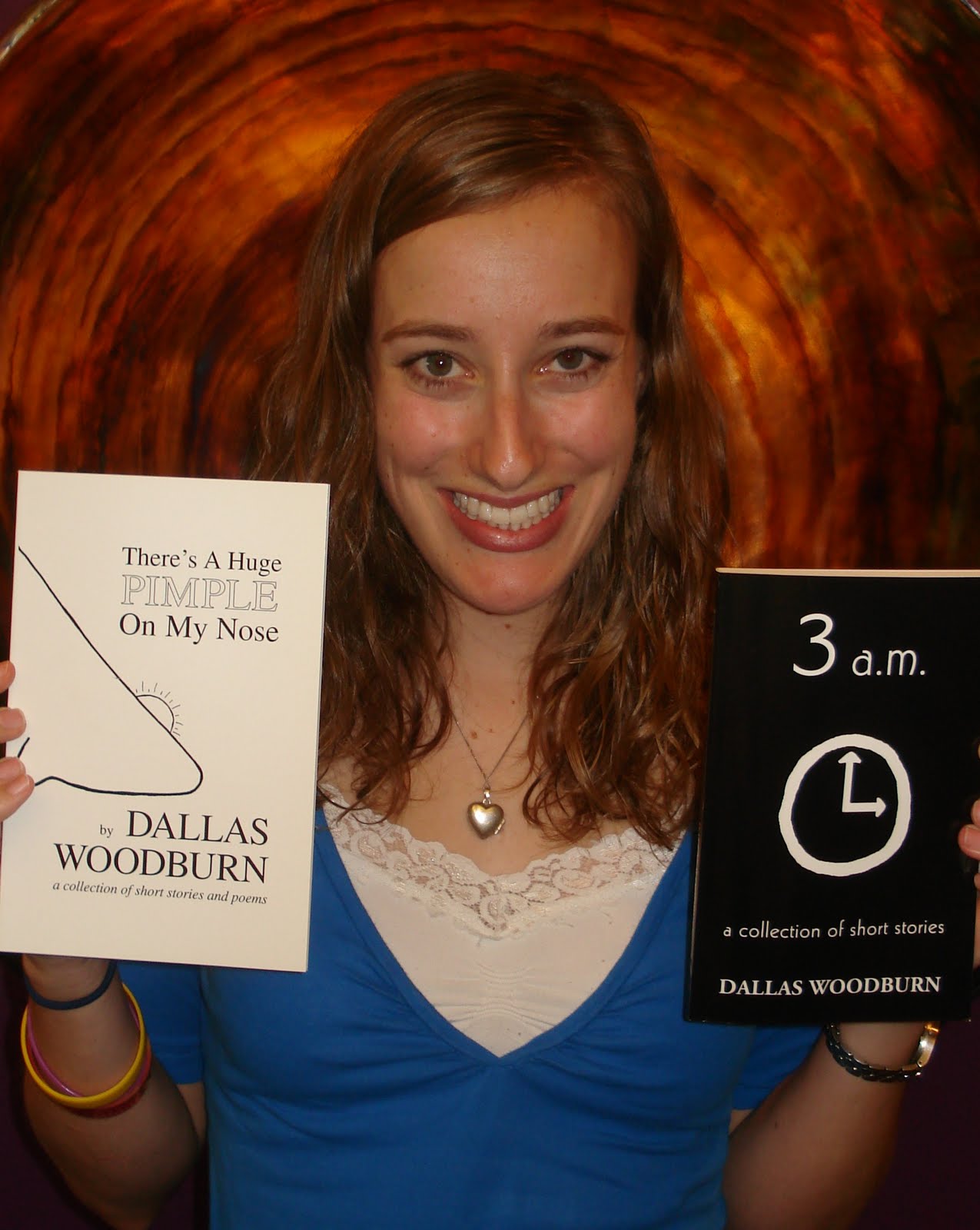
My writing experience: I recently signed a contract with the highly regarded agency Foundry + Media to represent my novel, The Identity Theft of Dani Norhall. I am also the author of two self-published collections of short stories. My first, There’s a Huge Pimple On My Nose, was published when I was ten years old and has now sold more than 1,100 copies; and my latest, 3 a.m., was featured on the nationally syndicated PBS book talk show Between the Lines. I have also written for numerous national publications, including Family Circle, Writer’s Digest, The Writer, Cicada, Justine, Listen, and my work has appeared in four Chicken Soup for the Soul anthologies.
To register or get more information, call me at 805-889-5570 or e-mail me at dallaswoodburn@aol.com.
Students will not only have FUN, they will also learn how to improve central components of their writing, including dialogue, characterization, plot and setting, through various creativity-inducing writing exercises. Poets, playwrights, short-story writers, novelists – all are encouraged and welcome to join!
The cost is $125 per student, but I am offering a SPECIAL discounted rate of $100 to the first ten kids to register. A portion of the money raised will go towards my nonprofit literacy organization “Write On!” (www.zest.net/writeon.)
* * *
Here’s what teachers and students have to say:
“Thank you so much for sharing your story with our students. My fifth graders came back to my room just bursting with enthusiasm. It was wonderful for them to hear from a young adult about her joy of writing. Thank you for encouraging our kids.”
-- Lisa Harvill, Poinsettia Elementary School, 5th grade Language Arts teacher
“What you said really inspired me. I love to write and think that it's really amazing how you published your first book.”
-- Ashleigh, 7th grade student
“Hi Dallas, I'm Bianca. You came to my school today, and let me tell you me and my friends were talking about how much you inspired us to write so I wanted to thank you so much for inspiring us to write.”
-- Bianca Rodriguez, 6th grade student
“Thanks again for taking the time to share your passions and inspire the next generation! I love the connection you make with kids by just being yourself!”
-- Stacy Eckstrom, Poinsettia Elementary School, 3rd grade teacher
* * *
My teaching experience: workshop instructor and coordinator of the Young Writers Program of the Santa Barbara Writers Conference for the past three years; guest speaker at the Jack London Writers Camp in San Jose; online workshop instructor at http://absynthemuse.com; speaker at dozens of schools, ranging from elementary school to high school; teacher of private writing workshops for the past four years. My writing experience: I recently signed a contract with the highly regarded agency Foundry + Media to represent my novel, The Identity Theft of Dani Norhall. I am also the author of two self-published collections of short stories. My first, There’s a Huge Pimple On My Nose, was published when I was ten years old and has now sold more than 1,100 copies; and my latest, 3 a.m., was featured on the nationally syndicated PBS book talk show Between the Lines. I have also written for numerous national publications, including Family Circle, Writer’s Digest, The Writer, Cicada, Justine, Listen, and my work has appeared in four Chicken Soup for the Soul anthologies.
To register or get more information, call me at 805-889-5570 or e-mail me at dallaswoodburn@aol.com.
Subscribe to:
Posts (Atom)