Showing posts with label getting published. Show all posts

Wednesday, January 24, 2018

Interview with Young Author E.K. Baer

Today I am thrilled to introduce you to my dear friend and fabulous poet E.K. Baer, who has recently released her first collection of poetry! It was one of my favorite books of 2017 and one that I think will delight and inspire all readers, young and old. E.K. was kind enough to stop by the blog today to answer a few questions about her writing process, how she finds inspiration, and the steps she took to get published. Enjoy!


What would you like readers to know about you as an introduction? 

My name is E.K, I am 10-years old and I am from Atlanta, Georgia. My best friend is my cuddly dog Coco who inspires me to do silly stuff. I has been writing poems ever since I can remember. Besides writing, I love to sing, play the violin and the piano. Music gives me the tempo and inspiration for my poems and helps transport me to the places that I write about.

Take us through your writing process when you were creating A Collection of Poems

A Collection of Poems started as just a bunch of random poems that came to mind. Writing has always helped me with whatever problems I encountered in my life. When I was writing these poems, it was not with the intent to publish a book. The idea of making it a book formed over the course of several months. It wasn’t until I met Ms. Dallas Woodburn that the possibility of making my poems into a book became a reality. Ms. Woodburn has been such a wonderful mentor! She assisted me in editing all my poems and formatting the book. This collection took me a couple of years to write, edit and publish. I am now thrilled to share it and I hope you enjoy my poems.

What do you like most about writing? 

What I like most about writing is how it is a way to organize your thoughts, to put your life and dreams into a legible form, to spread your creations with the world. Writing is a freeing experience – the satisfaction after your mind races around with inspiration is tranquilizing.

What surprised you the most about the publishing process? 

What I found quite surprising was the amount of work and time that went into publishing just when I thought I was done. ☺ I learned a lot through the whole process. It takes a lot of thought and consideration to figure out the right order of poems, an interesting cover and – hopefully – a good title!


Do you have any advice for other writers, or for other young people going after their dreams? 

Wow, this is difficult because I myself could use some good advice! I feel like some of my best work comes from the times when I do not worry about what other people think or do and when I simply focus on what I am currently writing. I find that it helps me when I can let go of the outside world. I would like to hope that I write some of my best poems when I am ready to describe all my feelings and experiences with pure honesty. I hope that it makes my poems into stories that other people can relate to. I once received a helpful advice about entering my work into contests. The suggestion was to try and put it out of my mind as soon as I click “submit” and try to forget about it. That way I can go on and focus on new work. It is not easy, though, because we are putting ourselves out there every time we share our work. I am still working on it myself.

Can you share a few of your favorite books or authors? 

Some of my favorite authors and books by them are:
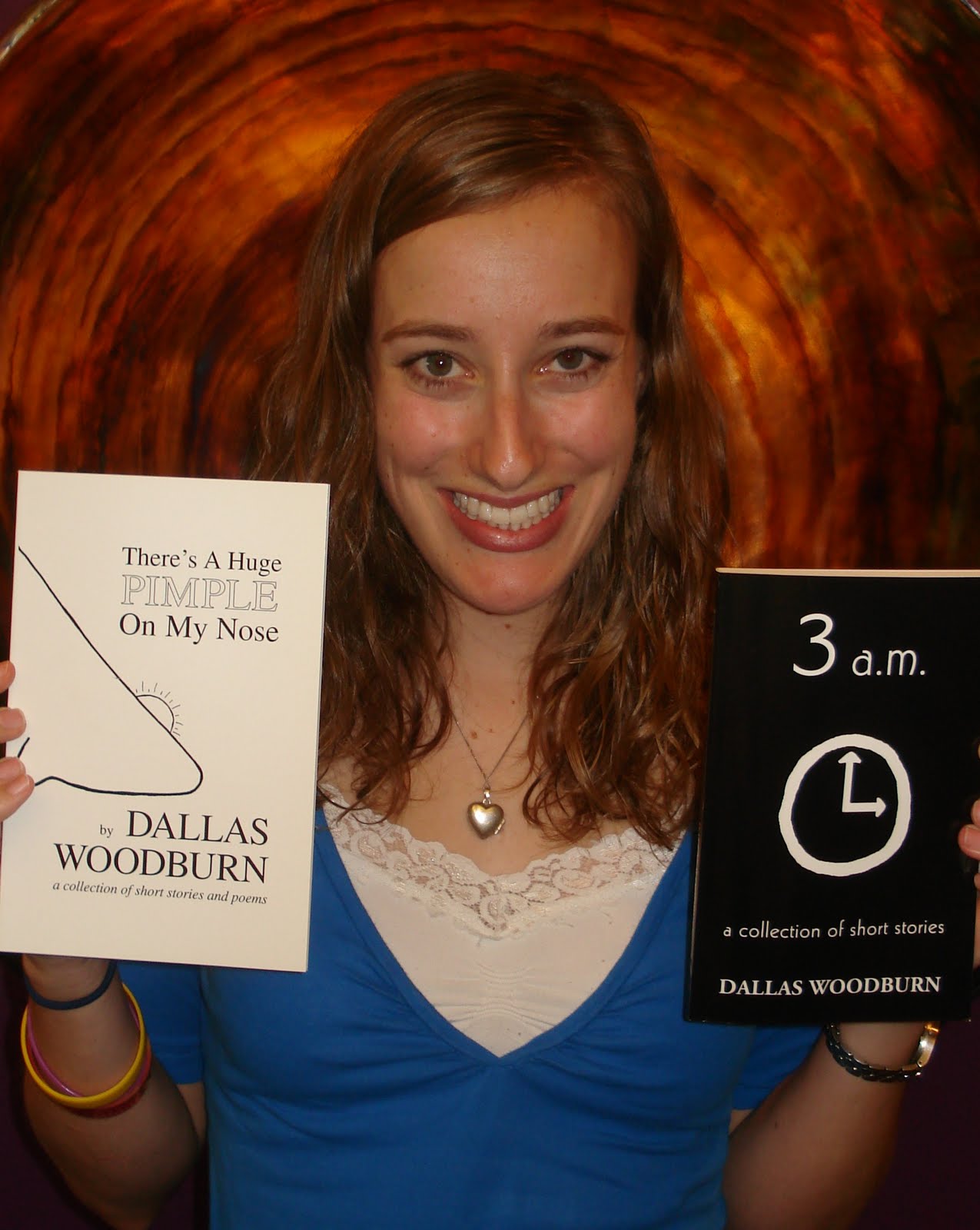
3 a.m., There’s a Huge Pimple on my Nose – Dallas Woodburn
Pride and Prejudice – Jane Austen
Jane Eyre – Charlotte Brontë
A Connecticut Yankee in King Arthur's Court – Mark Twain
The Giver – Lois Lowry
The Count of Monte Cristo, The Three Musketeers – Alexander Dumas
Blue Horses, A Thousand Mornings – Mary Oliver
To Kill a Mockingbird – Harper Lee

What inspires you? 

I am inspired by my favorite authors, as listed above, by the sounds and movement of nature, by my Mom, things people say in the booth next to us at dinner, my dog, Coco, the song of the birds, the whistle of the wind, and a cloud of thoughts. Inspiration never stops rushing to mind. Sometimes it seems as if inspiration is everywhere, floating around in little bubbles, ready to be used for stories or poems, but first you must catch it. ☺

What are you working on now? What’s next for you? 

Currently, I am working on poems for my next book, which I hope to publish very soon! I also continue to submit my poems and short stories to various competitions.

Anything else you’d like to add? 

Thank you for your interest in my new book. I wish everyone the best of luck. Always follow your dreams and never give up!

Links:

Friday, January 27, 2017

How to Get Published: Some of My Advice


Hi, everyone! It's hard to believe it is almost the end of January already! Some of you might have a goal to get published in 2017. One of my writing mentees sent me some questions the other day about publishing, and I thought it would be a great topic to explore a little more here on the blog. Here are her questions, and my answers. The main take-away is that there are a variety of options to publish your work -- all it takes is a little exploring and bravery to find them and submit!

And, if you have a flash-fiction story, essay, or poem you are interested in getting published online, please feel free to send it my way! I am currently accepting submissions for this blog and for the WordSmorgasbord online literary journal.


How do I find a publisher that will publish my book? 

There are some small publishers that you can submit your work directly to -- here is a website listing many of them: http://www.everywritersresource.com/bookpublishers/taking-submissions/

You will want to read through the publisher's website to get a sense of what they are looking for and if your book might fit. For submitting to traditional publishers -- big publishers like Random House and Scholastic, that you see in bookstores-- you need to have an agent. You can find agents listed in books like Jeff Herman’s Guide to Literary Agents and The Writer’s Market, magazines like The Writer and Writer’s Digest, and websites such as www.agentquery.com. When you find an agent you like, you send a "query" to the agent, which is a short letter about yourself, any publishing credits and writing experience you have, and why this book you have written needs to be published. This is where you sell yourself and make the agent want to read your work. Depending on the agent's submission guidelines, you might also send the first couple chapters and a synopsis of your book. After the agent reads this, they will contact you and ask for the entire manuscript if they are interested. And, if they like the entire book, they will ask you to sign a contract! Then they will work with you to revise the book and make it the best it can be before shopping it around to publishers.

Do you have a preference between self and traditional publishing? 

I think both are excellent options -- it just depends on where you are in your writing career and what you are looking for in a publisher. I was very happy to self-publish my first two books, and I learned so much about the industry and self-promotion to have "hands on" experience publishing my own books. Now, I am looking to venture into traditional publishing -- but it is taking quite a long time, for me at least, to break in! I have had two separate agents who believed in my books, but I have yet to get a publishing deal. Of course, some authors get publishing deals much more quickly, but for me at least, the lesson has been that it takes a lot of patience. When it comes to traditional publishing, you can control the quality of your writing, but beyond that it is pretty much out of your control. I think a lot comes down to luck and timing! Here, I have broken things down into lists of "pros" and "cons":

TRADITIONAL PUBLISHING
  • Pros: big-name publishers can help market your book, you don’t pay publishing costs, get an advance up-front, can build a relationship with editors
  • Cons: can get lost in the shuffle, lose control over book, can take a looong time, still need self-promotion!!

SELF-PUBLISHING
  • Pros: relatively fast, you have control over your content and cover design, you can publish what and when you want, platforms like CreateSpace make books available online to a wide audience
  • Cons: it's an investment, you bear costs up-front, self-promotion is vital, you might have a smaller audience for your work 

Do you think it is necessary to have an agent?

For traditional publishing with big-name publishers, yes, you need to have an agent. Those publishers will not accept work that is not submitted to them by agents. However, there are some smaller publishers that do accept work straight from writers, and then there is self-publishing, where you definitely do not need an agent! An agent is sort of like the connection between a big publishing house and a writer. They have established relationships with editors and, when it comes time to sell your book, they are the ones who are able to negotiate your contract. The standard rate is that an agent takes a small commission when they sell your work. They do not make any money if you do not make any money! Since my agent has not sold any of my books yet, she has not made a single penny from me (even though she has put in a lot of work on my behalf.) This just goes to show that if an agent signs you, they believe in you wholeheartedly! It is a neat relationship because you truly are a team.

***An Important Caution: If an agent asks to read your work or represent you, don’t be blinded by your excitement. You want to make sure this agent is the RIGHT agent for you – an agent that will represent you with honesty and enthusiasm, treat you fairly, and work with you to become a better writer. If an agent ever asks you to pay them money to read your work, they are NOT a legitimate agent. Find out about “scam” agents on the website Predators and Editors: http://anotherealm.com/prededitors/

Do you have experience having an agent?

Yes, I currently have a literary agent, who is actually my second agent -- a different agent signed me for my first book, we spent over a year working on edits, but she never felt it was "ready" to send out, and she didn't like the second novel I wrote. So we ended up parting ways and I found a new agent who I really like. Perseverance is KEY. It took me two long years to find my first agent, and another year to find my second agent. I could paper all four of my bedroom walls with rejection letters! Agents told me my book wouldn’t sell because it was too long, too short, too edgy, not edgy enough, I was too young, etc. etc. etc. But I believed in my writing and I believed in myself. I know there is a place for my novel in the literary world – I just had to find my “soulmate” agent who understood my book and who was as excited to find me as I was to find her! As of right now, I have written three novels, and my agent is currently trying to sell the third one. If this one doesn't sell, I will just work on a new novel and hope that one does! Publishing can be very fickle and confusing, and an editor might not buy your book for so many reasons -- they might be having a bad day, or they really like your writing but they already published a similar book, or the name of the main character brings up a bad memory of someone who was mean to them in elementary school. If you are rejected, it does not AT ALL mean that your writing isn't good enough. I have learned, and keep learning over and over, that the most important thing is to believe in yourself and persevere, and to enjoy the PROCESS of writing -- that is what you have control over.

Have you published without an agent?

Yes, I published my first two books without an agent, and they were both wonderful experiences -- I feel like my books were successful and I learned so much from the process! I also publish the Dancing With The Pen series on my own through CreateSpace. I think it is a wonderful time to be a writer because there are so many avenues available to publish your own beautiful, professional books!


Is it important to read the submission guidelines before submitting to an agent?

Yes! There are so many agents and they all want slightly different things, so it is CRUCIAL to read submission guidelines. You don't want the agent to think that you are sending out submissions to hundreds of different agents -- you want them to know that you chose them specifically because you think they will like your work based on what they have represented before. A great way to find agents is to look in the acknowledgments section or on author websites of books you really like that you think are similar to the book you want to publish. Usually you will be able to find the name of that author's agent, and then you can go on that agent's website and see if they are accepting new clients. Then it is really important to carefully read the submission guidelines and follow them when you send the agent your work! For example, some agents want to see the first three chapters; others want to see the first ten pages; some want you to attach your document; others want you to paste it into an email. The rules may seem silly or small, but if you don't follow them, your submission won't even be read!

Do you think there is an advantage to having someone else look at your writing before publishing?


Yes! Again, I could not agree more with this question! I think having someone else -- and it does not have to be a professional editor, it could also be a parent, teacher, friend, or relative -- look at your writing before you publish it is absolutely crucial. They can help you catch mistakes, fix small spelling or grammar errors that your eye skips over because you have read the pages so many times, and also they can let you know if anything is confusing or might be expanded or explained better. Often as writers WE know what we are trying to say, but sometimes things get lost in translation, so it is important to get someone else's perspective. Before you publish anything, you want to make sure it is the best it can be, and having someone else look at your writing is an important step of that process.


Wednesday, June 29, 2016

Interview with "Dancing With The Pen II" Contributor Hope Bolinger

Today we continue our Dancing With The Pen II blog tour with an interview with young writer Hope Bolinger, whose poem "Her Eyes Breathe Life" is featured in the book. Order a personalized copy of Dancing With The Pen II: a collection of today's youth writing here or on Amazon here.


What would you like readers to know about you as an introduction? 

I am a nineteen year old sophomore at Taylor University. I major in Professional Writing and Philosophy. I am from Hudson, Ohio. When I'm not writing or going crazy, I like to sing in choir, do theater, copyedit our school newspaper, and play tennis. I am a Shakespeare nerd and have read every one of his plays.

Describe your piece or pieces that were published in Dancing With The Pen II

Dancing With The Pen published my poem "A Paragon of the 21st Century." The poem describes my mother through uses of sensory imagery. The line "her eyes breathe life" repeats several times, indicating even the breaths I take I owe to my mom. I got the idea for the piece from a Carol Shields quote. She states, “Write the book you want to read.” I altered it slightly to declare, “Write the poem you want to read.” I wanted to read a poem about mothers which engages all of the senses. My writing process most often begins with a little spark that ignites in my mind. No matter what I do, I can’t stop thinking about it. The idea can take the form of a psychological situation or a character with an odd quirk. No matter what shape it encompasses, I must, must, must write. Writer Bob Hostetler would describe me as a “pants-er,” or I ride by the seat of my pants when I write. I often let the characters take me where they want to go. I let them speak their mind for the first draft. Then, my editor speaks even louder for the next draft.

Have you been writing for a long time? What do you like about writing? 

I have written for nearly as long as I could read. In first grade, I would write three to four page stories. In middle school, I experimented with stage plays and had one I wrote performed during my eighth grade year. During my sophomore year of high school, however, I decided to tackle a different kind of giant. My close friend wrote novels, and I would often exclaim, “How in the world can you sit down and write 300-some pages? I don’t have that kind of patience!” The next week, I started my first novel.

To answer the second question requires words that do not exist. I like writing because it helps me explore realms I could never encounter. Words place me in the shoes of characters quite unlike myself. Writing gives me a chance to mold sentences with my hands and swirl bits of the unknown between my fingertips. Most of all, I like writing because I need it almost as much as I need to breathe.

What does it mean to you to have your piece included in this book? 

To have my piece included in this book means I get the honor of joining hands with brilliant wordsmiths. Getting in the news certainly thrilled me, and as my Professional writing professor states, “[I] have been bitten by the writing bug.” The chance to take part in a Dancing With The Pen book gives me the verve to keep writing. I don’t recall doing anything to celebrate, but I do remember the poem evoked tears from my mother. She wrapped me in a hug when she read Dancing With The Pen had published it.

Do you have any advice for other writers, or for other young people going after their dreams? 

Never, never, never quit writing. Even if you receive a thousand rejection slips, defiantly force your fingertips onto that keyboard and type. Harper Lee in To Kill a Mockingbird states, “Real courage is when you know you're licked before you begin, but you begin anyway and see it through no matter what.” Do not deprive the world of your words. They are your words. No one can tell your story quite like you.

Can you share a few of your favorite books or authors? 

Anything by Shakespeare (The Comedy of Errors is my favorite), The Great Gatsby, The Book Thief, and Redeeming Love.

What inspires you? 

People often inspire me. Those who use their weaknesses as strengths or those who laugh in the face of fire. I also owe a thanks to my Lord and Savior Jesus for the ability to write. He is the ultimate Author, and I am grateful He has given me the skills to craft words.

What are you working on now? What’s next? 

Currently, I am editing my latest novel, Lukewarm. In one sentence: In a dream, an indecisive teenager must decide which of his friends lives and which one dies. I also have two other books and a play I plan to write when I finish editing. I want to do a nonfiction piece on ancient philosophers and a contemporary retelling of the book of Daniel. The play will feature the psychological phenomenon known as the chameleon effect.

Anything else you’d like to add? 

Thank you for this opportunity, and I look forward to seeing what the young generations of writers create! For more information visit: https://www.facebook.com/therosewoman/

----------

Hope Bolinger has had her work published in two anthologies for Creative Communications and also participates in theater, choir, the school newspaper, and tennis.


Links: 

Order Dancing With The Pen I & Dancing With The Pen II directly (personalized copies available!) or via Amazon.

If you have a few minutes and could write a review on Amazon, that would be fantastic!

You can also follow Dancing With The Pen on Facebook. We're featured on Goodreads, too!

Monday, July 20, 2015

Interview with the editors of Textploit, a new literary journal for teens


Last month, I learned about Textploit, a new literary journal that exclusively publishes work by young people (writers and artists under age 20, to be precise.) I was blown away by the talent, variety, and sheer bravery of the work in their debut issues. Two of Textploit's editors, Natasha Lasky and Ella Bartett, were kind enough to answer some questions here on the blog today. Their words will no doubt inspire you -- perhaps to submit some work of your own!

Ella

Natasha

Textploit is a literary journal unique from anything else being published today. How would you describe Textploit, and what gave you the idea to start it? Could you give us a peek inside your path to founding this journal?

Natasha: I was drawn to Textploit for one simple reason: most publications for teens are lame. They either feel condescending, like a talent show where adults showcase “teen voices” instead of actually listening to what teens have to say, or they feel dry and elitist, as if a teen writer has to act like a mini-adult in order to be taken seriously. Neither type respects the fact that teens view the world in a unique, raw, even beautiful way, and that they deserve to speak for themselves. Not to mention that most publications only accept writing and art while ignoring music, photography, film, and all the other ways adolescents express themselves. I wanted to help create an online space where teens can be represented with the passion, seriousness, and sense of humor that they deserve.

Ella: We wanted to create a magazine that allowed teens to publish their work without judgment on whatever topic they chose. To echo Natasha, we want teens not to feel like they have to write (or draw) about “proper” adult things. We publish quality work, and we focus on letting teens write what they want to write about. In that vein, we also are online only, which makes all our work easily accessible to our target audience.

In addition to being editors and publishers, you are all writers too. I'd love to hear more about your various writing projects. What inspires you?

Ella: I am inspired by the smallest thing: a conversation on the subway, the way someone holds a pencil, a cool European accent. I take these things and create characters out of them. The stories form kind of on their own from there. Most of my stories are flash fiction, but I attempt poetry when I am in a certain mood, and I love the satisfaction of working on a longer short story.

Natasha: I am inspired by discomfort. Relationships I see, thoughts I have, stories that people tell me -- if it makes me uncomfortable in some way, I can write about it. I wish there was a better word for it than simply “discomfort,” but I’m talking about that area on the emotional spectrum between contentment and extreme suffering, the subtle kinds of pain that we experience every day but that there really aren’t good words for. It makes sense why nobody has come up with the right words for them, because those feelings are the most complicated feelings, and therefore moments of discomfort are the most interesting for me to write about. In terms of genre, I don’t have the brain for poetry, though I enjoy it. I prefer to write essays, fiction, and screenplays. Fiction is the hardest, but I love it the most.

What made you want to become a writer?

Ella: My third grade teacher, Mr. Barloon. We did a mini writing workshop in his class, and I found I loved it. Then, once I began to read great writers like Hemingway or Carver or Lahiri, I began to realize how serious and influential the craft can be. When you share your writing, be it in the form of reaching out for edits or even publishing, you can change someone’s life.

Natasha: This will sound weird and cliche but I feel like writing is part of who I am. I never really wanted to be a “writer,” and I still don’t really know what that means, exactly, to “be a writer,” but I know I’ve always wanted to write. I read obsessively as a kid, and I liked (and still like) that writing has the unique ability to speak to us in the same way we speak to ourselves. When you read a book you can get out of your own mind and live inside the mind of Humbert Humbert or Holden Caulfield or Katniss Everdeen for a while instead. It’s a tool for empathy, in a certain way. I also like spending time alone, in my own head, and writing definitely suits that disposition.

Could you give us a sample "day in the life"? In particular, when/how do you find time to write in your busy schedules?

Ella: That’s tough. I write when I can. Especially for teens now, with all the other pressures we put on ourselves academically and socially, it’s difficult to find a specific time of the day to dedicate solely to the craft. I journal every single night, sometimes for ten minutes and sometimes for half an hour, depending on how early I have to get up the next morning. I also often prioritize writing before other items on the long to-do list, especially when I need the release it gives me.

What is your biggest advice for writers submitting their work, and facing the inevitable rejection that comes along with that? Any tips for submitting to Textploit in particular?

Ella: All art (writing, painting, film, etc.) is so subjective. We are dealing with humans and human experience here. Writing is often so personal that you have to not take rejections personally. Just keep writing/drawing/etc. You’ll find a way to tell your story in a voice that is able to touch more people the more you write. As for Textploit, just be honest. We look for art that speaks to teens, and chances are you’re going through something that another teen is going through. If you illustrate your mind through a haiku, a watercolor, or anything else -- just make sure it tells the truth.

Natasha: Rejection sucks. There’s no way around it. If you really care about your writing, it will feel terrible when it gets rejected. And so I guess my rejection advice would be to feel the sad feelings that come with rejection, but recognize that those feelings are a good sign -- since it means that you love your piece and want people to see it. Then funnel that energy into making the piece better. As for submissions to Textploit, I will just reiterate what Ella says, since she is completely correct (as she often is). Follow that old (perhaps cliche) adage: write what you know. Don’t try and be H.P. Lovecraft or Hemingway or Emily Dickinson or Toni Morrison, just be you and be honest. We’ll love you just the way you are, I’m sure of it.

Why is it important for young people to have a voice in the publishing landscape?

Natasha: The fact is: teens see the world differently, and it’s cool. The liminal space between adulthood and childhood is inherently interesting, and that’s why YA is such a powerhouse genre, that’s why The Fault in Our Stars makes millions of dollars, that’s why we still read Romeo and Juliet. Teen issues are everyone’s issues. And that’s also why it’s so frustrating to me when teens feel like they have to write about “adult things” to be taken seriously. We should let teens speak for themselves about their experience, and respect them for that.

Ella: When young people are able to get their work out “into the wild” so to say, it is not only exhilarating for the artist. It is essential for others to understand what it is/was like being a teen. We want to make an imprint on the world by sharing these stories, to remind people that no, it’s not easy to be in this age group. I agree with Natasha: we think differently. Things that seem insignificant are not. They’re real.


Connect with Textploit:

Monday, May 18, 2015

Interview with Young Author and Entrepreneur Chental-Song Bembry

Chental-Song Bembry is the creator, author, and illustrator of The Honey Bunch Kids series, which she uses to promote literacy and entrepreneurship in youth. The Honey Bunch Kids is a humorous book series for boys and girls ages 7-12. The series follows the adventures of a group of middle-schoolers who learn the meaning of true friendship, respect, and getting along with others. You can purchase her books directly here.

Chental-Song was recently honored at the 2015 BET Honors as an "Early Riser" for her accomplishments as a young author and motivational speaker. Last month, she was honored as a Making a Difference Girl at the 2015 BET Black Girl's Rock awards show for her commitment to community service and education. 

Tell us about your book series THE HONEY BUNCH KIDS. What inspired you to write these books? 

I created The Honey Bunch Kids when I was 10 years old. At this age, I loved to read, write, and I loved to watch cartoons. I created three cartoon characters of my own and called them "The Honey Bunch Kids." When I turned 11, my mother sent me to a writing camp at Middlesex County College, where I wrote a story about my three characters, and I called that story The Honey Bunch Kids. In April 2010, The Honey Bunch Kids was published, and based on the overwhelmingly positive feedback I received from boys and girls, I wrote two more books: The Honey Bunch Kids: School's In Session (Book 1) and The Honey Bunch Kids: School's In Session (Book 2). Throughout each book, I highlight elements of African-American history, group dynamics, teamwork, and problem-solving skills.

In addition to being a writer, you are also a literacy advocate. Why are reading and writing so important, especially for young people? 

After publishing the first book in The Honey Bunch Kids series, I started the "Chental-Song Literacy Campaign," which allows me to travel to schools, libraries, and churches to speak to youth on the importance of literacy, goal setting, and the impact of reading on academic success. I believe that reading and writing are so important for young people because with reading comes knowledge, and with knowledge comes confidence. High confidence levels create the drive to achieve any and all goals in life. Writing allows freedom of expression and a chance to showcase creativity. It is an escape, and when people write, they discover stories inside of them that might have never gotten a chance to be exposed. The better the reader, the stronger the writer. When young people embrace literacy, they will be more inclined to tackle difficult homework assignments, and will be able to converse with others at a higher level. Literacy and education are crucial components to the success of a young person, and this is why I am so dedicated to the advancement of literacy in all children. 

You were a busy student in school when you first published THE HONEY BUNCH KIDS, and now you are a college student. What is your writing schedule? When/how do you find time to write? 

Currently, I attend Hampton University as a sophomore Broadcast Journalism major with a minor in Leadership Studies. Before sitting down to write anything, I make sure that my assignments are completed. I write (and draw) whenever I have the free time, and whenever a great idea hits me. If I cannot sit down at the computer to fully flesh out an idea, I will jot it down in my notes. I usually have more time to write and develop story ideas during Christmas, Spring, and Summer breaks. I always make sure to put energy into my craft each and every day, because energy creates movement in a positive direction.

Very true! What is your biggest advice for people (especially young people) going after their dreams and facing their own challenges in life? 

My biggest advice for young people (and all people) who are going after their dreams is to push forward, never settle, and do not give up. There will always be roadblocks and challenges along your journey to success, but you must remember that each challenge is put in your path to help you grow and develop into a stronger person. Do not fear challenges. Embrace them. Always remember that nothing of greatness comes without struggle. It is through hard work and difficulties that you become humbled and more prepared for the next chapter of your life.

Another piece of advice I have is a quote by Louis Pasteur: "Chance favors the prepared mind." You will only get your greatest opportunity in life when you are both physically and mentally prepared for it. You must always trust God and know that He has ordered your steps, and through Him, you can do all things.


Who are some of your favorite writers? 

Some of my favorite writers include Nancy Farmer, Virginia Hamilton, Zora Neale Hurston, and Maya Angelou. I grew up reading fantastic pieces by each of these authors, who influenced my passion for writing a unique story that all children can enjoy. 

What's next for Chental-Song Bembry? 

As I finish out my remaining three years at Hampton University, I am currently developing The Honey Bunch Kids book series into an animated series and a global brand, which will be featured on a major television network. From the animated series will come more books, and I will continue the literacy campaign I have started.

Is there anything else you would like to add? 

I am so grateful to God for each and every opportunity He places before me. I am looking forward to expanding The Honey Bunch Kids brand into an entertainment source that children around the world will enjoy, because I believe it is so important for all children to have positive role models within their cultures.

Here are links to connect with this amazing writer, illustrator, entrepreneur, and literacy advocate, Chental-Song Bembry:

Thursday, January 26, 2012

Part Two: Interview with Jeevan Sivasubramaniam


I am honored and delighted to have Jeevan Sivasubramaniam as my guest on the blog! I first "met" him on Twitter (follow him @EditorialHell) after becoming a fan of the informative and hilarious monthly newsletters he sends out for Berrett-Koehler Publishers. (Check out their website and subscribe to their newsletter here.) Berrett-Koehler is a publisher of nonfiction books and is a company dedicated to "creating a world that works for all." They are celebrating their 20th anniversary and also have a feature article in the latest issue of Publisher's Weekly: http://www.publishersweekly.com/pw/by-topic/industry-news/publisher-news/article/50199-berrett-koehler-posts-another-profitable-year.html.

Read on for an editor's insights on the writing and publishing process!

Some writers are anxious about today's publishing landscape-- the loss of many independent bookstores, the rise of ebooks. What are your thoughts about publishing today? Any advice for writers, particularly ones anxious about so much change?


The landscape is always changing in media and someone's always complaining. Back in the 1950s when there was a gradual shift to paperbacks, publishers said it was the end of the industry. I am old enough to remember when videotapes came on the market and everyone said that television was now dead because you could fast-forward through commercials so advertising would dry up. Traditional publishing is changing but I think there's a tremendous opportunity here if someone could just figure out the answer to the challenge. The challenge is this: people are reading more today than in any other time in history. They may not be reading books, but they are definitely reading -- mass quantities of it, in fact. Publishers are essentially generators of reading materials, and we are living in a time when people are reading more than ever before. Do you see how frustrating that is? Ideally, this should be our time to shine, not crash. So, writers, don't be anxious, but be innovative and don't restrict yourself to traditional mediums. Look what Amanda Hocking did by being innovative about how she created a market for her writing -- and sold over a million copies of her book (http://www.guardian.co.uk/books/2012/jan/12/amanda-hocking-self-publishing).

For you as an editor, what makes a writer great to work with?

A genuine openness to guidance. I understand why writers are hesitant about letting someone get involved with their writing. Writing is the most personal thing we can create and we're inevitably going to be very protective and guarded about it. That said, you have to trust the editor because, quite honestly, you can't trust yourself. This is why surgeons don't operate on their own family -- a level of distance and objectivity is needed to really assess and edit a project and a writer's over-protectiveness is not going to help. Just as the even the best surgeon in the world will hand the scalpel over to a trusted colleague when it comes to operating on a family member, writers need to listen to their editors. Remember that an editor's job is to make the book the strongest it can be and so make the author look the best he or she can be. Editors' names do not appear anywhere on the book (unless they are specifically thanked in the acknowledgments) and no will ever know their role in creating a book, so authors should understand that editors are not in this business for personal gain or fame. They genuinely like what they do.

Do you have some favorite books that might be helpful for writers to read?
  • Elements of Style has always been the primer for any writer, I think.
  • On Writing Well by Zinser
  • And of course the instruction manual for language, The Chicago Manual of Style (though I hate that they keep revising it annually).
  • Also, my friend and author Mark Levy's book Accidental Genius: Using Writing to Generate Your Best Ideas, Insight, and Content.
Is there anything else you would like to add?

I was thinking of something clever to say here but I think that if I really wanted to help your readers, I would be better off saving the pithy remarks and instead saying I am happy to take any questions and will do my best to answer them. Just email them to me at jsiva@bkpub.com and in the subject line, say "Question after reading Dallas' blog interview" so I'll know it's one of your folks.

Wednesday, January 25, 2012

Interview with Jeevan Sivasubramaniam, Managing Director, Editorial at Berrett-Koehler Publishers, Inc.

I am honored and delighted to have Jeevan Sivasubramaniam as my guest on the blog today! I first "met" him on Twitter (follow him @EditorialHell) after becoming a fan of the informative and hilarious monthly newsletters he sends out for Berrett-Koehler Publishers. (Check out their website and subscribe to their newsletter here.) Berrett-Koehler is a publisher of nonfiction books and is a company dedicated to "creating a world that works for all." They are celebrating their 20th anniversary and also have a feature article in the latest issue of Publisher's Weekly: http://www.publishersweekly.com/pw/by-topic/industry-news/publisher-news/article/50199-berrett-koehler-posts-another-profitable-year.html.

Read on for an editor's insights on the writing and publishing process!


What would you like readers to know about you as an introduction?

Well, I'm the Managing Director for the Editorial Department here at Berrett-Koehler Publishers. I do work on acquiring a project or two here and there but by and large I am the chief administrator for the Editorial Department and handle a lot of the inter-departmental stuff. People never think of editorial departments as having administrators, but they actually need it more than anyone else because a company lives or dies by the acquisitions and decisions the editorial department makes. I am responsible for tracking all projects, drafting contracts, administrating editorial reviews, overseeing signings by the editors (and meeting various signings goals), handling author relationships, inter-departmental communications, legal and copyright concerns, communications with various Library of Congress offices, and a few other boring things. I am also given some leeway to do the initial legwork on acquiring some promising projects and authors and I usually pull in about two or three a year. Because I don't have a quota of signings like the other editors, I can be very selective and hold out for the most promising authors -- a luxury few editors can afford.

How did you get interested in editing and publishing?

I was originally interested in intellectual property and legal documentation but slowly gained an interest in copyright and publishing legal issues during my time with a legal services company after graduation from college. In grad school I worked with a professor as a graduate research assistant and her big task for me was to find a publisher for an anthology of plays by women from around the world. I had to educate myself as I went along and it was quite exciting. It was also downright frustrating as I saw how publishers can treat authors. Almost all authors you meet have an adversarial relationship with their publisher -- as if they consider each other as necessary evils. I felt publishers could do better, and also wanted to be a part of a better publishing model.

What grabs you as a reader?

A compellingly different way of looking at things. I say "compellingly" because just seeing something in a different way is not enough. As human beings, we are programmed to see things differently whether we like it or not -- that in itself is nothing too exciting. But some people see things that almost contradict what everyone else sees. To give an example, there are so many books on how to act on the here and now -- how the past is not relevant, only the present moment and what you choose to do with it. Then I met an author who actually felt that was simplistic and wrong. He felt that the past was the most valuable tool we had to shape our futures -- that the lessons from our regrets and things we would rather not think about are most important to this exercise. I liked that he was not afraid of going up against an entire movement (you know which authors I'm talking about and you know how big they are) and challenging how they advised people to do things. A colleague once told me that I'm always looking for a good fight when it comes to the books that I like. I think his assertion was spot-on. I like books that create trouble and make people question what they thought they knew.

Check back tomorrow for PART TWO of my interview with Jeevan!

Saturday, March 26, 2011

Opportunities for Young Writers

  • The Stories for Children Magazine is in need of poetry and craft submissions for our May, Summer and Back-to-School issues. We are also always looking for submissions from youth authors ages 17 and under. If you have any wonderful ideas you would like to share with us or know of a talented writer who might be interested, please pass this info on. The Stories for Children Magazine guidelines can be found at http://storiesforchildrenmagazine.org/Guidelines.aspx
  • Call for Scripts, VSA Playwright Discovery (Washington, D.C.) VSA invites middle and high school students to take a closer look at the world around them, examine how disability affects their lives and the lives of others, and express their views through the art of playwriting. Playwrights may write from their own experience or about an experience in the life of another person or fictional character. Scripts can be comedies, dramas, or even musicals - be creative! Deadline to submit is April 15, 2011. For more information, please visit http://www.vsaarts.org/x244.xml
  • The Etheridge Knight Poetry Contest for Young People was established in conjunction with the annual Etheridge Knight Festival that honors the work of the acclaimed African American poet Etheridge Knight and to further as established to honor the work of acclaimed African American poet Etheridge Knight and to encourage understanding of the things in life that troubled him and that he held dear. Deadline: March 18, 2011. For guidelines and writing exercises visit http://www.indianawriters.org/knight.html
  • Night of Vonnegut Writing Contest: The Kurt Vonnegut Memorial Library is holding our second writing contest. We are asking you to tell us why you think that Kurt Vonnegut's writing is just as relevant today as it was 40 years ago. The first place winner will receive two tickets to "Night of Vonnegut" on April 16. First, second, and third place winners will have their essays posted on the KVML blog. Please keep your entries under 1000 words and include a cover sheet with your contact information. Winners will be contacted April 8. Thank you for your participation and continued support. We look forward to reading your entries!
  • Send your essay by March 25th to Rebeccah Glass Lowe, Kurt Vonnegut Memorial Library, The Emelie Building, 340 N. Senate Ave., Indianapolis, IN 46204 or to Corey Dalton at corey.dalton@vonnegutlibrary.org
  • Norman Mailer High School Writing Awards: Free contest for currently enrolled high school students; offers $5,000 and a trip to NYC for the award ceremony. 2011 genre is creative nonfiction. Submit one or more essays, maximum 10 single-spaced pages total, through their online form. http://www.ncte.org/awards/student/nmwa
  • Sylvia Burack Writing Award: Recommended free contest for personal essays by 11th and 12th grade students in the US or Canada. Prize is $500 and publication in The Writer, a monthly magazine with advice and markets for creative writers. Submit a 600- to 800-word personal essay in English on the theme of a "work of fiction, poem or play that has influenced you. Discuss the work and explain how it affected you." www.writermag.com

  •  

    Tuesday, May 25, 2010

    Websites of Interest for Young Writers

    Markets for young writers:

    * Prufrock Press, Inc. is looking for the very best material by students (ages 8–16). Material may include cartoons, songs, stories between 500 and 1200 words, puzzles, photographs, artwork, games, editorials, poetry, and plays, as well as any other creative work that can fit in the pages of the magazine. http://www.prufrock.com/client/client_pages/prufrock_jm_ck_wg.cfm

    * CyberKids is looking for stories, poems, articles, pictures, and other creative work. They do not pay for submissions, but if they use your work, they will send you an email telling you when it will be published. http://www.cyberkids.com/he/html/submit.html

    * About Teens publishes articles, short stories, essays, book reviews and jokes. http://www.aboutteens.org/submissions.htm

    * Fantasy & Science Fiction Magazine is a great place to send fantastical short stories: http://www.sfsite.com/fsf/glines.htm


    Resources for young writers:

    * Write Away: a forum with writing prompts, contests, author interviews, book reviews, and more. http://www.writeaway.org.uk/content/blogcategory/16/28/

    * Teenage Writers: an online community for teen writers. http://teenagewriters.com/forum/

    Monday, May 17, 2010

    Interview with Gayle Trent

    I am absolutely delighted to have Gayle Trent join us today! Gayle writes the Daphne Martin Cake Decorating Mystery series for Bell Bridge Books. The second book in that series is Dead Pan. Both Thorndike and the English publisher BBC Audiobooks will be releasing the first book in that series, Murder Takes the Cake, in large-print, hardcover format in the coming year. Gayle also writes an embroidery series under the pseudonym Amanda Lee for NAL/Penguin. The first book in that series is due to be released in August of 2010.

    Gayle was kind enough to answer some questions about her life as a cozy mystery writer.

    First of all, what exactly is a "cozy mystery"?

    Cozy mysteries usually take place in a small community and involve a relatively small number of people. The reader knows that someone within the intimate group will turn out to be the killer. Think Desperate Housewives with one of the cast turning out to be the killer as opposed to Criminal Minds or CSI. Cozy mysteries also feature an amateur sleuth as opposed to a professional detective, and the heroine has an interesting profession or hobby.

    Tell us about your book Dead Pan.

    Dead Pan is the second book in the Daphne Martin Cake Decorating Mystery Series. When the book opens, a police officer is questioning Daphne about a cake she took to the Brea Ridge Pharmaceutical Company Christmas party. Many people at the party got sick, but most recovered after being treated with a vaccine manufactured by the company. Only one, Fred Duncan, went into a coma and died. Coincidence? Or did somebody have it in for Fred?

    What would you like to overhear people saying about your book?

    "I laughed so hard when--" A local book club selected Murder Takes the Cake as one of their books, and when I attended the meeting I was delighted to hear that they thought this or that part was funny. I also love it when people say, "I never guessed ______ was the villain." Also, there was a review where a woman said she loved the main character's relationships with various members of her family -- that they were beautifully or realistically drawn. I felt like, "Oooh, she got it!" Actually, I'll take anything that's not negative. :-)

    What inspired you to write Dead Pan?
    I was reading an article in Wired magazine about clinical drug tests. I did some further investigation, and I came across some fascinating stuff.

    Do you have any advice for new writers?

    Read the genre you're interested in writing. For instance, when my agent pitched my first three chapters of the embroidery mystery to the editor, the editor said she liked it but didn't love it. I needed to revise it to make her love it in order for her to buy the book. I asked my agent who the editor had published recently. With two names in hand, I went to the bookstore and bought two books. I read them and found they were more descriptive than my own books. I went back, added more description and gave the heroine a bit more spunk, and the book sold. Sometimes you have to be flexible.

    Any funny writing stories to share?

    I once tried to "write" using my laptop's voice recognition feature while baking brownies and peeling potatoes. Great multi-tasking, right? BUT, there is a drawback to using voice technology gadgets when you have a Southern drawl. Although, the exercise helped me get unblocked and continue on through the chapter I was struggling with, the computer misunderstood most of what I said. AND, to add insult to injury, when I read back over what it said and laughed, the computer translated that as "a a a a a a a a."

    Last but not least, do you have a favorite quote that inspires you on those hard-to-write days?

    "It's not enough to stare up the steps. You must step up the stairs." – Vance Havner


    Thank you, Gayle! It was a delight to have you join us!

    For more information about Gayle or to order her books, visit her website and her blog.

    Also I know Gayle will be stopping by the blog today to answer questions, so please don't hesitate to leave your comments! You can also share the love on Twitter by retweeting this post -- just click on the button below. :)

    Wednesday, March 24, 2010

    Markets for Young Writers

    Thanks to Writer's Gazette for calling my attention to these markets for young writers! (Note: I am not endorsing these publications in any way. But they are opportunities to check out if you are interested!)

    * Benchmark Group
    We want talented young writers who speak clearly to their generation. Following the guidelines doesn't necessarily mean that you will have a publishable manuscript that will be accepted. Some things can be taught about writing, but we believe that there is a definite gift that all good writers have. We are looking for the best young writers we can find. Our editors will have final say about whose work we publish. (If it comes to our attention that one of our authors or a potential author is involved in any immoral or illegal situation that is of their own choosing, we have the right to pull their published book(s) and/or to not publish what is being considered.)

    http://www.benchmarkgrouppublishers.com/Writers_Guidelines.html


    * Young Christian Writers
    PAY: $10 - $20
    We are interested in short stories, articles, poetry, and book reviews written by Christian students (ages 12-18). To be considered as a book reviewer, please send us a sample of a book review that you have already written. Then if we are interested in your work, we will contact you with the title of a book that we would like you to read and review for our magazine. Also, see our Book Reviews page for important tips. Your work should be guided by Christian themes such as: truth, honesty, humility, love, kindness, faithfulness, purity, courage, service, obedience, honoring parents, Creation, sanctity of human life, and the sovereignty of God.

    http://www.youngchristianwriters.com/guidelines.htm

    Friday, December 4, 2009

    Advice for Young Writers

    Can young writers get published?

    ABSOLUTELY!

    Here is a great article, "Get Published: Advice for Young Writers" from PublishingCentral.com: http://publishingcentral.com/articles/20061005-87-4509.html?si=1

    Publishing Central is a terrific resource for writers of all ages.

    Happy writing!

    Wednesday, December 2, 2009

    Interview with "Ella Enchanted" author Gail Carson Levine for TweenParent.com

    Newbery Award winning author, Gail Carson Levine, talked to TweenParent.com about her experiences as a young adult novelist and shared advice for aspiring writers. As well as penning Ella Enchanted, Fairest, Dave at Night, The Wish, The Two Princesses of Bamarre and the Princess Tales among others, Gail also wrote Writing Magic: Creating Stories That Fly to help young authors avoid writer's block and develop a process. If your tween is interested in creative writing or is a fan of Gail's books, we highly recommend sharing this article with them.

    How did you start writing? Did you always want to be a writer?

    I wrote as a kid, but I never wanted to be a writer particularly. I had been drawing and painting for years and loved that. And, I meditate. One time when I was meditating, I started thinking, "Gee, Gail, you love stories - you read all the time. How come you never tell yourself a story?" While I should have been saying my mantra to myself, I started telling myself a story. It turned out to be an art appreciation book for kids with reproductions of famous artworks and pencil drawings that I did. I tried to get it published and was rejected wholesale.

    That book led me to a class on writing and illustrating for kids, and when I went into it I thought that I would be more interested in illustrating. But I found that I was much more interested in writing and that I didn't like the illustrating at all. I had always been the hardest on myself when I drew and painted. I am not hard on myself when I write. I like what I write, so it is a much happier process.

    That's how I got started. And then everything I wrote was rejected for nine years.

    Read the rest of the interview at: http://www.tweenparent.com/articles/view/205

    Saturday, August 15, 2009

    Today's Teen Writer: A Fabulous Resource

    Today's Teen Writer is a wonderful online magazine for young writers, chock-full of information about writing queries, finding inspiration, editing drafts, dealing with rejection, and getting published.

    Here is their goal, in their own words from their website:

    “If you have built castles in the air, your work need not be lost; that is where they should be. Now put foundations under them.” ~ Henry David Thoreau

    Our goal is to provide you with the tools to put foundations under your dreams. Whether you want to break into non-fiction or simply write novels for your eyes only, Today’s Teen Writer will be right here to guide you in the process.

    I am honored to be featured on the Today's Teen Writer website. You can check out my interview here:

    http://www.todaysteenwriter.com/current-issue/08/2009/dallas-nicole-woodburn-on-self-publishing