Showing posts with label a picture is worth. Show all posts

Wednesday, August 10, 2016

Savoring the Anticipation

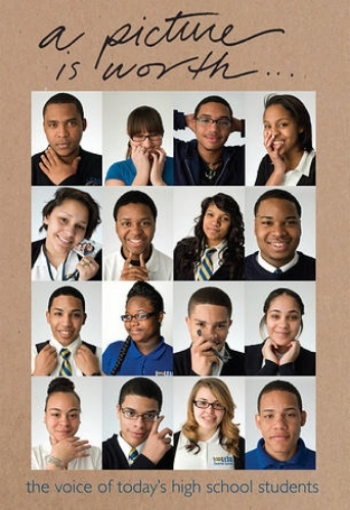
One of the most striking and moving aspects, for me, when reading the beautiful book a picture is worth... (Arch Street Press) is getting to hear the unfiltered voices and perspectives of these young adults, smack in the middle of growing up. They write with insightful reflection about their pasts, and their words ache with excitement for the future when they share their goals and dreams -- graduating high school, attending college, having a family and home of their own.


In her essay, Betania Robles writes:

"I would like to say that at the moment I am at the awkward stages of being a teenage girl. Some days I'm happy and some days I'm extremely sad and depressed, and sometimes both at the same time. I don't know if that's normal but I am pretty sure those weird feelings will pass by as I grow up. I'm pretty goofy. I love boy bands and random things like that, and the Internet has to be one of the best inventions ever. It has caused me much happiness and provides me with things that the outside can't. I also love reading; it is like I enter a stranger's world and I learn and feel their feelings. That is truly amazing. Call me ridiculous, but I'd rather read than go outside sometimes, and because of books I believe in true love."
Reading Betania's essay took me back to my own teenage days -- the newness of adventures, the excitement of the wide-open world, the daily dramas and jokes and loves. In all of the narratives in the book, glittering details about these teens' present lives stuck out like treasure: close-knit friends at school; chaotic dinner tables with their parents and stepparents and siblings; favorite teachers and subjects; the neighborhood and community they have always known. I wanted to reach in through the book and tell the young authors: this time of your life is beautiful, too! Savor it. It will fly by faster than you can imagine.

* * *


In three and a half weeks, I am getting married. Life is a whirlwind of tasks, questions, and to-do lists. I wake up in the middle of the night to scribble notes to myself that are only sometimes legible in the morning: song for recessional? cupcake labels? check with minister about kiss timing. My brain is flooded with details and planning and more details. I feel constantly abuzz with nervous energy, my stomach a flurry of butterflies.

And at the same time, I have never felt more ready for anything in my life.

I cannot wait to marry my sweetheart and officially join our lives together. Yet I am savoring this anticipatory time, too. In the midst of the chaos and craziness, I stand in the middle of our one-bedroom apartment, crammed with wedding gifts and decorations and half-completed craft projects, and smile with giddy contentment to be here, now, in this glorious mess and in this perfectly imperfect moment. There is something delicate and beautiful in these final days before we hold hands and leap together into the unknown.

* * *

When I was in college, I lived in an apartment with three of my best friends. Every year, we threw a big holiday party the weekend before winter break. Our anticipation was born right after Thanksgiving. We spent hours planning the party: sending out invitations, shopping for refreshments, deciding on party favors and music. We cut out paper snowflakes and hung them from our ceiling; we strung up twinkle-lights; one year we even managed to get a “Charlie Brown” Christmas tree on super discount at a tree lot, and we decorated it until it was more tinsel than tree. I would be so excited for our party that time seemed to drag on as I tracked its glacier-slow approach on my calendar.

And then, suddenly, it was the day of the party. There was always a flurry of last-minute preparations: baking cookies, making peppermint hot chocolate, wrapping presents. Every year, the party itself passed in a blur of friends and laughter, dancing and singing, photos and hugs. Within three or four hours—the blink of an eye, it seemed—our party was over. We’d wave goodbye as our last guests headed out the door, and then my three best friends and I would be left standing in our empty apartment with a mess to clean up.


It’s hard not to feel a little sad in those moments, when all the anticipation is over, and life resumes to normal. It can feel like the magic is gone. But, looking back, my favorite memories from those holiday parties are not the parties themselves, or even all the anticipation and preparation. The memories I cherish the most are from the mornings after the parties, when my roommates and I would eat scrambled eggs—ignoring the dirty dishes and overflowing trash can for a little while longer—and talk all about the amazingly fun event we had just hosted.

Because, yes, there is joy in the anticipation. There is joy in the savoring. But there is also joy in the telling, the retelling, and the remembering.

"The world is shaped by two things: stories told and the memories they leave behind." — Vera Nazarian

Thursday, March 10, 2016

Reading My Mind Through The Words of Others

{Photo credit: D Sharon Pruitt}
Dylan Thomas said, “The blank page is where I read my mind.” Additionally, as writers—and, indeed, as people—we can learn and grow a great deal by reading the minds of others. In the forthcoming months on this blog, I will be posting about a few books that have taught me a great deal.

From The Collected Stories of Lydia Davis, I have learned that a story can be as short as a paragraph, yet still feel complete and connect with the reader in a deep, visceral way. Davis’s piece “The Sock” is one of the most emotionally stunning stories I have read, even though it is only two pages long. Part of what makes it so affecting is that the crux of the piece hinges on a description of a sock—something so ordinary and even a bit distasteful. Who wants to read a vivid description of a smelly, sweaty sock? Yet this is precisely what gives the sock its power as an object: it is so utterly personal, like underwear but without the sexual connotation. The main character is a divorced woman and the sock is used to characterize her ex-husband. Even more poignantly, the sock provides a glimpse into their relationship, as the woman remembers the countless times she had picked up her husband’s socks in all their years together. The juxtaposition is striking; she intimately knows how he takes off his socks while reading in bed (she describes his feet resting together “like two halves of fruit”) and yet now they are living separate lives, and he is married to a different woman.


In this story and others, I like that Davis doesn’t spell everything out for the reader; questions about her characters linger afterward. Often after finishing one of her stories, I immediately want to go back and read the story again. Even months after reading "The Sock," the main character has stayed with me. In my experience, the best stories are like that; they stick with you long after the book has been closed and put back on the shelf. 

Other stories that have stayed with me are those in the beautiful book a picture is worth…(Arch Street Press). The words of these sixteen young adults are incredibly poignant, honest, and filled with raw emotion. I am most struck by their mature insights and deep reflections on their lives, both the joyful and painful memories.


Betania captures the mingling of excitement and frustration that comes with artistic expression: “Just a couple of days ago, a professor from New York came and she taught photography and how to tell stories through pictures. … [She] got the school to provide us with cameras and she took my classmates and me out to our community to capture pictures. I loved the program and you really get to see that anything can be picture-perfect and everything is beautiful in its own little way. It made me see my community differently and I appreciate her for that. I didn’t like my pictures; at the moment that I captured the photos I thought they were amazing but then when I saw everyone else’s, I lost all hope in my pictures” (pg. 95). I think every artist has felt that sinking tug towards “the comparison trap”—you feel delighted with your work initially, but then at some point your internal critic takes over and suddenly it seems that everyone in the world is more artistically gifted than you are. I wish I could tell Betania: your photographs are perfect because they were created by the one-and-only you! 

Ashley’s story of resilience and strength is incredibly moving. She describes cutting the word “crazy” into her arm after being bullied in school and being made to feel like an outcast. She describes moving from town to town, school to school, and battling depression: “I was simply a shell in my own life: looking pleasant on the outside but empty inside. All I wanted was for someone to come up to me and tell me that they knew exactly what I was going through and how I felt. I wanted them to tell me that they had a solution, but that didn’t happen. Why didn’t anybody just ask me how I was or how I felt?” (pg. 24). A common theme that runs through many stories in the book is a yearning for care and compassion. In this way, the book expands into not simply narratives about what it is like to be a young person in the world today, but rather what is means to be human. For this is a crucial aspect of our common humanity: wanting to be loved and seen and heard and understood.

{image credit}
Eventually, Ashley manages to reach out for help and begins to make more connections at school. She writes she has “come to realize that things always get better. Everyone has to go through hard times, some harder than others, but in time cloudy skies will clear away.”

 Hope for the writer, and hope for the reader, too.

Friday, May 8, 2015

Finding Your Voice as a Writer

“Words mean more than what is set down on paper. It takes the human voice to infuse them with deeper meaning.” –Maya Angelou 


How do I find my writing voice? This is a question I hear often from writers of all ages, and especially from young writers. And it is very closely related—indeed, I would say it is interwoven—with other important questions, such as:

  • How do I get “unstuck” when I am struggling with writer’s block? 
  • Will other people think my ideas are interesting enough? 
  • What do I have to say that the world will care about? 
Developing your voice as a writer is akin to developing your voice as a human being, as a global citizen of this one world we all share. Cultivating your own unique writing voice will resonate in all aspects of your life. It requires you to reflect on what you believe and how you feel comfortable sharing those beliefs with others. What feels natural to you on the page? What captures you most fully and truthfully?

All writers begin as readers, and when we first begin writing it is natural for us to write like—for our voices to sound like—the writers we most love and admire. The first pieces I ever wrote were Dr. Seuss-like poems; years later, in college, I was still honing my writing voice, working on magical-realism short stories inspired by Aimee Bender and George Saunders. Gradually, as I have grown and learned and developed as a writer—and as a person—my own true voice has emerged more and more clearly.

Now, when I sit down to write, I don’t sound like anyone else. I simply sound like me.

The process reminds me of breaking in a pair of shoes until they fit your own individual feet perfectly. You can even use your speaking voice to develop your writing voice! How? If you feel stuck, a great strategy is to “talk through” your idea to a friend or teacher. Better yet, talk it through to yourself by recording your thoughts—you can buy an inexpensive tape recorder or digital recorder, or many smartphones have free apps you can download.

Why does this strategy work? Speaking often feels like “less pressure” than writing; the more pressure you put on yourself to write, the harder it can be. Many people feel more comfortable talking out a story or essay instead of trying to write the words down on paper. Once you’re done talking it through, play back the audio and write down, word for word, what you said. Now you have your authentic voice down on paper, and you can edit and shape it as you wish!


The engaging and inspiring book, a picture is worth… the voice of today’s high school students (available from Arch Street Press) used a similar strategy to help the students develop their essays for the book. The sixteen students featured in this outstanding collection write about everything from their families to their faith, from their communities to their experiences in society as a whole, from their past histories to their dreams for the future. In order to craft their essays, each student told their story to an interviewer, preserved it as a recording, listened to it and shared it, and—yes—captured it in written words. But the writing down of the story was simply one strand of a larger web of storytelling, connecting, and sharing.

In the introduction of a picture is worth…, David Castro and Alisa del Tufo write: “Particularly within the personal essay form, good writing demonstrates voice. … [B]eginning with each student’s voice, this project grounds itself in the essential strength of the spoken word as a harbinger of awareness, creativity, and human connection.” By discovering and defining your own voice as a writer, you are then able to engage with the voices of others—and that is how meaningful conversations happen and true connections are born.