Showing posts with label habits. Show all posts

Sunday, April 10, 2016

Writing Lessons from a Maxed-Out Yoga Class

As I mentioned in a previous post, I recently moved to a new apartment. Habits researcher and author Gretchen Rubin writes, in her book Better than Before, that an excellent time to adopt new habits is when undergoing a shift or change in your life: a break-up, a new relationship, a new job, a home renovation, etc. Moving to a new place, it turns out, is actually the #1 time to successfully adopt new habits! So I leaped upon the opportunity to try cementing some new healthy habits that I had been wanting to fully integrate into my life.

Image source
One of these habits is going to bed earlier, so I can wake up earlier feeling refreshed and ready to tackle the day. Another is to focus on simplicity; I did a huge purge of clutter and papers before I moved, and I want to keep these nonessentials from slowly re-accumulating in my life, as they so often do. Also, I now begin every morning with two big glasses of water and a green smoothie. I try to write at least a couple hundred words on my creative work-in-progress each morning before I even check my email or work on projects for other people. And I am trying to set in stone a regular routine of going to the gym.

I belonged to a gym close by where I used to live, and I would go there fairly regularly, but it was never something I especially looked forward to. I could never figure out why. It was a nice gym, with lots of classes available and fancy amenities. I realize now that I did not fully feel comfortable there; the atmosphere was a bit competitive and intense, and I prefer my gym time to be low-key and low-stress. This new gym I joined by my new apartment is much less fancy, but much more my vibe: like me, the people who go there seem friendly, a little rag-tag, and much more interested in exercising for good health than for looks.

One of my favorite classes is a Monday morning gentle yoga class. The instructor is funny and upbeat, and the class always flies by and is the perfect way to ease into my week.

Lots of other people must think so, too, because the class is pretty much always filled to capacity. Classes work on a first-come, first-serve basis; when you arrive at the gym, you can ask for a pass to get into the class, and if they have any more available the person working the front desk will hand a pass to you. If not, you're out of luck!
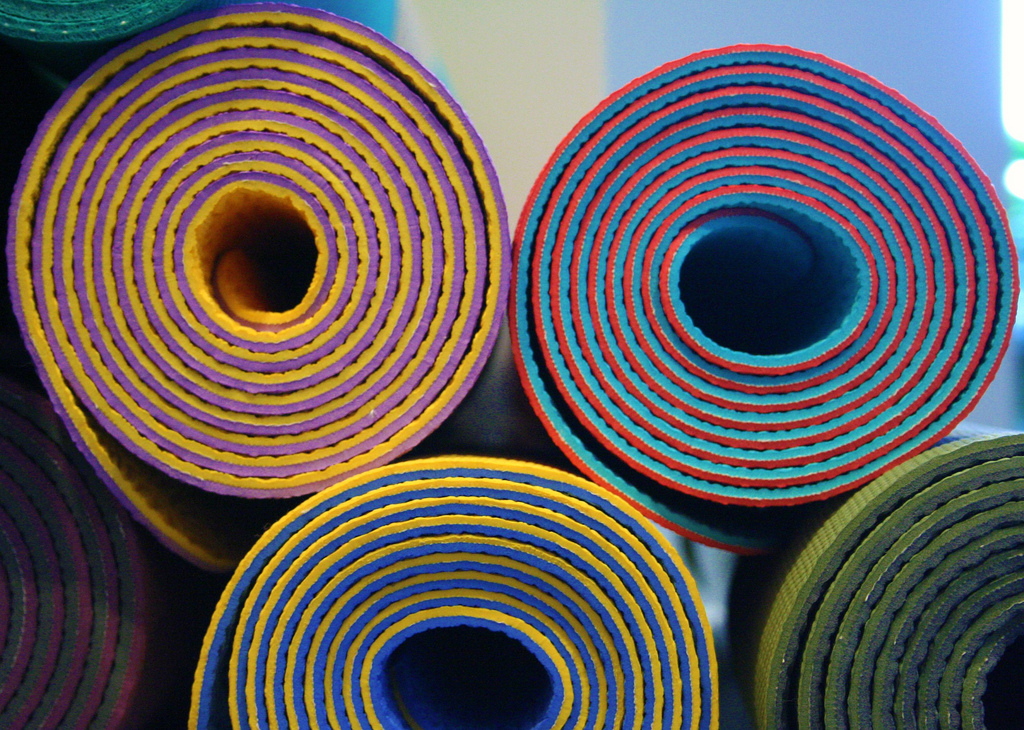
Photo cred: tricsr4kidz, Flickr Creative Commons
One week, I was a little late getting out of bed and, even thought I arrived to the gym ten minutes before class was scheduled to begin, they were all out of passes. Rats! I thought, but it was not a big deal. I stashed my yoga mat in the locker room and worked out on the elliptical machine instead.

When I was leaving, about twenty minutes before the class was scheduled to end, another woman was standing by the front desk holding a yoga mat of her own. She spotted my yoga mat and summoned me over. "Were you kicked out of the class, too?" she asked.

"Well, I wasn't kicked out... there just wasn't enough room when I arrived."

This woman shook her head angrily. "It's not fair! They should have two classes! I got here at the time the class was supposed to start, and I wasn't able to get into the class! They kicked me out! It's not fair!" She was like a toddler having a tantrum, blaming everyone else but herself for her predicament.

The manager behind the front desk met my eyes with a helpless expression. I realized this other yogi had probably been angrily complaining to her for the past half hour. And now she was trying to get me to gang up on the manager about the completely fair gym policy.

"It was my fault," I said, shrugging. "I should have gotten here earlier. But I still had a great workout anyway!" And then I smiled at the manager and headed out the door. I could still hear the other woman sputtering.

This woman, with her countless loud excuses, reminded me of someone familiar: my writing self, at times. Or more accurately: my non-writing self. For as much as I want to spend my days writing up a storm, on a minute-by-minute level it often feels like writing is the last thing I want to be doing. Because writing is so often difficult! It requires so much thinking and feeling, so much honesty and bravery, and so much willingness to fail, to deal with uncertainty, to feel like you have utterly no idea if what you are creating is going to ever come together at all. Yes, it is scary and exhausting to, as Red Smith famously said, sit down at a typewriter (or computer or notebook), open your veins, and bleed.


Usually, I find it is especially difficult to begin. To climb back into whatever I am working on. To bridge the gap between the shining potential of the idea in my head and the stark lines of words marching imperfectly across the page. And the act of beginning is often when my excuse-laden self pops up and brightly says:

Oh, you can't possibly write today! Look how beautiful and sunny it is outside! You don't want to waste a day like this. Go make a picnic! Go for a hike! Now, now, now!

Oh, look how rainy and dreary it is outside. Why don't you curl up with that new novel you've been wanting to read? Reading a couple chapters will be good for inspiration. Go on, just for a bit. ... Oh, why not read for a bit longer? Reading is important for writing, after all.

Oh no, you woke up late! You're completely behind schedule! No time to write today!

Oh, you woke up early! Aren't you feeling a little groggy still? Why not get a jump on some other projects, and you can come back to your creative writing once your cup of Earl Grey has kicked in?  

Shouldn't you clean the bathroom? Wash the dishes? Put in a load of laundry? Vacuum the carpet? Your desk is looking quite messy -- probably best to organize it first, before you start writing.

Don't you have a little headache? Your back is feeling kind of sore? Maybe you're getting sick. You should go back to bed. You should rest. Is that a pain in your gut? Maybe you should eat something. Drink something. Go put on the tea kettle. Go make a sandwich. 

Oh, and you should definitely check your email and your cell phone! Can't miss any messages! It could be something important!

Does this sound familiar? I've grown to recognize the sabotaging excuse-monster in my head for what she is: afraid. She doesn't want to sit in the discomfort. She doesn't want to risk failure. And so she tries to veer me off course. And, on those days (thankfully, becoming rarer and rarer) when I give in and I don't get the writing done, and I feel guilty and angry for not writing, she always pops up on those days, too. She is filled with those same excuses for why I did not put time into my most meaningful work. She always wants to blame everything else in the world but my own decisions. She is like the other woman who did not get a pass for yoga class.

She has taught me: only by taking responsibility for my own actions, can I change them. Only by recognizing when I am making excuses can I put the brakes on the excuse-train. And only by truthfully assessing my old habits can I build new, better habits.

In a recent podcast with Arch Street Press, Dr. Douglass Jackson, founder of Project C.U.R.E., says, "Figure out what gets you so excited that it gets you up out of bed, puts your feet on the floor, and you just can't wait to get back to it."


Writing has always been that something to me. Now, my habits are reflecting this, too.

Ever since that week when I was too late to get a pass, I arrive to yoga class half an hour early. That early, I always am able to get a pass. I walk into the yoga room and lay out my mat on the smooth wooden floor. I have my pick of places in the room. And then I go ride the exercise bike or run on the elliptical machine until it is time for class to begin. Instead of feeling guilty and upset, I feel empowered.

I think that is one of the best ways to feel in our creative lives and our work lives and our personal lives and our whole lives: empowered.

And the best part of all? It is in our power, every single day, to create that feeling for ourselves.

Monday, August 31, 2015

Interview with Poet Mary McCall

When I was a graduate student at Purdue University, I was fortunate to meet many amazing people who shared a passion for words. I remember the first time I met Mary McCall, I immediately wanted to be her friend. (And not just because she bakes legendary cupcakes!) She is a beautifully insightful person, which shines through in her poetry. (You can read three exquisite examples here.) I was thrilled to learn her debut poetry chapbook, SINGING FOR SIRENS, was recently published by Maverick Duck Press -- you can order it directly from the press here for about the cost of a fancy Starbucks drink. These poems will boost your spirit much more than coffee ever could!

Mary is pursuing her PhD in composition/rhetoric at Purdue University where she also teaches first-year composition. Her work has been nominated twice for Best of the Net and appeared in Decompression, Chantarelle’s Notebook, The Storyteller, Thick with Conviction, and elsewhere. I am absolutely delighted to have her visiting the blog today to share more about her new book, writing habits, inspirations, and more!


Tell us about your book and how it came to be. 

My chapbook has been a work-in progress since college where I started taking poetry and fiction classes as an English major/creative writing minor. Even after graduation and during graduate school, I made it a point to take online poetry classes during the summer to keep up with the craft. Being a professional writer has always been a dream of mine, but I wanted to follow this dream step-by-step. I first focused on getting some of my work published in print and online journals and then I turned my sights to putting together a chapbook. However, I wasn't alone in this endeavor and appreciate all of the support I received along the way from fellow writing friends, classmates, professors, and editors who helped me produce and shape the work that ultimately went into this chapbook. I couldn't have done it without them.

What inspires you? 

I’m a Jersey girl at heart, so I've always found the ocean to be a great source of inspiration. Many of the lines and ideas for the poems in my chapbook came to me while I was swimming at the beach near my grandparents’ shore house that I've visited every summer since I was 2. There’s just something about the salt air and crest of a wave that sparks my muse. My love for books is another source of inspiration as I’m a fan of wordplay à la Lewis Carroll. I enjoy weaving literary references into my work at times, which hopefully you can get a hint of in my chapbook!

How do you find time to write in the midst of a busy schedule/life? 

Good question. There are times where I’m better at juggling graduate school and poetry than others, but overall, I try to set easy goals for writing during the school year so that I don’t become too overwhelmed. For instance, I may intersperse reading a new collection of poetry with grading or reading for classes. Or I might try to finish a draft of a poem in a week. During the summer, I try to sign up for a 6-8 week online poetry course to join a workshop setting again and get feedback on my work. The Gotham Writers Workshop has been a wonderful place to sign up for classes, and I would recommend Gotham’s classes to anyone interested in creative writing. In addition to poetry classes, they also offer classes in fiction, nonfiction, scriptwriting, and many others. They offer classes for teen writers, as well.

Who are some of your favorite poets? 

I’ve really enjoyed reading the work of Jeannine Hall Gailey. If you’re interested in modern takes on characters within fairy tales, I would recommend reading her book, Unexplained Fevers. She also writes from the perspective of superheros and spy girls in Becoming the Villainess. Another favorite poet is a former poetry professor of mine, Kim Bridgford. Her teaching and her work showed me how a writer can be creative with structured poetry. A good example of this is her book, In the Extreme: Sonnets about World Records. This is a fun and clever read and I especially enjoyed her sonnet about the woman with the longest fingernails in the world.


Do you have a favorite poetry prompt to share? 

This prompt was the inspiration for my poem, “After-Prom at the Diner,” and comes from poet Matthew Lippman, who taught one of my Gotham poetry classes and offers his own one-to-one poetry workshops: I would like you to locate something iconic about your country/state/city and write about that place by using the image of that “thing” to convey the geographical, political, cultural, social landscape of that place.

What is your biggest advice for other writers and artists? 

As writers, we all have big dreams about where we want to take our writing—and this is great! We need these dreams to motivate us to write that next paragraph, sentence, few words when we’re tired and feel blocked. However, it’s easy (at least, for me) to become so fixated on these dreams that we focus less on how we’re actually going to work towards them. So, I’ve found it useful to break down any writing aspirations I have into smaller goals. For instance, when I realized that I wanted to publish a chapbook, I decided to work on writing and editing individual poems for this collection. I researched presses and bought chapbooks from them to both support the press and its poets and to learn more about the type and style of work that they preferred. Overall, I hope that my experience with publishing a chapbook will be a stepping stone towards my first full-length book of poetry. For me, it’s easy to compare myself to others and to feel like I’m not doing enough when it comes to writing. However, there is no set timeline for writing and I use the smaller goals I set for myself to remind me that every writer has his/her own pace—it’s not a race!

Is there anything else you would like to add?

First off, thank you for showcasing me on your blog! I’m honored to be featured here and hope that my responses help other writers as all of my writing friends and teachers have helped me. I would encourage anyone reading this to continue to write and read what you love and to find a fellow writing buddy to share drafts with and bounce ideas off of. You could even schedule a time to meet with him/her once a month or every other week to read other’s work either in-person or online if (like me) you need deadlines to keep you focused. I find this to be a great means of support when classes or workshops aren’t easily available. And, finally, pay this support forward. Read a chapbook or collection of poetry (or fiction) from a new author and/or press. Presses always need more readers and you may find a new source of inspiration in the process! A win-win for all.

Order Mary's Chapbook SINGING WITH SIRENS here: 

Thursday, January 2, 2014

Make 2014 Your Best Writing Year Yet!


Happy New Year, everyone! I love the brand-new slate a new year brings. A chance to reflect on where we've come and where we want to go.

Here are some of my goals for 2014:

Writing Goals
1. Establish writing routine. 400 words. Every day. No excuses.
2. Revise thesis manuscript and send to agent.
3. Complete memoir manuscript.
4. Complete 200 pgs of new novel.
5. Write a new one-act play.
6. Write a full-length play.
7. Finish Verna novella & put out as an ebook.
8. Write three blog posts a week.
9. Read at least one short story a week.
10. Read at least 40 books.

Write On! For Literacy Goals
1. Send out a newsletter every other month.
2. Become an official nonprofit organization.
3. Teach a summer writing camp.
4. Teach a winter writing camp.
5. Teach a college essay/app seminar.
6. New ebook of work by young writers.
7. Compile Writing Camp ebook/program
8. Hold a Holiday Book Drive.

I'm inspired by this story shared by Glamour Editor-in-Chief Cindi Leive: "When my father-in-law was 58, he volunteered with a group that assists disabled athletes. Fit but no marathoner, he agreed to run the first half of the New York City Marathon tethered to a blind runner who'd flown all the way from Thailand for the race. At mile 13, another volunteer would take over. Except: That other volunteer never showed, and there was my father-in-law, exhausted, with 13 painful miles he'd never trained for ahead of him. 'What did I do?' he recalls now. 'I kept going!' All the way to the finish line -- inspired by the even more heroic efforts of the blind man beside him. I think of that story often, and not just while running. With the right motivation you can almost always go farther, accomplish more, reach higher than you thought."

What motivates you to go farther and reach higher than you thought possible? And how can you stretch that motivation past the sparkling new shine of 2014, into the coming weeks and months?

Here are some habits that work for me, to help keep me motivated:
  • Keep a gratitude journal to remind yourself of all the things going well in your life.
  • Keep a list of all your successes to look over whenever you feel discouraged.
  • Set goals that are based in ACTIONS rather than results. For example, instead of setting a goal to win first place in a writing contest (something you have no control over) set a goal to enter x number of writing contests. Entering contests is an action you can control; the judging process is something you have zero control over.
  • Remind yourself of the "big picture" -- what are the bigger underlying reasons you are going after your goals? For example, maybe you want to write a book this year. Who is the audience you are writing for? How might they be inspired by what you have to say? Imagining a reader picking up your book and being moved by your words can be enough to banish ever the worst case of writers block!  
I'll leave you with this quote, one of my favorites, from Sallie Krawcheck of 85 Broads: "Plant seeds, plant seeds, and don't ask for anything. The seeds will grow." 

What seeds can you plant today?

Friday, August 31, 2012

Guest Post by Karen Smith

Inherited Habits: 
Know When to Honor Thy Father and Mother 

by Karen Smith

We all derive some of our personality from our parents, and some of it from rebelling against them. It’s a healthy, dialectical process: we get to choose which of their beliefs, inclinations, and habits are beneficial to us, and which we can improve on.

Personally, I was raised by a wonderful mother who also happened to be a librarian by trade. Although you would think that this vocation might imply an orderly, organized nature, that part of the job description was not as evident in her own personal life as was the compulsion to hoard.

Admirable enough in the context of a library, where it can be put to use preserving mankind’s knowledge for posterity, this retentive, pack-rat quality made for an unbelievably cluttered house. Kitchenware and other goods, however obsolete or redundant, were never, ever thrown away. Surely, someone will want those someday! Newspapers (remember those?) and magazines were piled and clipped and shredded, and piled again, on any available surface. My sister and I would sometimes joke that our living room looked like a gerbil cage.

My father had the same tendency, though his was mostly confined to the realm of gadgetry and electronics. Boxes of wires that once belonged to God-knows-what. Defunct computers. A whole slew of long-obsolete MiniDisc players, which he had bought in multiples, not because they’d be worth something someday (at least he wasn’t that delusional) but just so he’d never have to buy another one, even if he could find someone still selling them.

Dad also had some bad habits when it came to work. A government attorney, he often found himself working long into the night, due less to any overly onerous caseload than to his own procrastinating ways. He would schmooze and dawdle and not get nearly enough done at work, to the point that it ate into his personal and family life, thus affecting us all.

Unfortunately, as a writer, I find myself replicating this behavior pattern frighteningly faithfully. I’m not in analysis or anything (though maybe I should be!), but I frequently find myself thinking, D’oh! I’m doing exactly what I used to judge Dad for. It’s something I have to actively struggle against.

The hoarding compulsions less so: now don’t get me wrong, I’m no Spartan, but I don’t like clutter. I relish the feeling of control that comes with a well-organized and streamlined household, though without ever being totally anal about it. In other words, I think I’ve found the balance they never did between keeping a sterile and uptight “museum house” and being a complete slob with cars up on cinder blocks in the front yard.

If only I could find that same balance with the productivity issue. Some parental curses are hard to break, as mythology soberly notes. In Christianity we trace this “original sin” all the way back to Adam. But whether you’re religious or not, it’s hard to avoid recognizing that the sins of the father often truly are visited on the son, whether by genetics or environment. We do each have the choice, however -- and the ability -- to be a little bit better than the last generation. We would want the same for our own children. Right?

So think about it: which of your habits constitute a helpful inheritance from your parents? On the other hand, can you recognize places where these ingrained ways of living might be holding you back? Mom and Dad formed you, but it’s your life to live.

BIO: Karen Smith is a versatile freelance writer who often writes for onlinebusinessdegree.org. While her writing focus is trends in small business, she also enjoys writing about the challenges of parenting, continuing education, health, and more. Karen welcomes comments below!