Showing posts with label advice. Show all posts

Monday, September 24, 2018

Guest Post from Descript

How to Overcome Writer’s Block with Automatic Transcription

a guest post from Descript

If you’re a writer — of books, essays, scripts, blog posts, whatever — you’re familiar with the phenomenon: the blank screen, a looming deadline, and a sinking feeling in your gut that pairs poorly with the jug of coffee you drank earlier.
If you know that rumble all too well: this post is for you. Maybe it’ll help you get out of a rut; at the very least, it’s good for a few minutes of procrastination.
Here’s the core idea: thinking out loud is often less arduous than writing. And it’s now easier than ever to combine the two, thanks to recent advances in speech recognition technology.
Of course, dictation is nothing new — and plenty of writers have taken advantage of it. Carl Sagan’s voluminous output was facilitated by his process of speaking into an audio recorder, to be transcribed later by an assistant (you can listen to some of his dictations in the Library of Congress!) And software like Dragon’s Naturally Speaking has offered automated transcription for people with the patience and budget to pursue it.
But it’s only in the last couple of years that automated transcription has reached a sweet spot — of convenience, affordability and accuracy—that makes it practical to use it more casually. And I’ve found it increasingly useful for generating a sort of proto-first draft: an alternative approach to the painful process of converting the nebulous wisps inside your head into something you can actually work with.
I call this process idea extraction (though these ideas may be more accurately dubbed brain droppings).
Part I: Extraction
Here’s how my process works. Borrow what works for you and forget the rest — and let me know how it goes!

  • Pick a voice recorder. Start talking. Try it with a topic you’ve been chewing on for weeks — or when an idea flits your head. Don’t overthink it. Just start blabbing.
  • The goal is to tug on as many threads as you come across, and to follow them as far as they go. These threads may lead to meandering tangents— and you may discover new ideas along the way.
  • A lot of those new ideas will probably be embarrassingly bad. That’s fine. You’re already talking about the next thing! And unlike with text, your bad ideas aren’t staring you in the face.
  • Consider leaving comments to yourself as you go — e.g. “Maybe that’d work for the intro”. These will come in handy later.
  • For me, these recordings run anywhere from 20–80 minutes. Sometimes they’re much shorter, in quick succession. Whatever works.
Part II: Transcription
Once I’ve finished recording, it’s time to harness ⚡️The Power of Technology⚡️
A little background: over the last couple of years there’s been an explosion of tools related to automatic speech recognition (ASR) thanks to huge steps forward in the underlying technologies.
Here’s how ASR works: you import your audio into the software, the software uses state-of-the-art machine learning to spit back a text transcript a few minutes later. That transcript won’t be perfect—the robots are currently in the ‘Write drunk’ phase of their careers. But for our purposes that’s fine: you just need it to be accurate enough that you can recognize your ideas.
Once you have your text transcript, your next step is up to you: maybe you’re exporting your transcript as a Word doc and revising from there. Maybe you’re firing up your voice recorder again to dictate a more polished take. Maybe only a few words in your audio journey are worth keeping — but that’s fine too. It probably didn’t cost you much (and good news: the price for this tech will continue to fall in the years ahead).
A few more tips:
  • Use a recorder/app that you trust. Losing a recording is painful — and the anxiety of losing another can derail your most exciting creative moments (“I hope this recorder is working. Good, it is... @#*! where was I?”)
  • Audio quality matters when it comes to automatic transcription. If your recording has a lot of background noise or you’re speaking far away from the mic, the accuracy is going to drop. Consider using earbuds (better yet: Airpods) so you can worry less about where you’re holding the recorder.
  • Find a comfortable space. Eventually you may get used to having people overhear your musings, but it’s a lot easier to let your mind “go for a walk” when you’re comfortable in your environment.
  • Speaking of walking: why not go for a stroll? The pains of writing can have just as much to do with being stationary and hunched over. Walking gets your blood flowing — and your ideas too.
  • I have a lot of ideas, good and bad, while I’m thinking out loud and playing music at the same time (in my case, guitar — but I suspect it applies more broadly). There’s something about playing the same four-chord song on auto pilot for the thousandth time that keeps my hands busy and leaves my mind free to wander.
The old ways of doing things — whether it’s with a keyboard or pen — still have their advantages. Putting words to a page can force a sort of linear thinking that is otherwise difficult to maintain. And when it comes to editing, it’s no contest: QWERTY or bust.
But for getting those first crucial paragraphs down (and maybe a few keystone ideas to build towards)? Consider talking to yourself. Even if you wind up with a transcript full of nothing but profanity — well, have you ever seen a transcript full of profanity? You could do a lot worse.

This article was originally published by Descript.

Thursday, September 20, 2018

Interview with Acclaimed Author & Motivational Speaker Amberly Lago


I am so thrilled to welcome Amberly Lago to the blog today! I read Amberly's book TRUE GRIT & GRACE in a matter of days and was so inspired and moved by her story. This is a book that will change the way you see yourself and the world -- it will open your eyes to the possibilities before you, and will help you tap into the grit and grace inside yourself. 

Amberly was kind enough to stop by the blog today (in the midst of her busy schedule and book tour!) to answer some questions about not just writing and publishing, but also strength and resilience. Grab a mug of tea, turn off your cell phone, and sink into her insights and words of wisdom. 

It is such a pleasure to present to you... Amberly Lago!


Can you tell us about you that you’d like the readers to know?

I was an athlete and professional dancer turned fitness trainer when a horrific motorcycle accident severed my femoral artery and shattered my right leg almost beyond repair. Months in the hospital and 34 surgeries—along with plates, pins, and sheer will—eventually spared my leg, despite the initial recommendation to amputate. As a result of the trauma, I was diagnosed with an incurable nerve disease called Complex Regional Pain Syndrome, dubbed “the suicide disease” because it is ranked highest on the pain scale. But giving up was never in my wheel house. By embracing gratitude, acceptance, and self care, I found the ability to thrive despite living in constant, chronic pain.

I started sharing my story of hope and inspiration to small assembled crowds and then before I knew it, I was being asked to speak at conferences, schools, and institutions. My heart was instantly filled with joy the more I shared my story and made connections with others. Although I had never written a book before, I was passionate about writing my story in hopes of giving others a shift in their perspective and to leave them believing in themselves a little bit more. I wrote True Grit and Grace: Turning Tragedy Into Triumph and it was published earlier this year by Morgan James Publishing and launched on the Megyn Kelly TODAY Show.

Take us through your writing and publishing process. 

The thought of writing a book was a little overwhelming and I knew I needed help. Although I always did well in school, I didn’t even have a college education. I started asking around if anyone knew of a writing teacher. Three different people told me about an incredible teacher named Jack Grapes. I looked him up and enrolled in his Method Writing class. Method Writing is an organic approach to the creative process, a way of finding your deep, authentic voice. The Method does not take the traditional approach, which emphasizes structure and form; instead it focuses on truth and organic process. Method Writing deals with the inner voice and how it can be used to create unique works of art, true to your own voice and style, true to your own vision and point view, and true to your own life experience—whether writing a book, poem, recipe, Instagram post, or ransom note.

So along with writing every day in my journal, I made an outline for my book, and used Jack Grapes Method Writing class as a way to start writing. I wrote every day, even if it was just a page, and it took two years. I had to find the time to write between working, being a mom, being a wife, and trying to have any kind of social life. There were a lot of days I just wanted to keep pushing the snooze button, but I would wake up at 4:30 every morning to get my writing in before my day officially started.

It took a total of two years to finish my book, and then came time to find a publisher. I attended a conference called “Author 101” where I learned about everything from publishing to marketing and literary agents. Although I left there feeling even more overwhelmed, it’s also where I ended up finding my publisher.


What is your favorite thing about writing? 

My favorite thing about writing is getting things out of my head and onto the paper. When I was in the hospital and stuck in the hospital bed, writing was a way of coping with my situation.

I opened my journal and immediately began a gratitude list—that is, all the things for which I was grateful. So instead of staring into darkness, I focused on what was light in my life, and as the list grew longer, the less depressed I became. This was my medicine and it worked. Psychological depression, as opposed to biochemical depression, doesn’t occur in a vacuum. It occurs in negativity, when “what I don’t have” seems greater than “what I want to have.” We human beings rarely know how to value what we have until we lose it. And I was determined to beat those odds by listing and acknowledging all my blessings. Gratitude turns denial into acceptance, makes sense of our past, brings peace for today, and creates hope for tomorrow. Writing a gratitude list keeps me in a place of gratitude, and when you are grateful you don’t have room for self-pity. Writing down all my emotions is healing and takes me out of my head and keeps me in my heart.

Your writing is so authentic, honest and vulnerable. How do you push past fears, doubts, or self-criticism that is inherent for so many of us in the creative process?  

I try to write like I speak—straight from the heart. Sometimes I will read a post I have written for social media and I think to myself, what was I thinking writing that?? But it is how I was feeling at the time. I have found when you own your story and accept where you are on your journey it strengthens your resilience and allows you to make meaningful connections with others. Plus, it’s much easier to write when you are just keeping it real and letting the words flow.

Do you have any advice for other writers, or for anyone going after their dreams? 

Write from you heart and write vividly, using all your senses. Keep it real. I think readers can smell when you aren’t authentic. I started writing my memoir like I was telling a story and it was less intimidating for me to get started. The secret is to just get started. This is your perspective on life and events, and if you can share what you think, feel, and have gone through, others gather the wisdom and benefit of your experiences. No matter what, keep writing every day.

Can you share a few of your favorite books or authors? 

One of my favorite authors is Brene Brown and I love her book The Gifts of Imperfection. I start my day by reading several of my favorite spiritual books to center me before my day gets crazy. Some of those books include Each Day a New Beginning: Daily Mediations for Women, published by Hazelden; I’ve Been Thinking: Reflections, Prayers, and Meditations for a Meaningful Life by Maria Shriver, and The Wisdom of Sundays by Oprah Winfrey.

What inspires you? 

My two daughters inspire me to be my best and my biggest motivator is anyone who tells me I can’t do something.


 What are you working on now? What’s next for you? 

I am still on my book tour and have one last stop in Charlotte, North Carolina at Barnes & Noble. Next I will be delivering a keynote “Claiming Your Resilience When Living In Chronic Pain” at the annual RSDSA conference and also leading a 5K fundraising walk “Fight the Flame” to benefit those diagnosed with CRPS. I am launching an online inspirational fitness course soon, and my dream is to do SuperSoul Podcast with Oprah AND a TED Talk—Hey! I always say if your dreams don’t scare you, then they aren’t big enough!

Anything else you would like to add?

What I have learned is that life is a series of choices we make regardless of our circumstances. I could either make the choice to give up and let my life be determined by my circumstances, or fight to create something positive out of my situation. My choice is to notice the gifts life offers, which are particularly plentiful when you look for them. I believe in seeing the good in every situation and learning form it.

I believe we can have the life we always imagined, even if our circumstances have narrowed our possibilities. My sincere wish is that my book will help each reader claim their own power and belief in themselves and their dreams, and find their own resilience to move forward and choose a life filled with laughter and love, even when things don’t go as planned. We can’t choose what life throws our way, but we can choose to be happy and live a full life, despite our circumstances. Through our trials, we can embrace our challenges, connect to our innermost resilience, and change our perspective on life. We are strong, but together we are unstoppable.

Connect with Amberly:


Tuesday, September 11, 2018

Interview with Young Author Macy Li

I am delighted to feature an interview today with talented young author Macy Li. I have known Macy since publishing her short story "Teaching Helen Keller" on Word Smorgasbord two years ago. She was a superb writer then, and I have been amazed at how her writing continues to grow and evolve ever since!

Macy just recently published her first book, a fabulous collection of poems, stories, essays and plays titled Shards. (Order your copy on Amazon here!) Macy has won many writing contests, including: Gold and Silver Keys in the Scholastic Art and Writing Awards, Honorable Mentions from Stone Soup magazine, the Best in Class Award for the Growing Up Asian in America Contest, first place in the Art Tales Writing Contest, and prizes in the Palo Alto Writing Contest. Next week, she will be featured on the Palo Alto Podcast. She was kind enough to stop by the blog today to answer some questions about her writing process, finding inspiration, creativity, and more!


Hi Macy! What would you like readers to know about you as an introduction? 

My name is Macy Li, I’m thirteen years old, and I grew up in Sacramento, California. Other than writing, I enjoy playing piano, dancing, and reading. I’m also interested in biology and Latin. My favorite genre to write is poetry, because of the amount of emotion and meaning that’s able to be expressed in every line.

Take us through your writing process when you were creating Shards. 

Shards is my collection of poems, stories, and plays, consisting of pieces from a year ago until recently. Each piece started out as a spark, an idea, a message that I wanted to share. I laced my thoughts and feelings into tales, hoping to express them in abstract ways that I loved. And so sometimes my words flowed into poems, stories, and plays. Other times, my pieces just didn’t work out. But through these experiences, I came out with a collection of my writing that I felt expressed the most of my emotions. Each word is like a shard, a hint to something bigger, completing my collection.


What do you like most about writing? 

My favorite thing about writing is that I can do anything with it. In the real world, there are people I can’t stand up to, things that I can’t do, and lives that I can’t have. But when I write, anything is possible for me. When I write, I finally feel free -- I feel happy. When I write, I escape from reality and drown in my own world. The bottled up emotions spill out, and I can paint worlds from my imagination. Sometimes, I feel weak and lost in reality, but writing gives me a power: a power to create. Writing is something I love.
 
You write in a variety of different genres -- poetry, short stories, drama, nonfiction. When you get an idea, how do you decide what form it will take? 

When I get an idea, I think about which way it would be most powerful when presented. Some ideas are stronger as plays, others as poems, others as stories. I like to use poetry to communicate more abstract ideas and feelings, and I like to write plays to create closer connections between the characters and readers. I use stories to tell more vivid tales, ones which I like to pack a lot of description and emotion in.
 
Do you have any advice for other writers, or for other young people going after their dreams? 

I want anyone who’s interested in writing to know that in every piece of writing, there is always something special and beautiful about it, because reading someone’s writing is like hearing someone’s words from his or her heart. These words are special and amazing. My advice is to just let go when writing. Just relax and let whatever’s on your mind spill into a story. In order for your words to come out, they have to come from the heart. Never be afraid to write out your feelings into tales.

Can you share a few of your favorite books or authors? 

Some of my favorite books are The Book Thief by Markus Zusak, To Kill a Mockingbird by Harper Lee, and Mapping the Bones by Jane Yolen. I like to read historical fiction, realistic fiction, and a little bit of science fiction.

What inspires you? 

I’m inspired by happiness, laughter, and love. I’m inspired by failure, rejection, and hurt. I’m inspired by mean people, by nice people, by people who make me cry, by people who give me hope. I’m inspired by the words people say, the feelings people feel. I’m inspired by anything that fills me with emotions, thoughts, and ideas.

What are you working on now? What’s next for you? 

I’m continuing to write poems, stories, and plays of all kinds, and simply enjoying the art of writing. I hope to be able to compile another collection soon.

Anything else you’d like to add?

Never give up, because there is always hope until you give up. This is the most important thing I’ve learned. If you want to do something, you can do it. There is always a chance.

Thank you so much, Macy!

Dear readers: you can purchase your own copy of Shards on Amazon here!

Monday, August 13, 2018

Interview with E.K. Baer about her New Collection!

Talented young writer E.K. Baer has recently published a new collection of poems titled Down the Road (which is available on Amazon here -- there's even a Czech edition!) This is a stunning collection that showcases her continued evolution as a poet, and her fresh insights and wisdom about the world will blow you away. And, in a testament to her compassionate soul, E.K. is donating all proceeds from book sales to charity. Buy one for yourself, and buy a copy for a friend, too! 

E.K. was kind enough to stop by the blog today to answer questions about her writing process, how this second collection differs from her first, and where she finds inspiration. You can also read the interview she did with us after publishing her first collection of poems here

Congrats on this beautiful book, E.K.! I am so proud of you. 


Take us through your writing process when you were creating Down the Road. Was this a different experience from writing your first book, A Collection of Poems

When creating Down the Road, it felt as if I was suddenly ready to address all of the difficult and sad situations that I have been through over the years. When I was writing the poems of A Collection of Poems, I wasn’t really ready to go there. So, writing Down the Road was a very cathartic experience.

To you, what is the hardest part about writing? Do you have any advice for other writers who might struggle with this? 

The hardest part for me is the time when I am inspired, but am not quite able to find the right words to weave into a poem. What helps me is to write down the thought, get up, walk away, and come back to the poem later. Personally, if I push myself to come up with something when it doesn’t flow naturally, I’m not happy with it in the end.

What is the most fun or magical part of writing, for you? 

I love being able to weave my dreams into a sort of reality in front of me. Also, when I write I strive to make all the difficult times in my life relatable, and I feel better, in a way.

How do you think you have grown as a writer since your last book was published? 

I feel that, having read more of other people’s poetry, I have changed my style a little bit, and write a bit differently than I used to. I now feel more comfortable digging deep and letting the emotions tangled up inside of me come out.

Can you share a few of your favorite poems or poets? 

A few of my favorite poets and/or my favorite poems by them are:
  • Mary Oliver, "Angel" 
  • Robert Frost, "A Time to Talk" 
  • Emily Dickinson, "Because I Could not Stop for Death" 
What nourishes you and fills up your creative well? 

I am inspired by everything around me – the way the trees wave in the wind, the way the crickets chirp, all in all how beautiful the world can be. I come up with a lot of my poems just by looking out the window! Also, I try to turn my life experiences into a relatable form – poems.

Can you give us a peek into your writing routine? 

I really do not have a very strict writing routine – I write when I feel inspired, which is almost every day. Many days I write several poems/short stories in a day, and other days I just write one.

What are you working on now? What’s next for you? 

This summer, I was fortunate to travel a lot and see other cultures and places, which gave me a lot of inspiration. Currently, I am working on more new poems and a few short stories. I hope to create another book soon!

Anything else you’d like to add? 

When writing, I feel one needs to have people around who support you and your craft. For me, one of those people is Ms. Woodburn. She is always encouraging me and guiding me through my writing journey. Thank you, Ms. Woodburn!

Aww, it is my pleasure! Thank you E.K. for taking the time to join us today and to share your beautiful thoughts on poetry and writing. 

Links:

Tuesday, April 10, 2018

Interview with Young Author Daniel Williams

I met Daniel Williams years ago when he reached out to me as a curious young writer. Since then, we have become good email buddies and pen pals, and I am so proud of how his writing career continues to blossom. His work was featured in Dancing With The Pen and he self-published his own book Brothers Stand Strong a few years ago. Now, his new book titled This is Dan will be released soon. Daniel was kind enough to stop by the blog today to answer some questions about writing, publishing, and following your dreams. Welcome Daniel!


What would you like readers to know about you as an introduction?

My name is Daniel Williams and I am 25 years old. I was born and raised in Fort Wayne, Indiana. I graduated from North Side High School in June 2011 and attended Ivy Tech Community College back in January 2012, but left in May 2013 due to personal reasons. My hobbies are reading books and writing my own books. I like going to movies, walking in parks, going to festivals, and spending time with family and friends. What people don't know about me is that I can dance, I can cook and I can bowl as well.

How did you get your idea for This is Dan? Take us through your writing process. 

I just started writing out my ideas out on paper. All I needed to say about myself. I wanted to write my life story out on paper and let readers know who I am. Let them know who the real Dan is. I started writing the book in January 2016 and just kept writing it. It took me two years to write it, and I finished in January 2018. Now, I am in the process of editing and doing the finishing touches to the book.

What do you like most about writing? 

I like writing mostly because you get to tell a story about what you want to talk about. You are in control of what you write and you can give readers an insight to help them in their lives.

How was writing and publishing this book different from the writing and publishing experience of your first book? 

The last book I wrote, Brothers Stand Strong, was my very first book. I had little support and was just a learning experience from publishing the book. I had to learn about the writing and publishing business out on my own and it took time. Now, with this book, I have had time to really understand self-publishing and having control of my book without anyone taking that from me. I put a lot of time with my new book This is Dan and hope that the readers know how dedicated I was with writing the book and when it is published.

Do you have any advice for other writers, or for other young people going after their dreams? 

My advice for any aspiring writer or upcoming writer is know what you have passion for writing. Know what you want to write and study the craft of writing. Read as many writing self-help books as you can and take notes. For young people out there going after their dreams, do what you want and continue to believe in yourself.

Can you share a few of your favorite books or authors? 

Goodness, my favorite books and authors I love to read are I Say a Little Prayer by the late E. Lynn Harris and The Battle of Jericho by Sharon M. Draper. E. Lynn Harris and Sharon M. Draper are my favorite authors.

What inspires you? 

What inspires me most is myself for going after my dreams and doing what makes me happy. I can do anything once I put my mind to it.

What are you working on now? What’s next for you? 

Next for me, once my second book This is Dan is self-published this year, I want to do a documentary on my life about all the highs and lows of my life. I plan to continue writing another book and will write another memoir on my life when I get older.

Anything else you’d like to add? 

Anyone reading this, make sure you all follow my social media sites online and see what I am up to.

  • Add or follow me on Facebook: Daniel Ray Williams. 
  • Follow me on Twitter and Instagram @dan_delightful

Wednesday, January 24, 2018

Interview with Young Author E.K. Baer

Today I am thrilled to introduce you to my dear friend and fabulous poet E.K. Baer, who has recently released her first collection of poetry! It was one of my favorite books of 2017 and one that I think will delight and inspire all readers, young and old. E.K. was kind enough to stop by the blog today to answer a few questions about her writing process, how she finds inspiration, and the steps she took to get published. Enjoy!


What would you like readers to know about you as an introduction? 

My name is E.K, I am 10-years old and I am from Atlanta, Georgia. My best friend is my cuddly dog Coco who inspires me to do silly stuff. I has been writing poems ever since I can remember. Besides writing, I love to sing, play the violin and the piano. Music gives me the tempo and inspiration for my poems and helps transport me to the places that I write about.

Take us through your writing process when you were creating A Collection of Poems

A Collection of Poems started as just a bunch of random poems that came to mind. Writing has always helped me with whatever problems I encountered in my life. When I was writing these poems, it was not with the intent to publish a book. The idea of making it a book formed over the course of several months. It wasn’t until I met Ms. Dallas Woodburn that the possibility of making my poems into a book became a reality. Ms. Woodburn has been such a wonderful mentor! She assisted me in editing all my poems and formatting the book. This collection took me a couple of years to write, edit and publish. I am now thrilled to share it and I hope you enjoy my poems.

What do you like most about writing? 

What I like most about writing is how it is a way to organize your thoughts, to put your life and dreams into a legible form, to spread your creations with the world. Writing is a freeing experience – the satisfaction after your mind races around with inspiration is tranquilizing.

What surprised you the most about the publishing process? 

What I found quite surprising was the amount of work and time that went into publishing just when I thought I was done. ☺ I learned a lot through the whole process. It takes a lot of thought and consideration to figure out the right order of poems, an interesting cover and – hopefully – a good title!


Do you have any advice for other writers, or for other young people going after their dreams? 

Wow, this is difficult because I myself could use some good advice! I feel like some of my best work comes from the times when I do not worry about what other people think or do and when I simply focus on what I am currently writing. I find that it helps me when I can let go of the outside world. I would like to hope that I write some of my best poems when I am ready to describe all my feelings and experiences with pure honesty. I hope that it makes my poems into stories that other people can relate to. I once received a helpful advice about entering my work into contests. The suggestion was to try and put it out of my mind as soon as I click “submit” and try to forget about it. That way I can go on and focus on new work. It is not easy, though, because we are putting ourselves out there every time we share our work. I am still working on it myself.

Can you share a few of your favorite books or authors? 

Some of my favorite authors and books by them are:
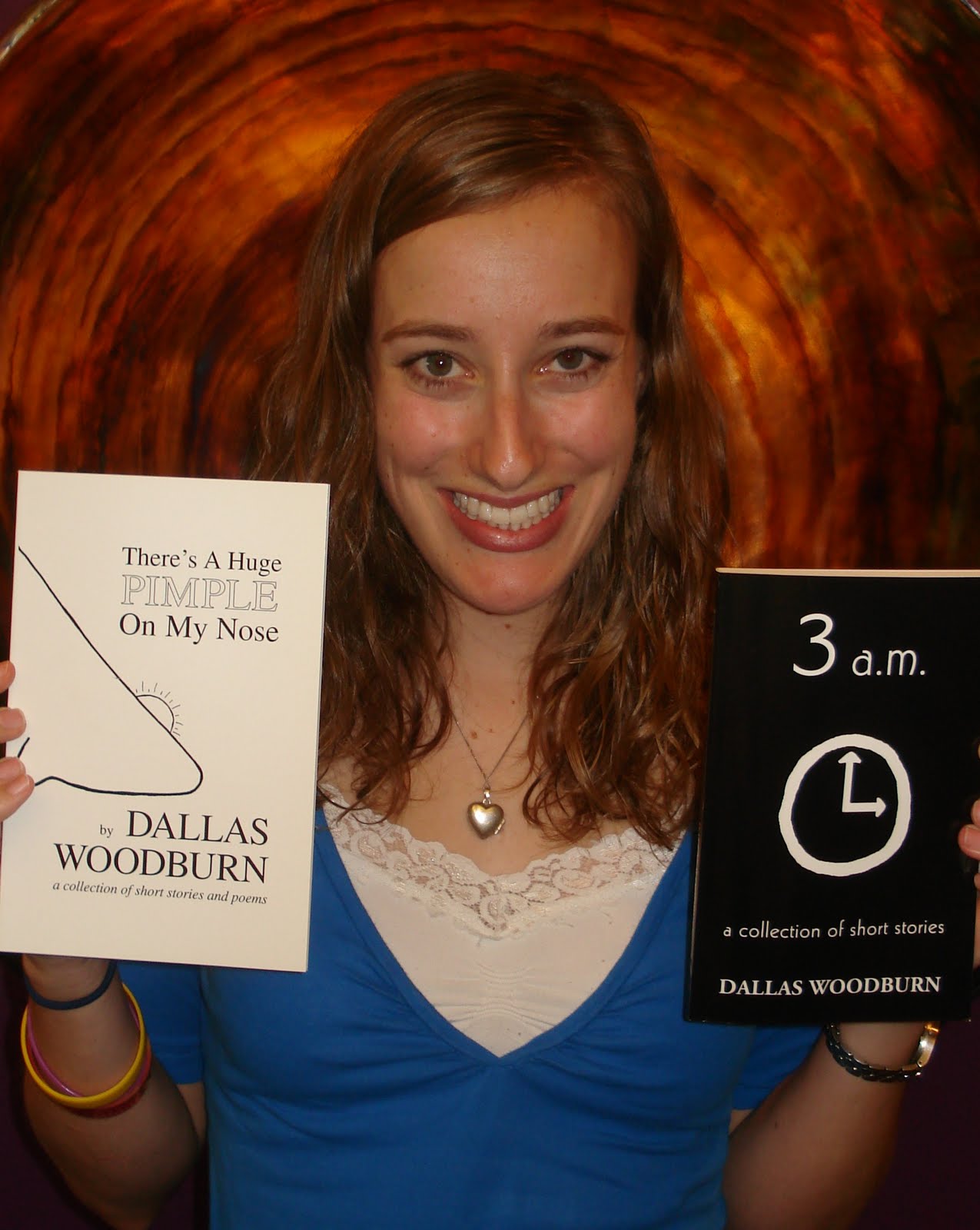
3 a.m., There’s a Huge Pimple on my Nose – Dallas Woodburn
Pride and Prejudice – Jane Austen
Jane Eyre – Charlotte Brontë
A Connecticut Yankee in King Arthur's Court – Mark Twain
The Giver – Lois Lowry
The Count of Monte Cristo, The Three Musketeers – Alexander Dumas
Blue Horses, A Thousand Mornings – Mary Oliver
To Kill a Mockingbird – Harper Lee

What inspires you? 

I am inspired by my favorite authors, as listed above, by the sounds and movement of nature, by my Mom, things people say in the booth next to us at dinner, my dog, Coco, the song of the birds, the whistle of the wind, and a cloud of thoughts. Inspiration never stops rushing to mind. Sometimes it seems as if inspiration is everywhere, floating around in little bubbles, ready to be used for stories or poems, but first you must catch it. ☺

What are you working on now? What’s next for you? 

Currently, I am working on poems for my next book, which I hope to publish very soon! I also continue to submit my poems and short stories to various competitions.

Anything else you’d like to add? 

Thank you for your interest in my new book. I wish everyone the best of luck. Always follow your dreams and never give up!

Links:

Friday, April 14, 2017

How Not to Lose the Ending of a Story


A Guest Post by Lucy Adams

(source)

Excellent stories influence people months and even years after they are read. However, it sometimes happens that a story that seems perfect at first glance eventually does not meet the high expectations of both the author and the audience. Why does this happen?

Imagine you read a book with all the components (conflict, plot, characters, idea, symbols) in harmony, but after half a year passes you can’t recall even the name of the protagonist, let alone the details. What's the catch?

In most cases, the weakest point of the book is its ending. Weak endings have buried millions of potential bestsellers! Memorable stories always have a strong ending, and it seems that such stories live their own lives. Some of them become great and live for centuries, influencing the fates of readers.

Today our goal is to identify and analyze the main mistakes that authors make when working on the final of the book.

To begin with, let’s distinguish three main reasons that make an ending boring and unremarkable: 

1. Premature ending.
2. Artificial ending.
3. Fully completed ending.

#1 Premature Ending 

There are several reasons that an ending might seem premature:

• There is a too-fast change in the character traits of the protagonist. 
For the reader, the shift in the mindset and character traits is the most important event: the climax in the story. And if it happens too early, the development of the character ceases, and hence all subsequent events seem not so significant and not so interesting to the reader.

• Too-fast goal achievements. 
In every story, the protagonist (as well as the antagonist) has an ultimate goal that he strives for through thick and thin. For example, to get the woman of his dreams. When this happens, the reader gradually gets bored. Therefore, if you want to change the global desire, you should introduce some plot twists as well.

• Untypical actions. 
A coward suddenly becomes brave; an angry soldier engages in charity; a child solves Fermat's theorem, etc. Untypical actions are a sign that the events happen not for the objective reasons but the will of the author. And it’s quite disappointing for the reader!


#2 Artificial Ending

The artificial ending is the most common mistake among aspiring writers. In most cases, the reason for such an unremarkable ending is a thoughtless plot. Note that any narration should be a consistent system that contributes to the development of the protagonist and further change in his or her traits. Non-compliance with this rule results in a blurred ending. Although there’s often is a visible ending, the thoughtful reader will see that you did not know where you were going but simply wandered meaninglessly in the dark.

(source)

#3 Fully Completed Ending

The protagonist reached his goals, changed his traits, and finally achieved complete tranquility… nothing more bothers him, and that’s cool! All the secondary conflicts are solved, and there’s nothing more to talk about. These events suggest that the story is over. But in fact, it should not be so! The achieved calmness is temporary while the change in traits does not guarantee a peaceful life! An excellent story lives for a long time because its ending is always a start of something even more intriguing!

Let’s recall One Flew Over the Cuckoo's Nest by Ken Kesey. The story seems to be over. What to talk about? Suddenly the Chief escapes from the hospital to continue the work of McMurphy, thereby giving us a new meaning. The idea is still alive; it doesn’t die with the protagonist!

In Conclusion 

When working on the ending of the story, authors should make sure that:

• The ending is not premature and the plot develops naturally, preparing readers for the final stage.
• All the secondary storylines are completed.
• The protagonist has reached the goal or failed the mission.
• There are no questions left regarding the main characters.
• The ended story gives birth to a new one and leaves room for thought.

I wish you best of luck in your writing endeavors!


Bio: Lucy Adams is a blogger and essay helper from BuzzEssay. She covers a wide range of topics, from education to psychology. Lucy is a generalist ready to prepare a few guest posts exclusively for your blog. Feel free to suggest something interesting, and you will get a fast and grounded response!

Thursday, February 9, 2017

Interview with Young Author Caylen D. Smith

 A few months ago, I was super impressed to read about young author Caylen D. Smith in my hometown newspaper. Her self-published "Guardian" series of books is amazingly popular -- the second book in the series, Uneven Odds, even garnered a spot on the Apple iBooks Young Adult New Releases! I reached out to Caylen through her website and she was kind enough to give her time for an interview. I am thrilled to feature her on the blog today! Her story is inspirational and filled with practical writing advice. Read on for more about Caylen, in her own words!  


What would you like readers to know about you as an introduction? 

My author name is Caylen D. Smith (the D stands for dramatic), and my age is 21, soon to be 22! I’m a senior in college and my hometown is Agoura Hills, California. My hobbies—more likely known as addictions—are scrolling through Tumblr and working on my Tumblr blog. It’s a way to be creative. Also, that tweeting nonsense as well. I will never turn down the opportunity to read, mostly anything, but I lean more toward books that are fantasy, or contemporary novels. They are my weakness. If I am not reading or writing, I am definitely watching my favorite movies repeatedly. Mostly anything from the Marvel Universe or a Christopher Nolan film.

Describe your path to publication. How did you get your idea for the first book? Take us through your writing process. 

The idea of the first book, Ripples: Book One of the Guardian Series, was sparked by a dream. The difficult part about it was that I didn’t remember everything that happened. All I remember was there were rebels, a girl and her friends that lived in a huge house, and a lighthouse abandoned on the beach. Not writing down exactly everything in the dream when I first woke up was my fault, but I somehow managed. I thought it would be interesting to name these strangers, and create backgrounds for them as well. Surprisingly, Landon was the first, then came Alexandria, the main character. The rest just followed. I invented their storylines, daily lives and what made them important to the story itself.

I never really thought of putting my work out there to sell. I didn’t think it was quite possible because all I wanted was to write and see where these characters would go on this little adventure I placed them in. Actually, my mother was the one who pushed me to publish my stories. We sent out a few drafts to some companies that were interested, but no offers. So, we decided to self-publish instead. Every now and then we would purchase magazines about self-publishing, and found sites about authors who went that route. It seemed easy enough, but using an editor was something we didn’t think to find at first. Though once we realized how important it was, we found an editor with the help of a friend. We checked out artists on the internet who created book covers too. And soon we had a team that I have used for all three of the Guardian books.

Have you been writing for a long time? What do you like about writing?

Surprisingly, I didn’t start out like other authors. Many say in interviews that they have always aspired to be writers, or how they began to write when they were children. I became passionate with the writing world when I was a tenth grader in high school. That was less than six years ago that I aspired to be a writer. Since then, I have completed nine full manuscripts – three of which have been published. Writing is a complicated thing. I think creating worlds and characters is what keeps me interested. Having to make up backstories of characters and how they got to the point where the book started, and weave in their own unique stories throughout the novel is a challenge I like to make for myself. Like why is this character always angry? Or how can this character have this much joy in their heart? What they look like, smell, and what are their favorite foods—their hobbies and wants. It is what helps me make their world.

What has been the most surprising thing to you in your journey as an author?

The most surprising thing has to be that people actually enjoy reading my books. I know there is this sense that “you are your toughest critic” but all my life I didn’t think I was that great of a writer. That was why I placed myself so low on the food chain, but the funny thing is that each part of the food chain is important in its own way. Each one has a special gift in their own role in life.


Do you have any advice for other writers, or for other young people going after their dreams?

Write what you want to write. I see all the time the contradictions on the internet. For example, one side wants less random death in stories, and the other side can’t get enough of emotional pain. I think, if done appropriately, character death is highly essential for the plot. People die in real life all the time, and having that in the story gives a sense of reality. In one way, listening to the readers is extremely important. Their voices do matter, don’t get me wrong -- but also be aware that not everyone is going to like one thing or the other in a story.

Can you share a few of your favorite books or authors? 

Well, author wise it would have to be Flannery O’Connor, F. Scott Fitzgerald, Colleen Hoover, and Meg Cabot. Each of these authors has a special place in my heart. If I ever need inspiration to help me as a writer, I look to these wonderful people. Especially O’Connor, since she is extremely quirky. My favorite books are The Great Gatsby by F. Scott Fitzgerald, Lord of the Flies by William Golding, We Were Liars by E. Lockhart, and The Scorpio Races by Maggie Stiefvater.

What inspires you? 

Music inspires me. I cannot write without some type of song playing in the background. The way movies can capture true emotion for the audience is through lyrics and sound, and I use that to my advantage. Music tells its own story with words as well, and it helps me paint a scene in my head, or an emotion I am trying to convey for my characters.

What are you working on now? What's next for you? 

With the Guardian Series finished, meaning the fourth book is done, just needs to be edited and cover reveal and all, I am working on this new project of a story retelling of Robyn Hoode. Yes, that is the spelling. I told myself if I were to do a retelling it would have to be on something that has not been constantly retold. So, this was the story that I saw less of on the shelves and wanted to give it a chance and see what I could create.

Anything else you'd like to add? 

I know the thought of self-publishing can be taboo in the writing world, but times are changing. It takes finding a wonderful team (editor, cover artist, and proof readers) that can help you along your path. It might be one of the best decisions you can make, if you are more focused on getting your story out there than receiving money right away. Those who start from the bottom sooner or later can reach the top. And that is an inspiring story to be told.

Links:

Tuesday, August 16, 2016

Interview with "Dancing With The Pen II" Contributor Charlotte Owens

Today we continue our Dancing With The Pen II blog tour with an interview with young writer Charlotte Owens, whose story "Grammy's Life" and essay "Nature Walk" are featured in the book. Order a personalized copy of Dancing With The Pen II: a collection of today's youth writing here or on Amazon here.


What would you like readers to know about you as an introduction? 

Hello. My name is Charlotte Owens. I am an 11-year-old 6th grader from Richardson, Texas. Writing is where I shine the brightest, but my other hobbies include drawing, softball, and volleyball.

Describe your pieces that were published in Dancing With The Pen II. How did you get your ideas? 

My first piece is titled "Grammy's Life." It was written shortly after the passing of my great grandfather, who I loved very much. Writing this tale helped me to express my grief. My second piece, "Nature Walk," was written after I left my busy household for a breath of fresh air. This was a prompt given to me by Dallas, which I found to be one of my favorites. I found peace in my quiet neighborhood and put it into words.

Have you been writing for a long time? What do you like about writing? 

I have been writing for quite a while. I've always loved books and found great joy buried within. When I was 6, I asked my mom while in the car if I could type up a story on her laptop. Thinking it was going to be a short story, she gladly let me do so. However, it ended up being 50 full pages of nothing but writing. That's when I realized that I loved to write. I think what interested me most about it was the freedom it gave me to express my thoughts and feelings through the minds of my characters.

What does it mean to you to have your piece included in this book? What was it like to get the news? 

I was thrilled to get the news that two of my pieces were to be published in Dancing with the Pen II. However, when I received a copy of my own, my family was not there to celebrate with me. I was at summer camp when it arrived in a package. I began flat-out crying. Happy crying!

Do you have any advice for other writers, or for other young people going after their dreams? 

As for advice for other authors or young people going after their dreams, keep doing what you're doing. If you work hard and believe in yourself, it will pay off in the end. Believe me, I know. Getting my stories published has given me a great head start, but I know I can do more. You will meet people that will give you wonderful opportunities. For instance, Dallas Woodburn has been a huge influence and inspiration in my life. I think we need more people in the world like Dallas!

Can you share a few of your favorite books or authors? 

As for my favorite book, I believe it would have to wind up somewhere in the Harry Potter series. Whenever I open up one of those immensely thick books, I feel as if I've landed in a whole new world. A magical place I would never want to leave. (This is one of the reasons I was so thrilled the eighth book came out!) J.K. Rowling has a brilliant mindset, and I will always look up to her.

What inspires you? 

What really inspires my greatest writing is when somebody changes my point of view and my eyes are open to new thoughts and ideas. For example, when a young idol such as Albert Einstein, Eminem, or Walt Disney had been turned down by others, they eventually rose above it to make it on top. They pushed through the negative and turned into something bigger than anybody could imagine. That's what I call inspiring!

What are you working on now? What’s next for you?

I am currently working on a story based on the amazing tale of Jeff Banister retold with my own twist. I find him to be an amazing man with such a dauntless childhood.

What's next for me? An adventure of inspirational events that are sure to turn into wonderful books!

----------

Charlotte Owens is an eleven-year-old sixth grader living in Richardson, Texas. In her spare time, she loves drawing and writing short stories prompted by her writing mentor, Dallas Woodburn. 


Links: 


Order Dancing With The Pen I & Dancing With The Pen II directly (personalized copies available!) or via Amazon.

If you have a few minutes and could write a review on Amazon, that would be fantastic!

You can also follow Dancing With The Pen on Facebook. We're featured on Goodreads, too!

Friday, August 12, 2016

Interview with "Dancing With The Pen II" Contributor Arielle DeVito

Today we continue our Dancing With The Pen II blog tour with an interview with young writer Arielle DeVito, whose poem "senescence" is featured in the book. Order a personalized copy of Dancing With The Pen II: a collection of today's youth writing here or on Amazon here.


What would you like readers to know about you as an introduction? 

My name is Arielle DeVito, I’m 17 and I’m a rising senior. I’m from Cleveland, Ohio, and when I’m not writing or reading, I play the flute, figure skate, paint, sew costumes for myself and others, and bake a lot of cupcakes.

Describe your piece that was published in Dancing With The Pen II. How did you get your idea for the piece? 

My poem “senescence” was published in Dancing with the Pen II. The idea from the piece actually came from my wanting to write a four-part poem based off the four elements -- senescence was originally intended to be for the “earth” part. But when I finished it, I realized that I preferred it as a standalone piece, and that it didn’t follow the element theme as much as I’d intended.

Have you been writing for a long time? What do you like about writing? 

To be honest, I can’t remember a time that I haven’t been writing! I’m fairly new to poetry, but I’ve always been writing stories. I like writing for a lot of reasons, including because I get to share my stories with other people and because it can help me figure out what I’m thinking and feeling.

What does it mean to you to have your piece included in this book? What was it like to get the news? 

It was really exciting! Being published has helped me realize that there’s a possibility that I can actually follow this dream and make writing into a career for me. When I found out, I immediately called up all my friends and my English teacher to tell them, and we just all freaked out a little bit.

Do you have any advice for other writers, or for other young people going after their dreams? 

My advice would be to get started following your dreams now. Things might sometimes seem far-off, but there’s always something you can do to work towards them. In my case, this was starting to submit my writing for publication and making time to free-write for at least ten minutes a day. Little things you can do are just as important as big ones!

Can you share a few of your favorite books or authors? 

This question always gets me, because I love so many different books and authors! As a child, I think I was most influenced by Lord of the Rings, Harry Potter, and of course the Chronicles of Narnia. Recently, I’ve really loved reading books by Neil Gaiman, Malinda Lo, and Marissa Meyer, as well as reading poetry by Billy Collins, Sarah Kay, and Jamaal May.

What inspires you? 

I think I’m inspired by the world in general, but especially by the amazing people who surround me and the stories I read or hear from others.

What are you working on now? What’s next for you?

Right now I’m working on editing the novel I wrote for NaNoWriMo a few years back and just continuing to write poetry. I think next I’d like to work on more short stories and maybe a sequel to the book I’m editing!

Anything else you’d like to add? 

Just a huge thank you for being included in this book, as well as good wishes for any other young writers trying to get themselves out there – I believe in you!

----------

Arielle DeVito, native to the suburbs of Cleveland, Ohio, is an incoming twelfth-grader who can often be found lurking in libraries and comic book stores. A passionate writer since the age of six, she also enjoys reading anything and everything available, sewing historical costumes, and baking (usually cupcakes).


Links: 


Order Dancing With The Pen I & Dancing With The Pen II directly (personalized copies available!) or via Amazon.

If you have a few minutes and could write a review on Amazon, that would be fantastic!

You can also follow Dancing With The Pen on Facebook. We're featured on Goodreads, too!

Tuesday, July 26, 2016

Interview with "Dancing With The Pen II" Contributor Shane P.R. Carlson

Today we continue our Dancing With The Pen II blog tour with an interview with young writer Shane P.R. Carlson, whose story "Endwise Swan Song" is featured in the book. Order a personalized copy of Dancing With The Pen II: a collection of today's youth writing here or on Amazon here.


What would you like readers to know about you as an introduction?  

My name is Shane Paul Rockenstein (yes, that’s what the P.R. stands for) Carlson. I am 14 years old, going into my freshman year of high school, and I live in Camarillo, CA. I have many, many hobbies, some of which are playing piano, playing guitar, playing ukulele, playing harmonica, singing, acting, reading, watching (good) movies, swimming, golfing, playing hockey, and filming short films. In fact, I want to become a (film) director when I grow up.

Describe your piece or pieces that were published in Dancing With The Pen II.

It’s very funny how different my story is now than when I first wrote it. It was initially more of a horror story, but now it’s sort of like the movie “Stand By Me.” I got the idea from a story I heard on the Internet. My initial story was similar to the story on the Internet, and then I changed it and made it my own. My story was about two kids having a sleepover being haunted by someone in the forest nearby. I had to change it since it was a bit too dark. Just a wee bit.

Have you been writing for a long time? What do you like about writing?

I’ve been writing for a very long time. I used to write scripts for movies on my mom’s computer. I actually started writing more-or-less professionally in the fourth grade, when I was 10. I wrote a story about pirates. It was essentially Pirates of the Caribbean: Curse of the Black Pearl verbatim. I love writing because I love creating characters and stories and worlds. It’s amazing to see a story that I’ve written completed so others can see it and experience my creations.

What does it mean to you to have your piece included in this book? What was it like to get the news? 

This is my very first publication. I am so excited for people to read what I’ve written for the first time. Hopefully there will be many more stories of mine for people to read very soon! Getting the news was great. I was excited. I didn't really have time to do anything to celebrate, though, since I’ve basically been acting in show after show for the past three years.

Do you have any advice for other writers, or for other young people  going after their dreams?  

Just keep doing what you’re doing. If someone tells you, “You can’t be in the film industry! Don’t you realize how slim a chance there is for you to get in?” or something like that, just ignore it. Though it’s true that it’s hard to get noticed in an industry like the film industry, don’t let naysayers stop you from achieving your dreams. It’s like my mom says, “If it’s meant to be, it’ll happen.” Stephen Spielberg, one of the greatest directors of all time, got into the industry by staying in the bathroom during the bathroom stop on the Universal Studios tour (back when they had a bathroom stop). He then toured the lot and got a pass to do so for three days. He toured it all three days, and, when his pass expired, he found another person to give him a new one. He did this every day during the summer, then quit school and got a job at Universal.

Can you share a few of your favorite books or authors?  

I’ve been on a Stephen King kick lately. I’ve read tons of his books, my favorite so far being Misery. His books are dark, but I absolutely love horror. I guess you could say he’s my favorite author. To anyone who’s interested in reading his books, I’d recommend Carrie, Salem’s Lot, It, The Stand, and, of course, Misery.

What inspires you?  

Many things inspire me. Most of what inspires me comes from my life, but I combine what comes from my life with genres I’m interested in. My book about a boy who becomes a superhero was inspired by my love of Batman and a girl I liked. (Note: This was back in fifth grade.) Inspiration can come from anywhere, I believe.

What are you working on now? What’s next for you?  

I really want to finish editing my superhero book I mentioned previously soon. I’ve finished my first draft, and I’ve run into some trouble with editing. I’ve lost motivation, I guess. I let the book sit for a while, and now I think I’m getting my motivation back. This publication definitely has helped, as I now want to have more publications. Once I finish this book, I can move on to other projects, like an apocalyptic novel I’ve started.

Anything else you’d like to add? 

To my fellow writers: Keep at it.
To Dallas: Thank you for helping me for the past couple years. Here’s to many more to come.
To my family: Thank you for everything. I love you guys.
To everyone: Look out for my name, 'cause I’m going to be famous very soon. :)

----------

Shane P.R. Carlson has been writing since he was five. He always has ideas for stories, which he sometimes acts out with his Legos. He loves to write and hopes he can continue to throughout his life. 


Links: 


Order Dancing With The Pen I & Dancing With The Pen II directly (personalized copies available!) or via Amazon.

If you have a few minutes and could write a review on Amazon, that would be fantastic!

You can also follow Dancing With The Pen on Facebook. We're featured on Goodreads, too!

Friday, January 29, 2016

My Thoughts About Writing, Revising, and Finding Your Genre

One of my guided writing mentees recently sent me a list of terrific interview questions, and she gave me permission to share them, and my answers, with you! I hope these thoughts might be useful or motivating. I would love to hear your comments and answers to these questions below! 

You can also read my thoughts on teaching creative writing here.

My writing desk

When you are writing, do you think about the age differences of your readers? If so, do you have to change anything to make it more age appropriate? 

Usually, I do not think about the age differences of my readers when I am writing the first draft of my story. I prefer to let the story flow out of me as it feels most natural, and not to think too much about ANYBODY reading it -- that sometimes causes me to worry and freeze up and get writers' block. Revising is when I think about my intended audience and the possible ages of my readers. Since I do not write horror or crime novels, I have never really had to worry about inappropriate violence or anything like that. In my latest novel, I did go back through and scale back some of the adult language and sexuality, since the book is intended for a teenage audience.

Was there a teacher in the past that inspired/pushed you to write, or did writing just come naturally? 

I have been fortunate to have many wonderful teachers who have been SO supportive of my writing over the years! I would say my answer to your question is both -- I was inspired by teachers, AND writing came naturally to me. It’s funny, but looking back it’s difficult for me to remember a time before I loved to write! I learned to read when I was four years old, and I gobbled up books. Like many kids, I made up stories; I was compelled to write my stories down. I think this was largely due to my dad being a writer. Every night, my parents would read me bedtime stories, and every morning I would come downstairs and see my dad writing. As a result, I was very aware that someone had written the books I so loved to read. And I decided that I wanted to be someone who writes books for other people to enjoy.

My dad remains the first person who reads my work. His feedback and encouragement are invaluable. I remember when I was little, he would let me type out stories on his computer once he had filed his column for the day -- how special that was! Also, when I was in the first and second grade I was lucky to have an amazing teacher, Diane Sather, who encouraged my love for writing. I remember she had me read one of my stories to the class. I got such a burst of joy from sharing what I had written with others. It never crossed my mind to just write for myself.

How long does it usually take for you to revise your writing or do you just write it and send it off? 

I ALWAYS revise my writing! I think writing without revising would be like trying to play a sport with your shoes untied. You should use every tool in your writers toolbox to make your writing the best it can be! I like to set aside my rough drafts for a few weeks or even a month, so then I can come back and read it with "fresh eyes" and an open perspective. Often I immediately find changes I wish to make, on the word level and on the bigger plot level -- phrasing that sounds awkward, scenes that need to be further developed, actions that don't make much sense. And just one round of revision is never enough. For example, with my most recent novel, I revised it at least seven or eight times -- all 300 pages! -- and it morphed into a whole new book compared to the rough draft. I spent about one year writing the first draft and two years revising it. Sometimes writers start off not liking the revision process very much, but revising has become something I truly enjoy! It is your chance to make your work better and better, to see the world and characters really come alive. I think rough drafts are when you (or, I should say, when I, because all writers are different and I am just drawing from my own experience) sketch out my ideas with rough lines, and the revising process is when everything gets filled in and becomes real.

Do you write in more than one genre? 

Yes, I write both fiction and nonfiction. I would say my "home genre" (where I feel most comfortable and gravitate to most often) is realistic fiction, and more specifically YA realistic fiction. I write short stories for adults as well, and sometimes my fiction crosses over into the magical/fantastical realm. For nonfiction, I most often write short essays about personal experiences I have had, and I also write journalistic articles for magazines and websites. This might entail interviewing people and doing research, which can be a fun break from exploring my own mind and thoughts. When I was younger, I used to write poetry, but I do not write in that genre much anymore.

How did you discover what genre you are best at writing? 

Hmmm... good question! I'm not exactly sure how I knew what I was "best" at writing; I think I simply focused on what genre I enjoyed the most and felt most natural to me. I wrote in that genre the most, and the more you write, the better you become! I also think each idea you have or project you embark on has its own form and genre that feels most natural to the idea itself. For example, sometimes I do not realize I am writing a fantasy story until something magical enters the page -- and it feels like a surprise to me as much as to the reader, but it also feels RIGHT, like it just fits, and I realize that story wants to be magical/fantasy. I just need to listen to the genre of each project instead of trying to force it into a box of my own design. One final thing I would say about this is not to worry about forcing YOURSELF into a "genre box" either -- you are free to write in all different genres and all varieties of projects! Write what you feel excited and passionate about. That is the most important thing.

Do you enjoy teaching other people how to write? 

Oh, yes! It is one of my favorite things. I especially enjoy teaching writing camp and working with talented young writers like you who have a passion for writing and really love writing to begin with. That is my favorite environment to teach in. I have also taught writing to students (for example, as a guest speaker/teacher, a private tutor, and a college writing instructor at Purdue University) who don't really care about writing or want to write. In that arena, my goal as a teacher is to help them see the profound importance of writing and how becoming a better communicator will help them in any field they choose to go into. With all my students, my ultimate aim is to increase their confidence and joy as writers. Teaching writing helps me remember the magic and wonder of the creative process, and my students often inspire me with their enthusiasm and hard work! Also, teaching keeps me honest with my own writing practices. If I am telling students to find at least fifteen minutes to write every day, then I had better be practicing the same advice myself and writing every day, too! :)