Showing posts with label novel. Show all posts

Wednesday, April 22, 2020

My book is here!!

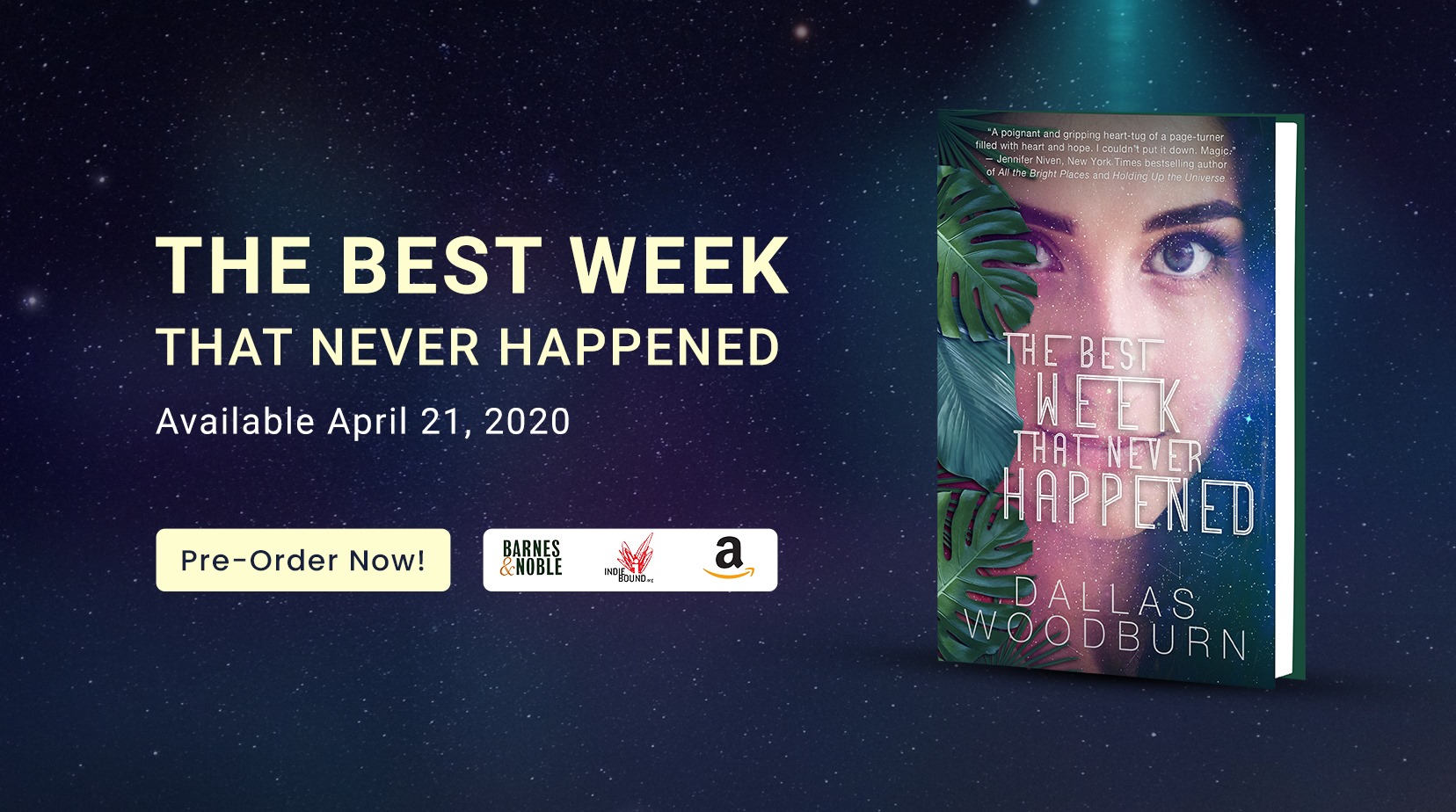
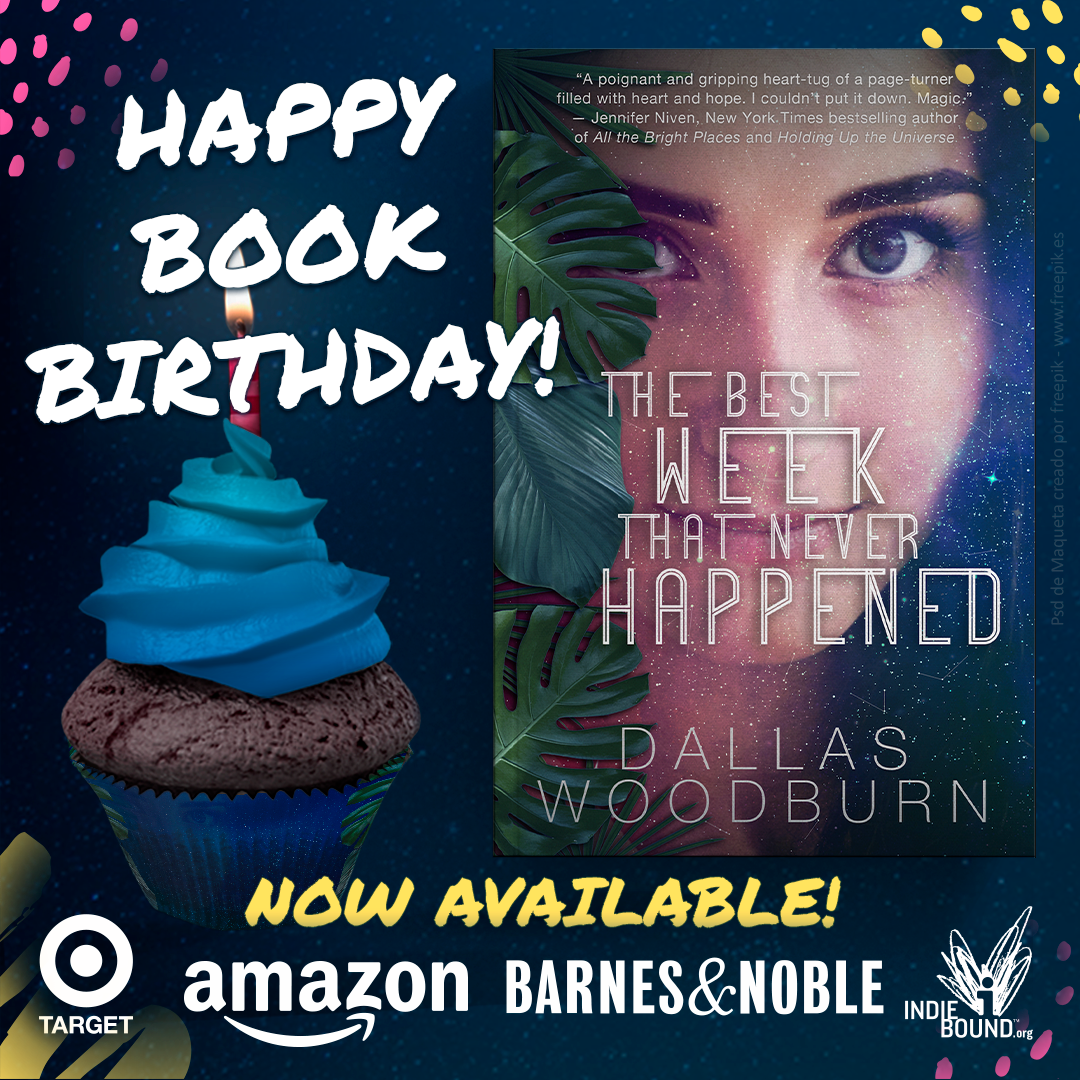
It is hard to believe... but nearly two years after I signed the publishing contract... and nearly four years after I completed the first draft... and after more than two decades of dreaming about this moment... my debut novel is out in the world today!!

THE BEST WEEK THAT NEVER HAPPENED is a love story set in Hawaii, with a dash of mystery and magic, about living each day to the fullest. It is available as a print book, an ebook, and an audiobook -- wherever books are sold!

Amazon / IndieBound / Barnes & Noble / Target / Books-A-Million / Book Depository

instagram-tbwtnh-publication-bday-az

ABOUT THE BOOK:

“This debut novel is captivating and moving. A dazzling, emotional story of love, loss, and living in the moment.”—Kirkus Reviews

After her parents’ bitter divorce, family vacations to the Big Island in Hawaii ceased. But across the miles, eighteen-year-old Tegan Rossi remains connected to local Kai Kapule, her best friend from childhood. Now, Tegan finds herself alone and confused about how she got to the Big Island. With no wallet, no cell phone, purse, or plane ticket, Tegan struggles to piece together what happened. She must have come to surprise-visit Kai. Right?

As the teens grow even closer, Tegan pushes aside her worries and gets swept away in the vacation of her dreams. But each morning, Tegan startles awake from nightmares that become more difficult to ignore. Something is eerily amiss. Why is there a strange gap in her memory? Why can’t she reach her parents or friends from home? And what’s with the mysterious hourglass tattoo over her heart? Kai promises to help Tegan figure out what is going on. But the answers they find only lead to more questions. As the week unfolds, Tegan will experience the magic of first love, the hope of second chances, and the bittersweet joy and grief of being human.

best week promo image-01

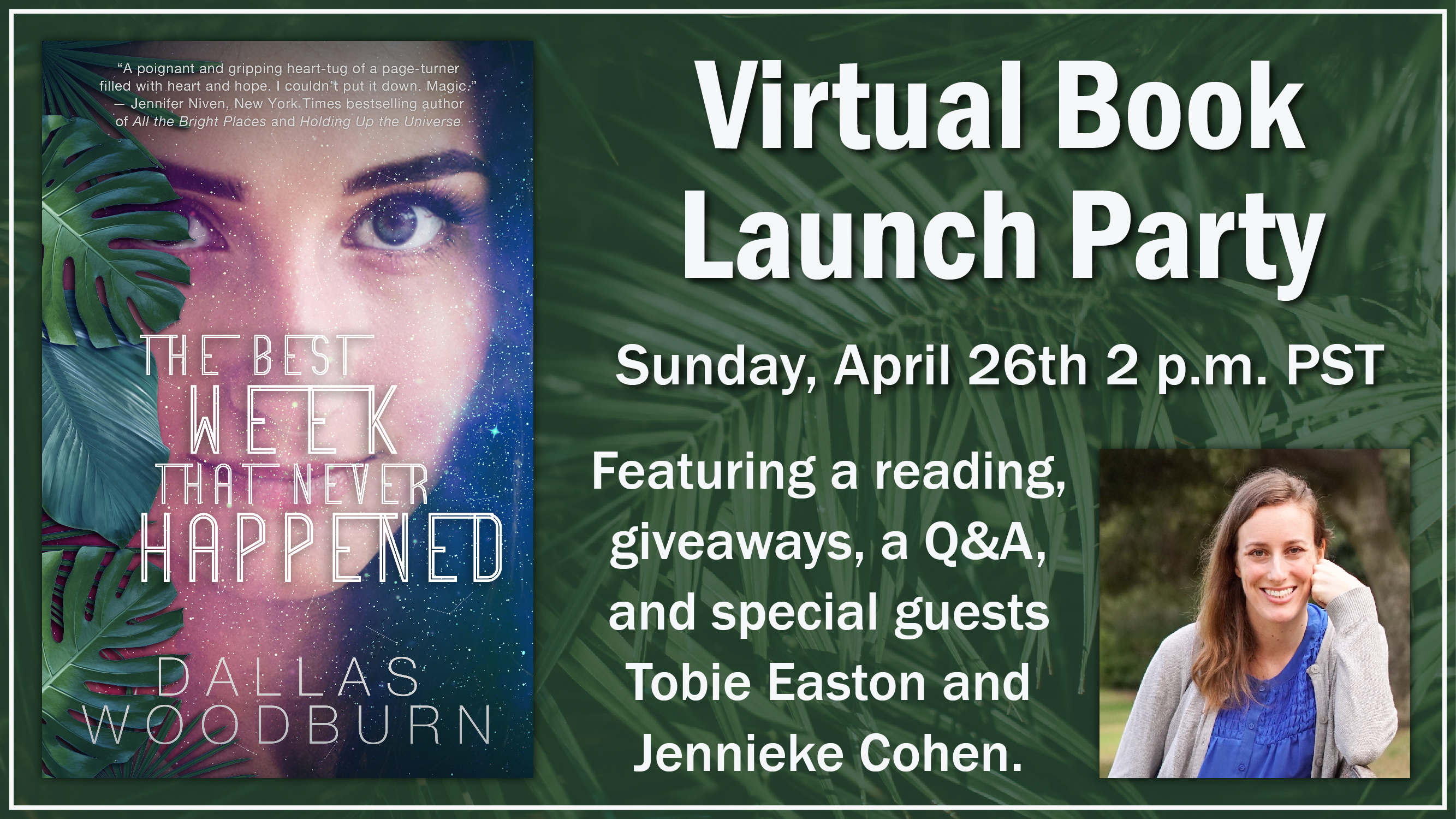
Due to COVID-19, I unfortunately had to postpone all my bookstore events... but the silver lining is that I am doing a virtual book launch that anyone can attend from the comfort of their homes around the world!

On Sunday, April 26th at 2pm PST I will go live on Facebook and YouTube!

For the livestream, I will have a book talk, reading, and Q&A that will be led by the young adult authors Tobie Easton & Jennieke Cohen.

Prizes will also be given out! There will be small prizes for those who participate in a trivia game that will be run in the comments (themed bookmark, postcard, and temporary tattoos!) There will also be some bigger prizes!

Please add the event to your calendar and invite anyone who might be interested!

best week facebook cover

There is even a book trailer! Special thanks to Demi Bernice Eslit & Bryan Murphy for their help with production.


It's also been really fun to connect with book bloggers and websites who have been kind enough to help spread the word about my book! Here is a sampling:
This has truly been one of the best days of my life!! My heart is so full. I feel so supported and loved-- and in this time of social distancing, I feel connected to all of you! Thank you for your support of me and my dreams!

Tuesday, December 17, 2019

Giveaway!

I am hosting a giveaway to celebrate the upcoming release of my debut YA novel, The Best Week That Never Happened. I hope you will take two seconds to enter this contest because it could not be easier, and I have lots of fun prizes to send your way!


TO ENTER: Simply mark The Best Week That Never Happened as “Want to Read” in Goodreads. That’s it! 

Bonus entry: ⇓ share this giveaway on social media and tag me ⇓

  • IG: @dallaswoodburnauthor 
  • FB: @writerdallas 
  • Twitter: @dallaswoodburn 
On December 31st, I’ll be randomly choosing 30+ winners for the following prizes:

Hand-carved wooden snowflake ornaments 


Why wooden snowflake ornaments? Here is a sneak-peek passage from The Best Week That Never Happened to explain how these beauties tie into the novel:

Crowded against the front window is a fake Christmas tree decorated top to bottom with wooden ornaments—“HAND-CRAFTED,” a sign proclaims. Trying to distract myself, I walk over and study the display. Some ornaments are smooth wooden globes, surprisingly light in my hand. Most of the globes are painted with images of Hawaii: surfers, dolphins, ocean waves.

My favorite ornaments are the wooden snowflakes, paper-thin, so delicately carved it is impossible to imagine an actual person crafting them. Maybe, despite the sign’s promise, these are machine produced. I take one in each hand and compare them. It’s clear they are different: one has six narrow points while the other is broader, like a starfish. Could it be possible each ornament is unique, like real snowflakes? That would definitely mean they are hand carved.

The bell jingles.  
I glance over.  
There he is. Kai. 

A few of my favorite YA books 


I wrote about some of these fantastic reads in my post for the “31 days of #quietYA” blog; others are perennial faves that I find myself returning to again and again. I will be giving away new copies of all of these books!

  • Emerge by Tobie Easton 
  • We Speak in Storms by Natalie Lund 
  • All The Bright Places by Jennifer Niven 
  • When The Moon Was Ours by Anna-Marie McLemore 
  • Unclaimed Baggage by Jen Doll 
  • Merged by Jim & Stephanie Kroepfl 

So what are you waiting for?? Enter and share with your friends!

TO ENTER: Simply mark The Best Week That Never Happened as “Want to Read” in Goodreads. That’s it! 

Bonus entry: ⇓ share this giveaway on social media and tag me ⇓

  • IG: @dallaswoodburnauthor 
  • FB: @writerdallas 
  • Twitter: @dallaswoodburn

Wednesday, January 31, 2018

TeenPit: mentoring, editing, support, and being taken seriously as a writer

Guest Post by Lyric Shard 

You know that feeling of having butterflies in your stomach? The first one flapped its wings when I saw my manuscript title by a mentor’s name, the second when I met my fellow mentees, the third when I received an email from my mentor where she said she loved my pages. Then it was continuous flapping, hundreds of butterflies all at once. I still can’t count how many are left flapping their wings in my stomach, because my TeenPit experience did not only last for the one month promised--it’s stretched until today and hopefully will remain forever.

TeenPit is a writing contest designed for high school writers, where the participants submit their first 250 words and a short pitch for a chance to be paired with a mentor. You can go here to read about all the details for TeenPit 2018. And hurry up, the very brief submission window opens on March 17th.

I first noticed a tweet from K. Hopkins, a PitchWars mentor, in early April about a contest for teens. It’s always hard to be taken seriously when you’re sixteen trying to find your way into the publishing industry. TeenPit sounded like the perfect chance where I could hear something more than "your writing is good for your age." I could get feedback about my writing as a writer, not as a kid, and go from there to improve.

I immediately checked it out, drafted my submission email (almost a month before the submission window opened since only first 200 entries were accepted). Then one month passed fast, and the submission day came.

Thanks to living on the west coast, the window opened at five in the morning, and more thanks to the flat tire in the middle of the road the night before, I’d just come home, meaning my brain was perfectly functioning. I was able to send the email… well, with one very embarrassing mistake which ate me up the entire time I waited for the results. I wasn’t going to be picked. I couldn’t be. I sent an email in Comic Sans. They would delete it before they read it. 

The mentor teasers started a few hours before the results were posted. My impostor syndrome, for those few hours, seemed weaker than my high hopes. However, my hopes were right. My manuscript title was there, in the list of those that made it to the mentor round.

A few rounds of screaming contest (to relieve the excitement) with my chickens later, I sat down to relax and take time to believe my eyes. Only then was I able to open the email from my mentor, Kristen Lepionka, author of the Roxane Weary mystery series. It was greetings, introductions, "I love your voice" and gifs. That was all that was needed, to know that the first two chapters of my manuscript and I were in good hands. The next thing I needed was to listen, understand, and be open to making changes in my manuscript.

That’s what I did. In between school, senior activities and tons of essays, I knew to give my manuscript some time to edit it. I read her notes and edited. And edited. Scenes, characters, lines—everything. It was sending those twenty pages back and forth, more polished each time until we both looked at it and thought, "That looks about perfect."

The final edits were sent in, and now it was time to wait again. The top picks were announced, they were going to go straight to PitchWars, where they’d work with mentors for two months before their entries went up for agent showcase.

I wasn’t one of them.

That was okay.

In that one month, and all the months afterwards, I’ve become friends with the mentees from TeenPit Class of '17, a group of talented teen writers who are still there for each other. In between edits and gifs, I realized Kristen was more than a mentor. Can I call her my fairy godmother? She’s there to help get me through--from her amazing feedback and edits, to fighting impostor syndrome, or whatever is in the way.

TeenPit is so much more than the contest itself. It is a community, filled with love and support that doesn’t go away when the contest is over.

Note from Dallas: I hope you enter TeenPit 2018! Here are all the details.

Friday, November 17, 2017

Interview with Young Author Marina Baker

I am so excited to feature an interview today with young author Marina Baker, who I have been honored to know for a few years now. She has participated in Write On's Summer & Winter Writing Camps and she is also a featured author in Dancing With The Pen II. 

Marina is a prolific and talented writer and has already published a collection of poetry titled Sock Drawer. Now, she is celebrating the publication of her novel Escape Reality, which is available on Amazon here. 

Read on for Marina's insights about the writing process, finding inspiration, going after your goals, and publishing your work!

Marina and her brother, Miles, in Colorado.
What would you like readers to know about you as an introduction?

My name is Marina Baker. I am in ninth grade and I live in Ventura, California. Some of my other hobbies, besides writing, are swimming and reading.

How did you get your idea for Escape Reality? Take us through your writing process. 

I got the idea for Escape Reality when my mom said that I had a little inner monster inside me after I got really mad when doing yard work. I thought that this would be really cool if I actually turned into a monster, which happens to the main character of Escape Reality, Lily.

What do you like most about writing? 

What I love most about writing is the fact that I can create a whole new world that can be my own. I also love that I can possibly inspire other people, just like how I was inspired by some of my favorite authors.

Marina, you are quite amazing because at your young age, this is already your second published book! (Your first, Sock Drawer, was a wonderful collection of poems!) How was writing and publishing Escape Reality different from the writing and publishing experience of Sock Drawer? 

I think that when I self-published Sock Drawer I was new to the world of publishing. One big difference was that my parents and I really had to set up the font size and page breaks, everything like that. When publishing Escape Reality I didn't have to worry about that as much, because the book was published as a Kindle eBook. I think that both experiences were very important and memorable. 


Do you have any advice for other writers, or for other young people going after their dreams? 

For other authors, I would say to keep working for your goals. If I had scrapped all of Escape Reality because of the first page, I wouldn't be where I am now. For other young people, I would say the same. Go with your gut and keep pushing because you are going to achieve great things. 

Can you share a few of your favorite books or authors? 

One of my favorite books is the Harry Potter series by JK Rowling. I really look up to JK Rowling and think that she is an amazing author. Another one of my favorites is the Selection series by Kiera Cass. I would definitely recommend both of them.

What inspires you? 

I am really inspired by other writers as well as my cat, Chanel. I also really like to write about magic and far off places.

What are you working on now? What’s next? 

Right now I am working on a story about an escaped prisoner. I don't really know how it is going to pan out, but I really like it so far, and I hope that I can stick with the story.

Anything else you’d like to add? 

Some other things about me: I am addicted to Harry Potter books. I just love the story so much!!!


Links:

Tuesday, August 25, 2015

Guest Post by Mary E. Martin

Exciting news, everyone: today we are being visited by a virtual blog tour celebrating the completion of author Mary E. Martin's second series, The Trilogy of Remembrance. A special welcome to followers of the tour joining us from Book Readers Heaven, http://gabixlerreviews-bookreadersheaven.blogspot.com/ and from other sites on the tour.

Followers of the tour have an opportunity to enter in a $200 Amazon gift card giveaway! Entries will be accepted until midnight on August 31, 2015 with an announcement of the winner posted from Mary's Blog on September 1, 2015. Anyone submitting a proof of purchase entry in the giveaway draw will receive as an added benefit the tour purchase incentive rewards package of free e-books and discount coupons donated by tour hosts. For a full tour schedule of events, as well as details on how to enter, visit Mary E. Martin at http://maryemartintrilogies.com/virtual-tour/

You can also tune in to JD Holiday's World of Ink Network interview with Mary and guests, over BlogTalkRadio at http://www.blogtalkradio.com/worldofinknetwork.


What Makes a Novel Great?

a guest post

by Mary E. Martin

Because everyone has his or her own personal taste, it’s hard to answer this question. What appeals to me, you might consider dull, boring or even downright ridiculous. And of course, vice versa. It’s the same with a painting or a song. Personal taste. I might love Anton Chekhov’s stories and you might think they are too dated to be relevant in today’s world—NOT great for a writer who wrote almost two centuries ago. You love Stephen King, but his work might leave me cold and eventually bored which would not be good for a horror writer.

Does this mean neither writer has written a great novel? Of course not. You can devise all sorts of rules to determine whether a piece of writing is great. Is it a page turner with an interesting plot? Do the characters seem real? All that is helpful, but lots of novels are like that.

Will it be read one hundred years from now? For me, that’s the real test. Unfortunately that means we’ll not be able to apply that test to novels written today. But we can look at the old ones still popular today and try to figure out why we still love them. Some examples? Take any one of Dickens’ novels. Even if you haven’t heard of his novel, Bleak House, I’ll bet you know about Scrooge. Why? Scrooge was such a powerful character and his story was so transfixing that some of us read his novella every Christmas or at least watch the movie. Why? Because the character Scrooge is embedded in the consciousness of popular culture and has been from the beginning.

When I was a child, I was extremely impressed with Alastair Sim’s portrayal of Scrooge. In one of the dream sequences, Scrooge was confronted by an apparition in a long black robe. When he drew it back, small children were huddled underneath representing “ignorance and want.” If that can’t frighten you, what can? What is it about Scrooge that sticks? He’s intensely unlikeable, stingy with a flinty disregard for his fellow man. Do you know anyone like that? Sure you do! He’s your boss. Or maybe he’s even closer to home. If we’re honest with ourselves, we know we all have a bit of Scrooge in us.


No one wants to be like Scrooge. When his employee Bob Cratchit tries to speak well of him, we see compassion at work. We all want a world with second chances to do better. It is one of the very best redemption stories ever written which was published just in time for Christmas in 1843 and to this day has never been out of print. With his characters and the dream sequences, the story strikes something very powerful—a universal and timeless chord. The story asks—what does it mean to be human and how do we deal with the many complications of our own nature? The characters are as real to us as our spouse, child, neighbour or—ourselves.

The writer and his characters make us think about what it is to be a human being in the place, time and circumstance he or she is in. And if it is truly universal and timeless, then it may stay with us forever and speak to future generations. The next question is: how to do this? Maybe it’s not so hard. I wonder just how much human beings have changed over the aeons. We still love and hate. We still suffer from greed, ambition, pride, lust, envy, wrath, sloth and gluttony. Paradoxically, at the same time we are still capable of great acts of kindness, forgiveness and love. If you look at that list of failings and attributes, you can easily see hundreds if not thousands of opportunities for terrific stories.

But it’s not just confined to characteristics of humans. Those characteristics drive plots. One of the most fundamental is the quest. Scrooge was dragged through dream sequences which were a hair-raising quest. We often say that Shakespeare’s characters were very powerful. Just think of Macbeth and his Lady. Ambition drove them to murder the King. Lear, the near feeble but once great King, is blinded with pride as he turns upon his daughters. But think what his pride did to him. Because of that foolishness he was turned upon viciously by those who should have loved and cared for him. Old age was never so terrifying!

If we start thinking of our characters and plots as embodying some of these characteristics, they may have a chance to survive. Why? Because humankind has not really changed all that much. In 2015, we will still be captivated by a character who is driven to a bad end by lust or avarice. He or she might be just like that person across the desk from you at work. Or if you look closely, a tiny bit might be found in our own hearts. When we’re writing our stories and want to strive for the top, let’s be thinking about what it means to be human and driven (even mad) by high emotion. Those are the questions to explore when creating our characters and plots if we want them to survive.

BIO: Mary E. Martin is the author of two trilogies: The Osgoode Trilogy, inspired by her many years of law practice; and The Trilogy of Remembrance, set in the glitter and shadows of the art world. Both Trilogies will elevate the reader from the rush and hectic world of today and spin them into realms of yet unimagined intrigue. Be inspired by the newly released and final installment of The Trilogy of Remembrance, Night Crossing.


Sunday, October 26, 2014

Some Tips on Beating Writer's Block

Writer's block is a question I often get emailed about, so I thought it would be helpful to write a quick post with my thoughts about it, and some tips that often work for me! I just finished writing my third novel, which I felt blocked on quite a few times, and which felt like a giant mess quite a few times, but now that I'm on the other side I can cheerfully report that all those times I felt like just throwing my hands up in the air often precipitated a HUGE breakthrough. Pushing through the hard times was worth it one-thousand percent. The important thing is to not letter writer's block defeat you! Keep plugging away.

For me at least, writer's block usually stems from worrying that what I'm writing isn't "good enough"... when this happens, I remind myself that no rough drafts are perfect and, as one of my creative writing professors used to say to us in college, words down on the page are ALWAYS better than words just in your head.

If you're working on a longer project, maybe you simply need to take a break. Try to writing a short story featuring some of your characters, or even a short story featuring entirely new/different characters. This can help you see the idea from a new angle, get excited about the idea again, and get to a "finish line" of a shorter project. That might be just the motivation you need to dive back into the longer work with your batteries recharged!

Most of all, I always encourage my students and mentees to go after the idea that is sparking inside you, the one that makes you excited. There is no time to waste! Write what makes you feel alive.

If it's the idea you're working on now, great! If you wants to try something completely different and new, that's great too! Remember: you can always return to this idea later if you want. No idea is ever wasted or abandoned.

Finally, here's the number-one thing that works best for me when I'm battling the writer's block blues, and that has made the biggest difference in my productivity, creative energy, and happiness as a writer: write every day.

Make writing a routine. I think even trying to write at the same time of the day is best, because you train your body to prepare to write during that time -- much in the same ways athletes often practice at the same times. Then, when that time hits, you are ready to go! It's like a muscle memory you are building.

Even if you feel like the writing isn't flowing, even if you feel like every word you are writing is terrible, stay in the chair and keep pushing through to the good stuff. Because the good stuff will come, believe me. You just need to have the patience to get to it!
Here are a couple other articles I found that might be helpful, too:

Tuesday, November 12, 2013

Interview with Patricia Fry

Patricia Fry is a full-time writer/editor and the author of 40 books. She is also the executive director of SPAWN (Small Publishers, Artists and Writers network). She says, "While I have written books on a variety of topics—grandparenting, local history, youth mentoring, journaling and even how to present a Hawaiian luau on the mainland—most of those I’ve written for the last fifteen years or so are for writers and authors." The most recent are Publish Your Book, Promote Your Book and Talk Up Your Book. While she established her own publishing company (Matilija Press) in 1983 in order to produce a comprehensive local history, some of her books have been published through traditional publishing houses. Allworth Press is the publisher for this trio of books. Patricia travels and speak at writers conferences and for writers groups throughout the U.S. on publishing and book marketing. She also writes two e-newsletters and a blog for authors and contributes numerous articles to other publications and blog sites each month. She says, "I spend most of my time promoting my books and working with other authors on their book projects. Of course, I also usually have a new book in the works. Most recently, I have started writing fiction." Patricia has generously given us some of her time today to talk about her novels and making the switch from nonfiction to fiction author!

Tell us about Cat Eye Witness. What was your inspiration/motivation behind this book/this series?

Thank you for asking. For my last birthday (in June), I decided to treat myself by finally attempting a work of fiction. I’d been writing nonfiction for nearly 40 years and wanted to try my hand at a novel. I like reading light (cozy) mysteries and I love cats, so decided to do what others before me have done and combine the two. Within six months or so, I had written two novels in my Klepto Cat Mystery series, “Catnapped” and “Cat-Eye Witness.” I had heard good things about Kindle Direct Publishing and decided to get my feet wet as a potential novelist through this program. Both of these novels are at Amazon for Kindle as we speak. (Links below.) There are no talking cats—just real cats with purrsonality. One cat, in particular, has a most unusual habit that usually results in helping to solve the mysteries.

What have you learned through writing novels as opposed to your nonfiction books and articles?

I have learned how much fun it is to manufacture characters and scenarios and what it feels like to be responsible for creating characters and stories that are entertaining as well as meaningful in some way. I notice that I incorporate some of my nonfiction tendencies to teach and educate into the stories I tell. And I’ve come to realize that there must be truth in fiction in order for it to be credible. I’ve been editing fiction for several years and I think this (as well as my tendency to read fiction with a rather critical eye) has helped me to write with my audience in mind. And this is as important in fiction as it is in nonfiction. I’ve also learned that the message I’ve been sharing for years—that the concept of and the process of promoting fiction is not all that different from promoting nonfiction. It has been a real challenge to convince most novelists of this fact.

How did you get started writing?

I was a young mother when I realized that I enjoyed the process of writing—letters, grocery lists, little stories for my children, etc. At some point, I decided that when my three daughters were older, I wanted to write articles for magazines. I was fascinated by the structure of an article and the wide array of possibilities in the way you could address a single topic. I started subscribing to writing magazines and I read a lot of magazine articles. In 1973, when the girls were in their teens, I borrowed a manual typewriter and wrote my first article. The first magazine I submitted it to published it. The first book I wrote was also published—by a New York publisher.

I earned my living through magazine article-writing for many years. My articles appeared in Cat Fancy, Your Health, Woman’s World, Ladies Circle, Catholic Digest, Pages, Entrepreneur, Western Horse, Writer’s Digest and many others over the years.

I now have 40 books to my credit, including several designed for authors.

I am one of those fortunate people who has figured out how to create a lifestyle and earn a living through writing.

What is your writing process like? Do you write on a computer? In a spiral notebook? Do you write at the same time every day?

I get up every morning around 4:30 or 5:00 and write (edit, do SPAWN work, respond to interview requests, etc.) until around 9 or 10. I straighten up the house, clean kitty litter boxes and take a walk and then go back into my home office and spend another several hours at the computer. I may take another break and run errands (ship books, pick up supplies, etc.) before finishing up the day of writing work by 3:30 p.m. or so. Often, I can be found conducting research or scheduling tasks for the following day while relaxing in front of the evening news.

As I said, writing for me is a lifestyle. It is my life—my hobby, my creative outlet and my livelihood. I do all of my writing at the computer now—although it was hard to switch from the spiral notebook when I purchased my first word processor some 25 years ago. I had to learn to think into the computer.

Because I often work (if you can call writing “work”) seven days a week, I occasionally suffer burnout. That’s when I will take a longer walk among nature, perhaps. I might do a little gardening or engage in another creative activity—photography, for example.

How do you get ideas for your fiction?
As you know, I’m new to writing fiction. So far, I’ve written three novels in the Klepto Cat Mystery series. Two are published for Kindle and one is waiting in the wings for extensive editing/proofing, etc. I will also turn it over to some readers before publishing. These three stories have materialized before my eyes as I write. I start with a premise, come up with a beginning scene (which may end up in the middle of the book somewhere) and just start writing. The ideas seem to emerge through the characters. Although, if an idea strikes me, I will write it down to possibly use in one of the stories.

What is your biggest advice for other writers?
My advice to those who are writing books is, keep your audience in mind throughout the entire writing process. For nonfiction, make sure the book is needed/wanted and that you have organized it in the most logical manner. Write instructions so they are easy to follow. For fiction, write in a genre that is popular. Write scenes that flow. Don’t leave the reader behind. If you are writing for publication, you must think about promotion from the very beginning of the project. I advise authors to build promotion into their books as they write them and one way is to consider your audience throughout the process.

What are some of your favorite books?
Because many of your readers are or plan to be authors, I’d like to talk about books for authors. If you are considering using one of the pay-to-publish (or self-publishing) companies, please read Mark Levine’s book The Fine Print of Self-Publishing. He has just done a major revision. But any edition of his book is worth the price. He rates and ranks these companies and explains their contracts (good and bad). Also read my books: Publish Your Book (a great guide to understanding and learning to navigate the publishing industry) and Promote Your Book (which is filled with over 250 book promotion ideas and how to use them). Both of these are available at Amazon.com in print, for Kindle and in audio. Or purchase the print version here: http://www.matilijapress.com.

Is there anything else you would like to add?

An educated author is a more successful author. Always, always think of yourself as the CEO of your book from the very beginning. Writing may be a creative endeavor, but publishing is a business and should be respected as such.

I’d also like to introduce SPAWN. Mary Embree is the founder of Small Publishers, Artists and Writers Network. She formed this organization in 1996 in order to provide the opportunity for authors, illustrators, printers, publishers, agents, etc. to network face-to-face and possibly collaborate on projects together. We also brought in experts and professionals to speak on pertinent topics. We started with three chapters in the Southern CA area. I have been involved in SPAWN since the beginning. I am now the executive director. We no longer meet in person. We are online only and still provide opportunities to network through an online discussion group. I write the SPAWN Market Update, a meaty e-newsletter each month for members only that is brimming with opportunities and resources for authors, artists and other creatives. We have two booths at the Los Angeles Times Festival of Books each year, where members can sell their books to some of the 140,000 visitors. Sign up for our free monthly e-newsletter, SPAWNews http://www.spawn.org.  Contact me at Patricia@spawn.org.

Are there any links you'd like me to share?
  •  http://www.matilijapress.com Here, you’ll find my books showcased, my speaking schedule, a large list of resources for authors, tons of articles of interest to authors and more.
  • http://www.patriciafry.com Learn more about my editing services. Also download my free e-booklet, 50 Ways to Establish Your Platform. Sign up for my new e-newsletter, Publishing/Marketing News and Views.
  • Join SPAWN (Small Publishers, Artists and Writers Network) http://www.spawn.org. Sign up for our FREE e-newsletter, SPAWNews. Receive a FREE copy of Promote Yourself! 25 Ways to Promote Your Work Whether You’re an Artist, Author of Small Publisher.
  • Order Patricia Fry’s two novels for your Kindle: Catnapped http://amzn.to/14OCk0W and Cat-Eye Witness http://amzn.to/1bJiq0x
  • Contact Patricia here: PLFry620@yahoo.com
Monday, October 15, 2012

Interview with Tracy Krauss to celebrate the launch of her new book WIND OVER MARSHDALE

 
Tracy Krauss is an author, artist, playwright, director, worship leader, and teacher. Originally from a small prairie town, she received her Bachelor’s Degree at the University of Saskatchewan. She has lived in many places in northern Canada with her husband, a pastor, and their children. They currently live in Tumbler Ridge, BC. Published works include four romantic suspense novels: And The Beat On, where archeological evidence for creation comes at a heavy cost; My Mother The Man-Eater, the story of a ‘cougar’ who takes on more than she bargained for; Play It Again, about an unlikely match during the 1980s rock n’ roll scene; and Wind Over Marshdale, where strong spiritual forces rock a seemingly peaceful prairie town. She also has several stage plays in print. Visit her website for more details. http://www.tracykrauss.com 

Who is Tracy Krauss? 

Besides an author, I am an artist, drama director, worship leader and teacher. I’m all about the creative process, so everything I do has that bent to it. When I’m ‘making’ something – be it a painting, directing my vision for a play on the stage, playing an instrument, or writing a book – I feel energized. Sometimes I tend to burn myself out because I don’t rest much, but I like to be busy and I love all my creative pursuits, so it’s hard to drop anything. I currently live in beautiful Tumbler Ridge, British Columbia, Canada, known for its many waterfalls. However, my husband and I have moved around a lot in our nearly thirty years of marriage, and many of the places we’ve lived have been in the far north. Places like Churchill, Manitoba - the ‘polar bear capital of the world’; the Yukon, which is next door to Alaska; and the North West Territories – all north of the 60th parallel. This has given me lots of fodder for my stories.

When did you start writing? 

I first started writing when my eldest was just a baby. I could hardly wait for her to go down for her nap so that I could pound away at my mother’s old typewriter. That was more than a quarter century ago. Four kids, plus homeschooling for nine years, plus going back to work as a public school teacher full time, and I finally signed my first contract in 2008. (This was after many, many rejections and a lot of hard work revising, querying, and revising some more.) My first book was released in 2009, followed by My Mother the Man-Eater in 2010, Play it Again in 2011, and now, Wind Over Marshdale in 2012. I’ve also had five plays published or contracted in that time with various play publishing houses.

What authors have inspired your own writing? 

Frank Peretti is still my favourite author. To me he is a groundbreaker. He’s tackled subjects that were previously considered taboo within Christian circles in such a compelling and thought provoking way that his writing is almost revered as truth. For instance, This Present Darkness has almost become a manual on spiritual warfare, even though it’s fiction. I try to include some of this ‘edge’ in my own writing. Francine Rivers is another that comes to mind. She has written about some pretty controversial topics as well, and her characters are always believable; they aren’t perfect in other words. Again, this is what I strive for with my characters.

Tell us about your new novel. 

Wind Over Marshdale takes place in a small prairie town where, on the surface, everything seems quaint and happy. Underneath there are some serious issues, especially with racism, sexual promiscuity, and the occult. Thomas Lone Wolf is a Cree man on a mission to build a heritage site near the town based on some ancient archaeological evidence. He and his children aren’t prepared for the level of prejudice they begin to face. Rachel Bosworth is the new Kindergarten teacher, fresh from the big city and running away from a hurtful past. Con McKinley is a local farmer, who also happens to be single and good looking. A love triangle of sorts develops, with the two men unwitting participants. As well, eccentric twin sisters bombard the town; one with her legalistic religious views and the other as a practicing witch. The local pastor has little effect trying to keep his parishioners in line since he is involved in some unsavoury business of his own. The lives of these and many other unusual characters weave together into a surprising climax. Beneath it all is a thread linking everyone’s problems to the spirit realm; an ancient curse from the past that must be dealt with once and for all.

What’s next? 

I have two more finished novels and several works in progress. I’m just in the process of polishing up Czech Out, about a hockey player who defects to North America during the cold war, and Three Strand Cord, a romantic mystery about three friends. Once they’re ready for submission I’ll be pitching them to my agent. I’m also always pitching plays as well, since I write most of my own material for my drama troupe. Finally, I’m publishing an illustrated children’s book. I just finished all the artwork and it should be ready fairly soon.


Blurb: Marshdale. Just a small farming community where nothing special happens. A perfect place to start over… or get lost. There is definitely more to this prairie town than meets the eye. Once the meeting place of aboriginal tribes for miles around, some say the land itself was cursed because of the people’s sin. But its history goes farther back than even indigenous oral history can trace and there is still a direct descendant who has been handed the truth, like it or not. Exactly what ties does the land have to the medicine of the ancients? Is it cursed, or is it all superstition?

Wind Over Marshdale is the story of the struggles within a small prairie town when hidden evil and ancient medicine resurface. Caught in the crossfire, new teacher Rachel Bosworth finds herself in love with two men at once. First, there is Thomas Lone Wolf, a Cree man whose blood lines run back to the days of ancient medicine but who has chosen to live as a Christian and faces prejudice from every side as he tries to expose the truth. Then there is Con McKinley, local farmer who has to face some demons of his own. Add to the mix a wayward minister seeking anonymity in the obscurity of the town; eccentric twin sisters – one heavily involved in the occult and the other a fundamentalist zealot; and a host of other ‘characters’ whose lives weave together unexpectedly for the final climax.

This suspenseful story is one of human frailty -- prejudice, cowardice, jealousy, and greed – magnified by powerful spiritual forces that have remained hidden for centuries, only to be broken in triumph by grace.

Congrats on the release of your new book, Tracy! Thanks for taking the time to stop by the blog today! 

Links to Purchase Wind Over Marshdale: 

Publisher: Astraea Press: http://astraeapress.com/#ecwid:category=662245&mode=product&product=12328252 

Amazon: http://www.amazon.com/Wind-Over-Marshdale-ebook/dp/B008ARYQPA/ref=sr_1_1?ie=UTF8&qid=1339803471&sr=8-1&keywords=wind+over+marshdale

Barnes and Noble: http://www.barnesandnoble.com/w/wind-over-marshdale-tracy-krauss/1111512160?ean=2940014767682

Sunday, September 23, 2012

Interviewer with Author & Publisher Alfred Martino

I am thrilled to welcome Alfred Martino to the blog today! Alfred's debut novel, Pinned, was published in 2005 and was chosen as a Jr. Library Guild Selection, Capitol Choices nominee, and nominee for YALSA's Best Book For Young Adults. His second novel, Over The End Line, was published in 2009 and centers around high school soccer. He'll be telling us more about his latest novel, Perfected by Girls, which just came out last month. 

Alfred is a graduate of Duke University and The Marshall School of Business at the University of Southern California, and is the co-founder and president of Listen & Live Audio, Inc., the premier independent audiobook publishing company in the US. With over 600 titles, Listen & Live Audio has worked with some of the finest narrators in the audiobook industry, including film legend Burt Reynolds, Penn Jillette of "Penn & Teller," Frank Muller, Grover Gardner, George Guidall, Simon Prebble and the incomparable Katy kellgren. The company has won 3 consecutive Odyssey Honor Awards, 10 Audie Awards, and dozens of AudioFile 'Earphones' and Publishers Weekly 'Listen Up' Awards. The company has also had the privilege of recording many high-profile books, including the New York Times bestseller The Jane Austen Book Club, The Darwin Awards series, The Worst-Case Scenario Survival Handbook series, as well as authors Donna Hanover, Carol O'Connell, David Rosenfelt, Leil Lowndes, LA Meyer, Barbara Corcoran, Karen White, and Cassandra King. 

A native of Short Hills, NJ, Alfred has been a resident of Jersey City, NJ, since 1998. He is the proud companion to two wonderful rescue dogs, Daisy and Sara. Visit his website at http://www.alfredmartino.com.

Tell us about you new book Perfected by Girls.

Perfected By Girls is about sophomore Melinda Radford, who is the lone girl on the Ashton High wrestling team (in Michigan), grappling with opponents who refuse to compete against her, a few who want to crush her, and a coach who's less-than-pleased having a female in his practice room. At home, Mel’s parents forbid her from seeing her new boyfriend, her grandmother insists she start preparing for her future by taking a dreary office internship, and her infuriating older brother, who’s the varsity team captain, flirts with her best friend, Jade. Just when it seems things can't get any more complicated, an off-handed comment puts Mel at odds with her teammates, her brother, and, worst of all, her coach. But through a twist of tragedy and fate, Mel is given an unexpected opportunity to accomplish something no girl in her school's history has ever done—something that just may redeem her in the eyes of her detractors.

How did you get the idea for this book? 

My debut novel, Pinned, was about boys high school wrestling. I thought girls amateur wrestling was worthy of a similar book, particularly since it is one of the fastest growing sports among girls in middle and high school.

How did you first get started writing? 

When I was in high school I wrote a lot of teen angst poetry and short stories (some of which weren't too bad). But then I got away from writing fiction in college and grad school, though I'm not sure why. The writing bug bit me again at the end of grad school, mostly because I was out in Los Angeles (at the University of Southern California getting my MBA) and everyone in Los Angeles is writing a screenplay for film or TV.

What is your writing process like? Do you write on a computer? In a spiral notebook? 

I prefer to write at night, the later the better. Most of the time, I sit at my computer in my condo with my dogs sleeping at my feet, though sometimes I'll go to a local coffee shop and write in a small notebook.

What is your favorite thing about writing? 

A good writing session leaves me as satisfied as a good physical workout, though obviously not as tired or sweaty. Of course, sometimes I try to write and it is frustrating and tedious. The idea is to write as often as possible so that you're able to create those few gems amid a lot of junk.


How do you deal with disappointment or discouragement? 

Oh, boy, if someone wants to be a writer but she has difficulties with rejection, she is going to have a very short career. Writing is all about disappointment, on a number of levels. First, you have to expect that only a portion of what you put down on paper or type on a computer is going to be any good (the rest you will eventually discard). Then, of course, the process of getting critiqued and, eventually, trying to be published, is chock full of disappointment and discouragement. But if someone wants to be a writer, he simply must accept that there will be many obstacles to overcome and, instead, focus on the craft of writing. That may sound cliche, but nothing is more important than writing the best story, character, plot, etc., that you possibly can.

What is your biggest advice for young people reaching for their dreams? 

I tell middle school and high school students this all the time, though I'm not sure it sinks in. If you want to be a writer, find one or two other people who do, as well. They can be friends, classmates or whatever. Then start a writing group, whereby, on a weekly basis, each of you gets to have a portion (say, five pages) of your material read and critiqued. This is so important for a number of reasons. First, you can't write in a vacuum. You have to develop a thick enough skin to be critiqued without it setting you back mentally (plus, you'll get wonderful ideas from the others in your writing group). In addition, you will become a better writer by critiquing others and understanding what does, and doesn't, work in a story. Finally, it's nice to be around other writers who are in the same boat as you are.

Is there anything else you would like to add? 

Those who are interested can contact me at acm7673@msn.com.

Wednesday, May 9, 2012

Interview with YA author Melissa Conway


Today I am honored to feature Melissa Conway on the blog! She is the author of four young adult ebooks, the latest of which, Xenofreak Nation, she'll be discussing here today. Melissa is the founder of the book review site Booksquawk. Her website is here, her YouTube channel here, she blogs at Whimsilly and can be found on Facebook and Twitter.

Thanks so much for taking the time to be here today! What would you like readers to know about you as an introduction?
 
I’d like my readers to know how much I appreciate that they chose my book. Beginning any book is not only a time commitment; it’s an investment that the reader hopes will pay off emotionally. I strive to produce work that will take them on a satisfying journey, and it’s especially gratifying when they take the extra time to give me feedback.

Tell us about Xenofreak Nation. What was your inspiration/motivation behind this book?
 
The story alternates between the two central characters, Bryn Vega, the daughter of the head of the Pure Human Society, and Scott Harding, an Xbestia gang member who is really an undercover agent for the XIA. At its heart, Xenofreak Nation is both a love story and an exploration of ethics set in the near future in a world mired in a deep economic depression where government decision-making has ground to a halt. Authorities have failed to regulate the medical practice of bioengineering animals to be compatible with humans for organ transplantation. Rogue xenosurgeons are responsible for the development of an underground sub-culture derogatorily referred to as Xenofreaks, who have replaced tattoos with grafts of bioengineered animal skin, teeth, horns and even tails and wings. When Bryn is kidnapped as retaliation for her father’s anti-xeno activities, she’s thrust into this frightening world. Scott is torn between his duty and his developing feelings for innocent Bryn.

What have you learned through writing this book?
 
I don’t know that I learned anything exactly...but certainly the story opened up a way for me to communicate a concept we are all familiar with: that there are two sides to every story. Given the state of the world, it can’t hurt to emphasize cultural tolerance!
 
How did you get started writing?
 
My family was poor, so the library was a big source of entertainment. And since I was shy, writing was one way for me to express myself. I wrote a silly poem in the fourth grade that my teacher submitted to a contest in the local paper. When I won, it was the first time I felt as if my writing had merit. I admire teachers in general, but good teachers, the ones who take that extra step to encourage children to flourish, they are my heroes.

What is your writing process like?
 
I’m kind of embarrassed to admit I find it hard to write unless the house is clean and all chores attended to. But I have this great set-up in the living room -- I sit in a La-Z-Boy with my PC discreetly hidden in a cabinet next to it. My monitor is mounted on a swing arm so I don’t have to turn my head, I set my wireless keyboard in my lap, and my wireless mouse rests on the arm of the chair. Very comfy!
 
I do like to see my characters not just in my mind's eye, so I use DAZ Studio to create them. Then I can put them in my book trailers, too, like the one I made for XN, here.
 
How do you get ideas for what you write?
 
My young son, with his limitless imagination, is constantly beginning his sentences with, “What if..?” The other day, I realized that’s how my ideas start, too. A little spark of curiosity about something -- almost anything -- will set my mind on that “What if..?” path, and the next thing I know, I’m actively plotting.

What are some of your favorite books?
 
I’ve made an effort to give new authors a chance this year and have discovered some great new voices: Rebecca Lochlann’s Child of the Erinyes series and J.S. Colley’s debut novel, The Halo Revelations, to name just a few. 
 
What is your biggest advice for young people reaching for their dreams?
 
First of all, I wouldn’t restrict my advice to young people! Whatever your age, it’s good to have dreams. Learn your craft, set goals, and follow through. Try not to let criticism slow you down too much. Filter the useful from the not-so-much. My personal mantra is: “You can’t please everyone.”

Wednesday, February 15, 2012

Review of Moon Over Manifest by Clare Vanderpool

Moon Over ManifestMoon Over Manifest by Clare Vanderpool

What drew me in right away was the voice of Abilene Tucker, the book’s spunky, curious, and honest young narrator for the present line of action. In the acknowledgments at the end of the book, Vanderpool thanks her grandparents, whose voices were in her head while writing: “Their voices and their stories, which I heard as a young girl, are the heart and soul of this book” (349). It is a book that begs to be read aloud. The voice sweeps the reader into the world, and it is not long before Abilene seems like a friend we know well.

In addition, I was greatly impressed by the way Vanderpool weaves history into a highly engaging narrative. By choosing to set the “present” storyline of action in 1936, and the past in 1918, Vanderpool is able to paint a vivid portrait of two distinct periods in U.S. history. In the 1936 storyline, Abilene thinks of 1918 as being in the distant past; for today’s young readers, who likely think of both 1918 and 1936 as a blurred "looong time ago," this subtly pushes them to consider the many different periods of the past, and that their grandparents and great-grandparents were once children like Abilene (and readers themselves.) The historical framework is reinforced by Vanderpool's choice to use newspaper clippings and letters home from World War I to tell the story in addition to a more straightforward narrative.

Other books by Clare Vanderpool: "Navigating Early" is forthcoming

Themes/motifs: the importance and healing powers of storytelling; collective memory; love of family and friends; home is “not down on any map; true places never are”; history: World War I, Great Depression, Prohibition/Temperance Movement, immigration, mining community, small town life

Teaching idea: Ask students to become historians themselves by writing down an oral history narrative, much as Abilene does in the novel. They could talk to their parents, grandparents, aunts, uncles, or even visit a nursing home and talk to residents there. What was life like for them as children? What are some funny stories they remember from growing up? Ask students to write one of these stories down, as if they are Miss Sadie divining the past, or Abilene piecing together the information she hears about Jinx/Gideon.

View all my Goodreads reviews

Thursday, February 2, 2012

Interview with James Garcia, Jr.


I am so delighted to have James Garcia, Jr. as a guest on my blog today! James was born in the Central California town of Hanford. He moved up the road to Kingsburg with his family as a child. After graduating KHS, he attended Reedley College, where he met his wife. They, along with their teenage sons, still make their home in Kingsburg which is also the setting of James’ debut vampire novel. Dance on Fire was published in 2010 and its sequel is scheduled for an early 2012 release.

What would you like people to know about you as an introduction?

I suppose the first thing I would like people to know about me is I’m just like them. I have a day job, a family, chores that need doing and I could use a few more hours in the day to be able to attend to everything, as well as my writing and everything that goes with all of that. I work as an Administrative Supervisor for Sun-Maid Raisin Growers of California. My day begins at 2:45 am and I’m in the office by 3:30 am. I work nearly 12 hours a day, five days a week. After squeezing in a little exercise, I can be found on my laptop, plugged into Twitter, Facebook and Google + while I catch up on networking and blog visiting. I head to bed at about 7:45 pm to try and get a little reading done before falling asleep.

Wow, that sounds like a full schedule indeed! Kudos to you for finding time to write even with such a busy schedule. Tell us about Dance on Fire. What was your inspiration/motivation behind this book?

I never intended to write a vampire novel, but found myself doing so quite by accident. I originally thought I was simply writing a crime thriller until a vampire came walking out of the shadows of one scene. The novel took twenty years because I pushed it away as marriage became family, and was followed by careers for each of us, etc., etc., etc.

I’m pushing 43 now, but when I turned 38, I really began to sense the regret that I was going to feel if I didn’t pull that manuscript out and see it completed. Over the course of the twenty years it went from being hard R-Rated material to the PG-13 crossover version that it is today. It went from being a crime thriller to vampires with Christian themes. I like to tell people that I thought the world needed another vampire story like a hole in the head, so I went with a crossover
slant to try and find my niche in the publishing world.

What have you learned through writing this book?

I learned that I am indeed a writer. I wrote a complete book with all of the components that one needs to have a working story. It may not be the next great American novel, but it has garnered fantastic reviews which I am forever grateful for. I did have that moment after the first one was done where I began to question whether I could do it again, considering the first one took so long. I wrote the first two drafts of the forthcoming sequel in eight months.

Amazing! So how did you get started writing in the first place?

I found horror novels while in Junior High. This was in the early 1980’s. I was inspired by The Amityville Horror, Jaws, most things Stephen King and Michael Slade. I grew my hair long and took up the electric guitar, thinking I might be a musician; however, I eventually began writing short stories instead of song lyrics.

What is your writing process like? Do you write on a computer? In a spiral notebook? Do you draw illustrations?

In the beginning I was a total pantser. I just turned on the computer and began typing. These days I have begun to outline a bit more. Creating an outline that is several binders thick takes the fun out of it for me. God love the ones that do that, but it isn’t for me. I want to be surprised a little by where a story is heading, too! For my third novel, which is only 10,000 words into its first draft, I have an outline that paces the plot for me with very general details.

The one thing that might make me a bit different from other writers is that I "see" the story. Once I hatch an idea, I begin to picture it and the direction that it might be heading. When I am ready to begin writing, I picture the first bit of action during the day before, as if watching a movie. The next day I sit myself down at the laptop and begin typing what I saw. Once I have written all that I saw, I leave and begin allowing the next bit of action to occur to me. The next day the process is repeated.

I don’t have the luxury of writing every day, although I am still attempting to figure out how I might be able to do so. At this point I spend most of my free time simply trying to get the word out there via networking and promotion.

How do you get ideas for what you write?

Once I had the first book, the sequel wrote itself. I have a third book in the series, too, but I have taken a break from those characters to write something else. I love haunted house stories and have always wanted to write one. I held off until recently because I didn’t want to simply retread over the same tired old ground. Too many ghost story films and books have started well, only to end poorly, and I didn’t want any part of that. Some inner office in the back of my brain has had staff working on this, searching for a great idea, and I think I may have found it. *laughs* I don’t want to say too much about that just yet. Perhaps spending most of the year networking, and little time worrying about next projects, helped keep the dreaded writer’s block away.

What is your biggest advice for other writers and young people reaching for their dreams?

It is easy for me to say, having one book published and another on the way, but please do not let having your name appear on a book be the defining characteristic that qualifies you as a writer. It only means that I was fortunate. You are a writer! If you are a writer, follow that dream. Move heaven and earth to see that dream come true. I just don’t want to be sitting in that old folks home at the end of my life with the thought that I should have tried harder, and you don’t either.

That is so true! My next question is, what are some of your favorite books?

Good question! I still think The Amityville Horror is one of the scariest books ever, whether you believe it happened or don’t. Headhunter by Michael Slade is fantastic. Clive Barker’s The Thief of Always is a fable that can be read to the kids. In spite of the fact that I write horror, my favorite book is Beach Music by Pat Conroy. My sister-in-law twisted my arm to read it. Once I did, I haven’t stopped reading it; so many plotlines and great characters. It is the most brilliant
piece of fiction that I have ever read.

Is there anything else you would like to add?

Only that I have been blessed. Sometimes I wonder whether my job is to write more books or to inspire others to follow their dreams and write theirs. If so, I’m okay with that. Thanks so much to your audience for taking the time, and thank you, Dallas, for having me. It has been great to meet you.

Thank you so much for being my guest today, James! It has been wonderful to meet you!

Connect with James at his blog
: http://jamesgarciajr.blogspot.com/

Wednesday, January 4, 2012

What I Learned From the Movie "Young Adult"


Yesterday I went to see the new movie "Young Adult" starring Charlize Theron. The premise: a writer of young adult novels returns to her small hometown to woo her high-school ex-boyfriend. Only problem? He's married with a newborn baby. Not exactly the recipe for a fairy-tale romance. But the screenwriter is Diablo Cody, who wrote the smart and quirky movie "Juno," so I went to see "Young Adult" with pretty high hopes.

Well, suffice to say it didn't live up to my expectations. After the movie ended, a woman sitting in front of me turned around and addressed the theater: "What did y'all think? I was not impressed." Still, I believe there is something to learn from every experience, so here are some writing take-aways I got from "Young Adult" that might be helpful to your own writing, too:
  • Write anywhere and everywhere. In the movie, we see Charlize Theron's character working on her young-adult novel in coffeeshops, restaurants, in her bed and at her desk. When she checks into a hotel, the first thing she does is plug in her laptop. That said, I was annoyed by the portrayal of her getting incredibly drunk every night and waking up hungover, yet still magically being able to finish her book. I think the drunken artist/writer is one of my least favorite cliches. I also didn't agree with the way the movie depicted the YA genre as shallow, uncomplicated, and easy to write. If classic books like Catcher in the Rye and To Kill a Mockingbird were published today, they would be considered YA.
  • Be mindful of your details. Charlize Theron's character constantly eats junk food throughout the movie, and a lot of it -- a family-sized meal at Kentucky Fried Chicken, pints of Ben & Jerry's ice cream, liters of Diet Coke. Yet she remains supermodel-thin and looks down on other characters from her hometown for being "fat." There is no way she could eat that way and look the way she does!
  • Avoid stereotypes. Charlize Theron's character returns to her small town, and her stereotypes about "small-town people" are reinforced. The comic-book lover is a "boring loser" who paints model action figures and lives with his sister. The women her age all got married at twenty and never left town. They wear tacky sweaters and have no idea who Marc Jacobs is. It would be one thing if this was just how Charlize Theron's character saw these people -- that would fit well with her character -- but that is not the sense we are given from the film. Case in point: a scene towards the very end, when one of the young women who lives in this small town asserts the stereotypes to be true: "People here are all fat and dumb." As someone who now lives in a small Midwest town, I personally know this is not only completely untrue, it is also offensive and, in terms of writing, sloppy. Push past stereotypes! Deepen your characters!
  • Have your characters grow. This is perhaps the biggest problem I had with the movie "Young Adult" -- Charlize Theron's character doesn't grow or change from beginning to end. She is immature, narcissistic, and self-centered when we meet her, and she is the same way when the credits roll. It's fine if you choose to write an unlikeable character, but even unlikeable characters should have likeable sides to them. The best characters, in my opinion, are nuanced people. What makes me care about and root for a character is seeing them grow and change, hopefully for the better. Charlize Theron's character certainly had plenty of room to grow, yet she didn't take any steps forward, not even baby steps. I left the theater thinking, What was the point of that?
Have any movies -- good or bad -- taught you something about writing? I'd love to hear your comments!

Friday, August 19, 2011

Interview with Young Author Corinne Fombelle

At just thirteen years old, Corinne Fombelle published her 245-page novel Below the Surface, which she describes as "a novel about a girl and her best friend who wind up in a wild ocean adventure full of sharks, dolphins, fun, and surprises." The book is available as a Kindle download. Read on for Corinne's inspirational interview!

How did you get the idea for Below the Surface?

I decided I wanted to write a book, and I was trying to come up with something. I remember looking around the room trying to come up with a random idea. I saw a picture of a boat on the water and imagined something big going on underwater. That's when I first got the basic idea, and it just snowballed from there.

What made you first interested in writing?

In the fifth grade, when I was ten years old, my teacher Mrs. O'Brien gave us a creative writing assignment. It wasn't anything crazy, just a few short pages would do. So I wrote my little story for class and ended up really enjoying it. After I had turned it in, I decided to write a longer story, more like a book.

What is your writing routine? 

When I was writing Below the Surface, I would go on our desktop computer in the basement about every day and type. My family didn't even really realize the extent of my project until I told them it was finished. I asked my mom if she would print it for me. I would always just call it "my story" so they assumed that it wasn't much longer than the one I had written for class. She told me that when she went to print it, the printer ran out of paper, and she was so surprised. That was when she realized that I had really written a book at the age of ten. I just liked writing so much that I would go and work on it nearly every day.


What do you like about writing?

My favorite thing about writing is probably that there aren't really any restrictions. You can take it wherever you want and think of anything that pops into your head and weave it into an entire plot.

How do you deal with disappointment and rejection?

As a writer, there are many times you get turned down. The biggest problem I faced was my age. To get a book published with a real company, you need to get an agent or they won't listen to you regardless. But I also think it's hard to make agents pay attention if you're under eighteen. When I finally realized that there wasn't a way to get agents to read my manuscript, I tried to find another way to get my book published, which was my ultimate goal from the time I finished it. I did many revisions and tweaked lots of things, just to get it that much better while I was trying to find another way to get the public to read my work. Finally, my uncle sent me an email about Kindle publishing, and how it was a great opportunity. I looked into it, and found out that there was no down side, and went through with it. Basically, I just always try to find a way to make things work out.

What is your biggest advice for a young person going after their dreams?

I would tell anyone who wants to get into writing or anything else that they should do the best they can to perfect their skills at whatever it is they're doing, and then things will just work out. If you're put a lot of work into something, people will notice and try to help you reach your goal.

Is there anything else you'd like to add?

I finished Below the Surface when I was ten and didn't get it published until I was thirteen. I never gave up on it. I didn't quit. I still was working on it even further and fixing little things in the story. I was still trying to find a way to make it happen, and finally my uncle gave me the last boost I needed, the information about Kindle publishing. If I hadn't still been editing the book and trying to make it better yet, I wouldn't have been told about Kindle publishing because I would have probably stopped writing. So, even if you face disappointments that seem to stop you, keep trying and always keep the things in your life that make you happy, and they will someday benefit you because of your passion for it.