Tuesday, October 29, 2013

Guest Post by Tara Heath

Setting Writing Goals

Guest Post by Tara Heath

Make a Plan to Write 

When it comes to writing, especially if you work in a creative field, it can be strange to think about writing a certain amount of words or a certain amount of pages every single day. After all, writing is supposed to be creative, right? While the words certainly do begin to flow sometimes for many writers, there is a certain amount of discipline involved in regularly creating content. In fact, many successful writers claim that routine is perhaps more important than inspiration -- at least when it comes to really getting the bulk of their work done. If you want to finish your writing in a timely fashion, making a plan and setting a regular goal is something that you absolutely need to do.

  Plan1 
  Image Courtesy of Wikipedia 

Determine Your Goals 

Before really making a plan to write, you need to know what exactly your goals are in terms of your writing. If you're simply doing it for fun or to relieve stress, writing for just 30 minutes per day should be your main goal. However, if you're looking to write a novel, finish a book, or create web content for sale, you need to think about when you want to reach your goals. For example, a goal could be to write a novel in one year or to create five pieces of web content each day. They're very different goals, but they both require you to set aside a certain amount of time per week for them.

Find Out If Your Goals are Feasible 

So, you want to write that novel in a year or create web content every day. Before you can make a plan to write on a regular basis, first determine when you'll be able to write. Do you have a day job? Do you have children that require your attention at night? Understanding how much time and when you can devote that time to writing is an essential part of setting realistic goals. Take a look at your average weekly schedule to determine the feasibility of when you'll be able to get your writing done.
 

Make Time For Writing 

If you can't find a set time in your schedule to write -- say from 5 to 7 PM every day -- you'll need to figure out some ways to find room for that writing. For some people that means cutting things out of their life that they do regularly. Maybe you can skip a social event once a week, or possibly take on a few less hours at work. If your writing is a priority, but you just don't have time in your schedule right now, you may need to make some tough decisions to make it happen.

  Plan2
  Image Courtesy of Flickr
 

Set a Standard Goal 

Once you find a time to write -- whether that's an hour per day or five hours on a Saturday each week -- figure out how much you can write in order to set a realistic goal. Perhaps the simplest way to do this is by timing yourself writing in hour-long sessions over the course of a few days. If, over five or six hour-long sessions, you generally create two pages of content, then there's your writing goal! Over time, it is likely that your speed will increase, in which case, re-evaluating your goals is wise. Weekly or monthly goals -- say, 10 pages per week or 25 pages per month -- are also useful. However, they work best when combined with daily goals. Without a daily goal, you may end up scrambling at the last minute to meet your weekly or monthly quota.

Writing to meet a goal might not sound like the most glamorous way to write. However, writing isn't all glamour, and even the best authors of all time had to put in a lot of hard, difficult work. No matter what it is you want to write, creating an actionable plan will help you get to the last page faster.

 
Tara Heath is a freelance writer in Southern California. Although never having written a book, she finds that making daily goals are essential to accomplishing what she wants to get done. She contributes health and beauty content to the Bellezza Spa blog.

Monday, September 16, 2013

Guest Post by Virginia Cunningham


Using Meditation To Inspire Creative Writing
by Virginia Cunningham

As a writer, you’ve probably experienced writer’s block- that horrible fog that clouds your thoughts and keeps your creativity from flowing. Sometimes, writer’s block is just temporary, lasting only a day or two before the creative juices start to flow freely again. However, in those awful prolonged times when writer’s block doesn’t just disappear with time, you need to take steps to return to a state of creativity. Meditation is one of the best ways to defeat writer’s block and inspire some of the best writing of your life.

Clarify Your Thoughts

If your main creative difficulty is that your thoughts are too muddled to form a coherent idea, then meditation might be the right path for you. Through the process of meditation, you can learn to focus on one thought and allow the other unimportant thoughts fade away. Once your mind can concentrate on your creative ideas, other ideas will certainly follow.

Clear Your Mind

When you are waiting for inspiration to strike, sometimes stray thoughts pull away your focus. You might think about work, relationships and fights you have had in the past, but if you can’t stop thinking about your problems, you won’t be able to be your most creative self. Meditation can teach you how to completely clear your mind of that negativity so that the next time you want to write, you can do so without issues.

Eases Anxiety

One of the biggest causes of writer’s block is anxiety about your talent. If you are too busy worrying about failing or not being “good” enough, you will never be able to put pen to paper and let your words flow. With meditation and breathing exercises, you can let loose of those anxieties and start to feel more confident about yourself and your writing abilities.
Removes Fear

Inhibition is one thing that can stifle your creative writing. If you feel too afraid to go to a certain emotional place in your writing, your writing might feel too safe or could lack depth. Without going to that place, your writing will always be missing something. Meditation can help you become the fearless writer you know you want to be.

Better Flow

It can be tough to write creatively if you keep stopping and starting with every thought. When you have flow, you can get all of your thoughts to paper much quicker. That way your thoughts don’t disappear before you have time to put them on paper. Meditation can help you have better flow when writing creatively.

Better Concentration

If you are anything like most people, you probably have difficulty keeping your attention on one thing for a long period of time. Without great concentration, you can’t focus on your writing or thoughts for too long before moving on to the next thing. In order to have better focus on your creative writing, meditation teaches you to concentrate on the task at hand.

Ignore Your Critics

Once you’ve learned to meditate, you will finally be able to shut out the voices of those who criticize you. Your critics can say that you aren’t good enough or advise you to quit writing, but you’ll be able to shut them up and only think about your work. That’s the way you’ll improve, not by listening to the voices that doubt you.

Meditation has so many benefits for anybody with a passion for creative writing. You can finally defeat the writer’s block and doubt as long as you have meditation on your side.


Virginia Cunningham is a writer in Southern California and her work can often be found on Northwest Pharmacy. Meditation has become very helpful to her when she struggles with a writing assignment, and it helps to keep her mind clear and focused regularly.

Monday, August 12, 2013

Essay contest: deadline September 17

Hi everyone,

I received info about this writing contest and thought I would pass it along in case anyone is interested in entering! Hope you're having a great day!

* * *

I would like to inform you of the Viva DressUp One Dress Can... essay contest. We would to offer the opportunity to your community of aspiring journalist to express how the right dress can make you feel amazing. And feeling amazing, empowered and ready to embrace life is the first and most important step in helping others, building community and making a positive impact on lives around the globe. Please inspire our panel of judges with an essay, no more that 500 words of what one dress can do.

Three finalist will be chosen by a panel of judges. Winners will be selected from the chosen finalists by vote over social media.

Prizes include:

 All submissions are due by September 17, 2013. Please visit http://www.vivadressup.com/one-dress-can/ to submit to the writing contest.

Monday, July 15, 2013

Great Writing Advice from Elizabeth Strout

I loved the interview with Elizabeth Strout {you can read my review of her book Abide With Me here} in the August 2013 issue of The Writer magazine. Here's a quote from the interview that really stuck with me:

What advice do you have for beginning and early-stage writers?

Elizabeth Strout: "I know the frustration which never goes away. You want so much to sit down and get it right. You have to learn to tolerate the frustration. You have to be patient and just keep writing. You're only going to learn it by doing it and by reading. You read and you write, and you read and you write. That's the hard part for beginning writers: having to accept that it may be a very long process. Also, you have to be willing to expose yourself -- to put your true emotions in your work."

What books are your reading and loving this summer?

Tuesday, July 9, 2013

Opportunities for Teen Writers

---

YC TEEN ESSAY CONTEST
http://www.ycteenmag.org/contests/ycteen.html
---
You must be between the ages of 14 and 19 to enter. All essays must be true stories written by you. This is a non-fiction essay contest. If you win, your story will be published on our website and in our print issue. First prize $150. Second prize $75. Third prize $50. Same for ages 15-18.

CONTEST QUESTION #219
Deadline: September 27, 2013
Describe a personal achievement that you are particularly proud of, and why. Be sure to discuss the challenges you faced in pursuing this achievement, and how you dealt with them. How did you change as a result of this experience?


SHORTHAND
http://diasporadialogues.com/youthsite/zine/2013/03/11/mar-2013/
---
Shorthand is looking for young Canadian writers between the ages of 16-25 to submit work for publication on-line in their New Voices special section. The deadline is the 15th of the month prior to publication. (Example: October 15th for a November publication) Writing must be in English from a resident of Canada, original, never published or produced, 2,500 words or less for fiction or non-fiction and 75 lines or less for poems (up to 3 poems can be submitted). Plays must be short or a one-scene excerpt.

Thursday, June 6, 2013

A terrific new book available for pre-order!

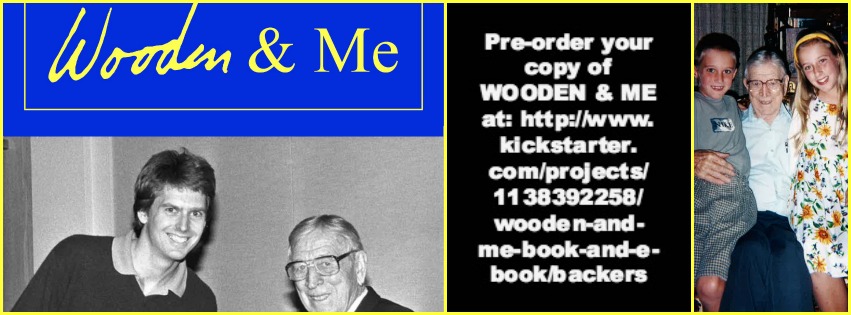
945567_10101564929565435_1193568778_n

WOODEN & ME: Life Lessons from 
My Two-Decade Friendship with 
Humanitarian and Coach John Wooden to Help 
"Make Each Day Your Masterpiece"

Hi, friends! I have a special post today with some terrific news to share: my amazing dad, who also happens to be an amazing writer, has written a book about his relationship with the legendary coach and humanitarian John Wooden. The book is now available for pre-order on Kickstarter, and he needs your help to make this book's publication a reality! Do you ever feel adrift? Are you looking for more purpose, love and strength in your life? Maybe you're feeling overwhelmed by your goals or disappointed by setbacks that inevitably spring up. Or perhaps you are looking for a wise, heart-warming book to read this summer.

If you loved books like Tuesdays With Morrie, The Happiness Project, or Kitchen Table Wisdom, I know you will love WOODEN & ME! This book would also make a terrific Father's Day or graduation gift. Do you love basketball or have a basketball lover in your life? This is the book for you!

Here's how you can help:

1) Pre-order your copy at the Kickstarter campaign at: http://www.kickstarter.com/projects/1138392258/wooden-and-me-book-and-e-book

 2) Share the link with your friends and family -- and ask them to do the same. Pledged supporters will receive a signed copy of WOODEN & ME this summer upon publication.

 3) Join the Facebook event and spread the word! https://www.facebook.com/events/630992526929012/633205676707697/?notif_t=plan_mall_activity 

970833_191704637653112_1862690072_n


Now I'll leave you with some words from my dad about the genesis of this project and what your support means to him:


As a longtime newspaper sports columnist in Southern California I am often asked to speak to civic groups – and the person audiences invariably want to hear more about during the Q&A afterward is Coach John Wooden. Listeners at these talks, as well as readers of my columns, over the years have encouraged me to write a book about my experiences with Coach.

Now I have, with the memoir WOODEN & MELife Lessons from My Two-Decade Friendship with the Legendary Coach and Humanitarian to Help “Make Each Day Your Masterpiece.” It was in 1987 as a young sports writer and near-newlywed that I met Coach, who soon became a friend and mentor through the births of my two children and their growth into young adulthood; the death of my mother; career decisions; and more.

As I note in my completed manuscript: “One did not have to play for Coach Wooden in order to be one of his students, and of this I am a privileged example. I was not one of his basketball players – except for one glorious week at his youth camp in 1975 – but make no mistake, I was his pupil. No coach or teacher or professor has taught me more, or taught me more important things.”

Just as Coach Wooden was beloved and revered by people of all ages and all backgrounds, readers from teens to parents to grandparents, basketball fans and non-fans alike, will find WOODEN & ME enlightening and inspiring.

 * * *

WOODEN & ME is an inspiring combination of Tuesdays With Morrie and Chicken Soup for the Soul -- author Randy Robertson

Order your copy today! http://www.kickstarter.com/projects/1138392258/wooden-and-me-book-and-e-book

Monday, May 27, 2013

Interview with author & playwright Mark Rigney


Mark Rigney is the author of numerous plays, including Ten Red Kings and Acts of God (both available from Playscripts, Inc.), as well as Bears, winner of the 2012 Panowski Playwriting Competition; during its March, 2013, off-Broadway run, Theatre Mania called Bears “the best play of the year.” His short fiction appears in Witness, Black Gate, The Best of the Bellevue Literary Review, The Long Story, Lady Churchill’s Rosebud Wristlet and Black Static, among many others. “The Skates,” a comic (and ghostly) novella, will be released shortly from Samhain Publishing; in non-fiction, Deaf Side Story: Deaf Sharks, Hearing Jets and a Classic American Musical (Gallaudet University Press) remains happily in print one decade on. Two collections of his stories are available through Amazon: Flights of Fantasy and Reality Checks. His website is www.markrigney.net. 

Tell us about your play "End of the Rainy Season," which recently won The Seven playwriting competition. What was your inspiration/motivation behind this piece?


My cousin Madeleine F. is finishing up her doctorate, studying land use and corporate land ownership in third world countries. I loved her stories of traveling through Mozambique, and somehow extrapolated that to the opening scenario of "End of the Rainy Season," where a very bedraggled western woman, traveling alone, begs for a room at a hovel of a hotel. I re-set the piece in Togo, largely because of my father-in-law, who worked in Togo with the Peace Corps in the early sixties. Thanks to him, I have a lovely hardback Ewe phrasebook, so I felt comfortable plucking at least hints of the local language. Of course, with the internet, I could have dealt with Mozambique almost as easily, but I do prefer the feel (and scent) of a scruffy old hardback when it comes to research. Why the piece went where it went after that launch point is anyone’s guess. Frankly, I had no faith in this play at all, and sent it to The Seven contest only as a lark. It now stands as further proof (as if I needed any) that I have no ability whatsoever to judge my own work.

I really admire how you write in all different genres, from playwriting to fiction to nonfiction. How do these different types of writing complement each other? 

Tackling different forms of writing allows my moods, on any given day, the full run of any given blank page. To wit, if I’m working on an idea that feels most like a prose piece but the prose, for whatever reason, isn’t flowing, I can do a u-turn and leap into a play. If the two-act family drama isn’t chugging along, I can tackle something short, "End of the Rainy Season," perhaps. (It probably needs re-writing. Plays always need re-writing.) If I’ve got an opinion that nobody wants to hear, that’s a signal it’s time for some non-fiction. And so on. Different written forms are the key to forever disarming the demon of writer’s block. For what it’s worth, I offend everyone, from my agent to my readers, by constantly crossing (or tangling) the line between commercial and literary fiction. The sword-and-sorcery stories I’ve published with Black Gate are light years from the experimental tropes of my Birkensnake offering, or the highbrow work now available (online and in print) at Witness. Artificial barriers, generally imposed by well-meaning critics, simply cry out to be breached. I do my best to oblige. All of which is to say that really, I’m a creature of caprice. Like Toucan Sam: follow your nose! Who knows (pun) what will turn up?

How did you get started writing?


I wrote an age-appropriate and completely juvenile play with several friends in second grade. The structure was good, I think: two rival street gangs taunt each other into entering the local haunted house. In they go, one by one, and get eaten by the resident monster, until the last kid barges in (said kid was played by Robert Gaucho, who was enormous), and then the monster gets pounded to mincemeat. One line survives in memory from the now-missing script: “Look at those turkeys, those eels!” I know, I know––but please don’t judge too harshly. This was the seventies, y’know? We were trying to be cool. Groovy, even. Anyway, I didn’t write anything else play-wise until seventh grade, at least, and not again until senior year of college. But one thing I learned along the educational way, and that was that I could generate material (essays and book reports and so on) faster than anyone else I knew. That doesn’t mean it was necessarily good, and my grasp of grammar was generally lousy, and I had no ability to spot a tpyo, but: at least I was a quick draw. Since math and science continually frustrated me (although I love involving both in my writing), it made sense, of a sort, to pursue writing full-time. It didn’t make financial sense, as I know now, but I suppose one cannot have everything.

What is your writing process like? Do you write on a computer? In a spiral notebook? Do you write at the same time every day? 

I’ve been known to write on napkins, coupons, and on my palms. No kidding: when an idea hits, I may only need a keyword or two to hold it for future use, but ideas often arrive at awkward or otherwise inopportune moments, so I get those words written on whatever’s handy. Most of the time, however, I type on a wireless keyboard rigged up to a mid-level Mac. Can’t afford the top-of-the-line stuff, you know. Not until I sell a screenplay to Dreamworks. I don’t use spiral notebooks except when attending play readings or rehearsals. Then I take oodles of scrawled notes, and transcribe what changes I need from these to the computer later on, as time and geography permit. As for writing at the same time every day, that’s a trap. Write when you can, or when you must, or both. My workday is typically the six-hour span during which my children are in school. The rest of the time, I’m Susie Homemaker. You want to talk laundry, or how to bake the perfect lasagna? In the words of the mighty Leonard Cohen, I’m your man.

How do you get ideas for what you write?


People frequently ask this, and it’s the only question I’d love to dodge, because I’m not entirely clear about this. I don’t want to fall back on, “It’s magic,” or, “The universe enters my mind and I become one with the cosmos, an astral being; I come back to my body blessed with a workable idea.” I don’t want to fall back on any of that because…well, because it’s not true. The problem is, it’s not untrue, either. What I can say with some surety is I write to entertain myself (Benjamin Disraeli: “When I want to read a book, I write one”), and the longer the piece, the more likely it is to be founded on some subject that bothers me, a problem to which I have no answer. I’m sure I’m not the only writer who needs spurs kicking my flanks in order to get from “Once upon a time” to “The End,” and the best way I know of completing a project (besides trusting myself) is to have, as my subject, a Gordian knot.

What is your biggest advice for other writers, particularly young writers or playwrights just starting out? 

Begin in the right place. It can be helpful to rely on “the Passover Question,” that being, “Why is today different from all other days?” If you can answer that, the second stumper worth considering is how late in any give scene or event can you begin. Of course, some stories do begin with description, and deservedly so, but the shorter the work, the more likely it is you need to open with action. Do so with alacrity. Don’t bother with “setting the scene” so much as entering the scene. Jump in at a moment where the stakes are already high, and your characters in flux. That way, the rest of the writing is a sort of downhill race; an avalanche, built-in, nips at your heroes’ heels. Most beginning writers try to do everything all at once: describe each person, provide an annotated list of their clothes and what’s in the room and who knew Aunt Dottie back in 1968. You can’t do it all at once. Provide what will hook a reader, and then “backfill” as you go, penciling in whatever else is needed.

What are some of your favorite books and/or plays? 

Among the best contemporary plays are Itamar Moses’s Bach at Leipzig, Sara Ruhl’s Eurydice, August Wilson’s Joe Turner’s Come and Gone, and Gina Gionfriddo’s Becky Shaw. Read those four and you’ll have a pretty fair idea of what the stage can offer. Then read Tom Stoppard’s Arcadia.

For short stories, I come back again and again to Shirley Jackon’s “The Lottery,” and Alice Sheldon’s “The Screwfly Solution,” also Z.Z. Packer’s “Brownies.” But of course there are literally millions of short stories to wade through, and once in a while, you turn up a gem no one’s ever heard of, one you more or less by default get to keep for yourself.

My favorite novel bar none is T.H. White’s The Once and Future King, which, in its proper form, would also contain its addendum, The Book of Merlyn. Recent favorites include John Crowley’s hugely emotional magnum opus Little, Big, and I am about to start Edith Wharton’s Custom of the Country. I find it helpful to alternate contemporary work with the classics––or possibly this is simply my own alarming sense of elitism making unhappy demands on my time.

What links can readers visit to learn more about you and your work?

Please come visit my website, which contains links to many of my stories and plays. That way you can judge for yourself if I’m a total fraud. (A fear or fraudulence is, by the by, very healthy; it keeps you sharp. As Neil Young put it, “You’re only as good as your last note.”) http://www.markrigney.net/Rigney/Home.html 

Also, I collect very old beer cans––got any? In fact, pretty much any beer-related item made before about 1970 is of interest to me. Check out my “Cans” page: http://www.markrigney.net/Rigney/Cans.html

And if you’d like to delve farther (also further) into the literary vs. genre fiction debate, may I suggest beginning here:
http://www.blackgate.com/2012/09/17/genre-2012-the-ghetto-remains-the-same/